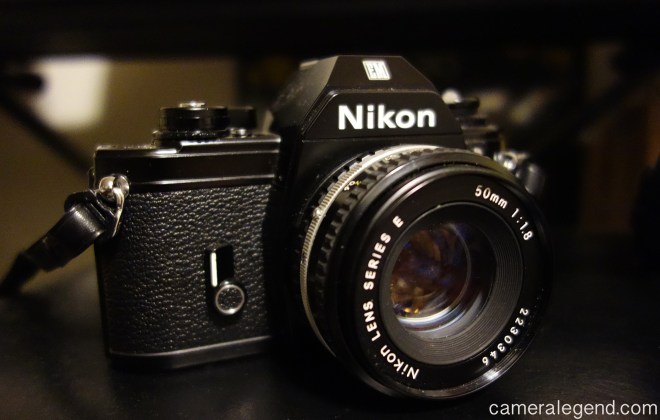
“The Nikon EM” 2015. Nikon’s smallest, lightest, and cheapest 35mm SLR from 1979 seen here with the 50mm f/1.8 Series E lens, which is a great match for the camera.
The Nikon EM is a 35mm SLR introduced by Nikon Corporation in 1979. It was at the time, considered the smallest SLR Nikon had ever produced, and also the cheapest.
The camera was supposedly meant to be marketed to beginners and women in particular, but it wasn’t a hit for either targets. Apparently, many women avoided it with the belief that Nikon’s position of selling them an “easy to use” camera was sexist and insulted their intelligence. You got to remember, this was the late 70’s early 80’s! 🙂
In addition, it alienated some hard core Nikon users who felt the lower quality build of the EM was a sign of bad things to come, especially for a company known for their tough and heavy duty professional cameras.
The Nikon EM is basically an entry-level camera. It relies on two S76/A76 or one 1/3N battery. The camera features aperture priority only camera with no full manual mode. However, it does have something lacking on many Pro cameras and that is an emergency 1/90 mechanical shutter which can be called upon in case of battery failure.
With the EM, Nikon also introduced a set of lenses that matches the EM’s position for price and lowered quality. These lenses were called the “E Series” lenses. While lower priced than Nikon’s AI or AIS equivalent lenses, these E series lenses have developed cult following for their price to performance ratio.
I have used the Series E 50mm f/1.8 and the 75-150mm f/3.5 zoom and they are both excellent lenses, optically anyway.
While there is nothing particularly special about the EM, I believe that time has helped the EM to achieve a “cute” status when people think of it. I mean, even for me, when I thought of what to profile tonight, the Nikon EM came to mind and I said…oh yeah, that cute little Nikon from the 80s 🙂
IN THE HAND
Despite the negatives, when you actually use the EM, it feels nice in the hand. Small, light yet adequately solid. This is a Nikon that you wouldn’t mind carrying around all day.
And while Aperture Priority may seem limiting, it is in fact the mode that seems to be preferred by most photographers. The fact that it has no manual override, well that I don’t like.
If the camera is too small for you, you can “bulk it up” by using the MD-14 motor drive which not only makes the camera grippier, but also has the added benefit of being about to do about 3.2 frames per second.
MY CONNECTION WITH THE EM
Cameras, like music, are objects that have the very good ability to bring you back to another time in your life.
I remember in 1981, as a kid, my Mom’s brother came from overseas with a couple of friends. They went downtown and came back with a camera, the Nikon EM. I believe it was one of my first encounters with a Nikon camera. My very first Nikon experience actually was being in Rockefeller Center in NYC and seeing this huge Nikon telephoto/telescope which was a 2000mm f/11 Cassegrain telescope. Same as the one being sold in this eBay auction.
http://www.ebay.com/itm/251761280659?_trksid=p2060353.m1438.l2648&ssPageName=STRK%3AMEBIDX%3AIT
BOTTOM LINE
The Nikon name evokes powerfully passionate emotions from photographers and even those who don’t know cameras, they know the Nikon name. It was, is, and probably will always be one of the greatest names in photography.
And while the Nikon EM is not the best representative of a classic manual Nikon SLR, it is a Nikon nonetheless, an interesting one, and perfectly usable in capable hands.

“David & Goliath” 2015. The Nikon EM on the left shown for size with brute of the Nikon family, the F4s. Sorry for the poor quality photo. I didn’t feel like dragging out the studio lights tonight 🙂
Prices on the EM go anywhere from $10-40 and don’t pay any more than that.
The Nikon EM itself may never be a Camera Legend, but it is an interesting tidbit, and time capsule into Nikon’s direction going into the 1980’s.


 Camera Legend