
“The Tank” 2013. My war-torn Canon T90 and 55mm f/1.2 Aspherical. They may be in “ugly” condition, but damn I love this combo!
The Canon T90 is a 35mm SLR introduced by Canon in 1986. It was their most advanced model in the classic Canon FD mount.
One look at the T90 and you can see that it was THE bridge camera to the Canon EOS line of cameras, which was introduced only a year later in 1987 with the Canon 650.

“All In The Family.” The Canon T90 from 1986, side by side with the EOS-1D Mark II digital from 2004. Note the family resemblances, despite the incompatible lens mounts.
THE FD MOUNT OUTRAGE
Although Canon introduced a Cosina made T60 model in 1990, the FD line was effectively over with the introduction of the EOS mount in 1987.
At the time, there was a bit of outrage from loyal Canon FD owners who now had their lenses rendered useless on the new incompatible EOS mount. They felt betrayed, and many even switched to “the enemy” Nikon, pledging they’d never use Canon gear again. Even today, I still hear of people who never forgave Canon for abandoning the FD line. Talk about crazy passionate! 🙂
Anyway, as great as the FD mount was, I believe that time has proven Canon right in their decision to change to the all electric EOS mount. With this mount came super-fast and near silent “Ultrasonic” motor autofocus lenses, super telephoto lenses, and some very unique “L” lenses such as the 85mm f/1.2L, the 135mm f/2L, and the 200mm f/1.8L, which are among some of the finest lenses ever made by anyone.
The larger EOS lens mount also made it possible to mount “alternative” lenses such as Olympus OM, Nikkors, Leica R, and Contax/Yashica mount lenses to name a few, which was not possible with the FD mount.
BUILD AND HANDLING
If you ever used an EOS camera, and most of you probably have, then you’d be pleasantly surprised to see and feel how much the T90 handles like an EOS camera with its buttons and front right hand dial.
The camera is built well, although it feels a little plasticky with its polycarbonate body. It is however solid and rather heavy, especially with the required four AA batteries and a lens attached.
The body is molded as if there was an accessory battery grip built on to the camera, so if you’re one who likes those bulky add on grips, you’ve got one built-in with the T90. It’s a beast! They didn’t call it “The Tank” for nothing 🙂
PERFORMANCE
I’ve used a couple of these cameras over the years and they have always provided near perfect exposure in aperture priority or program modes.

“Village Of Love” 2013. Canon T90, 55mm f/1.2 Aspherical on expired Kodak Ektar 100. A little bit of love going on in NYC’s Greenwich Village! This image I think has a bit of that 80s look to it. My method of creating “vintage” modern photos is to use “old” equipment vs apps or filters.
The T90 has a brilliant metering system, which included center-weighted, average, partial, and spot metering, highlighted by its famous “multi-spot” metering which will allow you to spot meter several readings in a scene and have the camera average them out for an accurate reading. You also have TTL flash with compatible Canon flashes.
There are only a handful of film cameras with multi-spot capabilities, the other two that I can think of offhand would be the Olympus OM-4/4Ti and Canon’s own EOS-3.
This is also useful if you’re one of those Ansel Adams acolytes who embrace the Zone system.
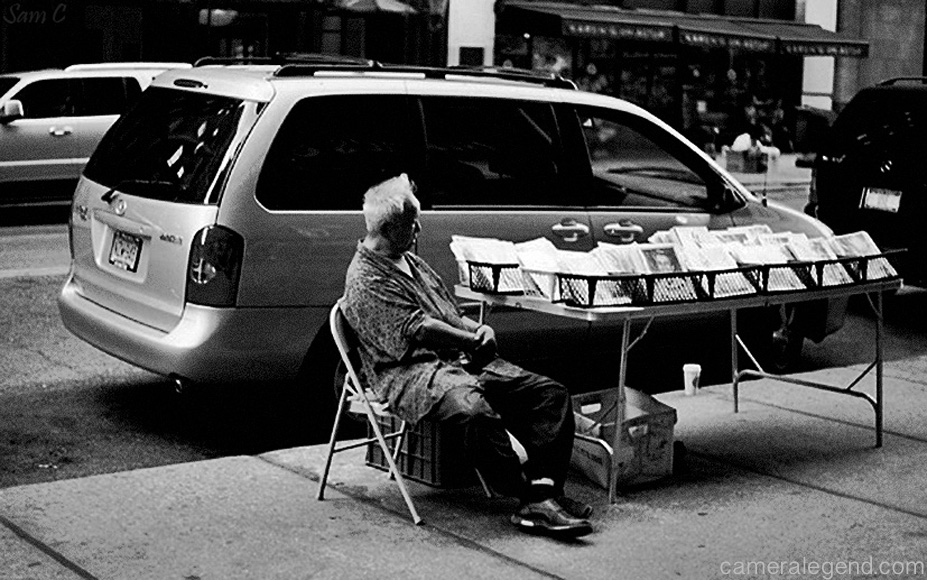
“I, Asleep” 2003. Canon T90, 50mm f/1.4 FD lens, film unrecorded. NYC is known for being a dynamic city, but with a gig this boring…hey! 🙂
I think the reason multi-spot is less of a selling feature these days is simply because with digital, you can just retake the photo if it didn’t come out the way you wanted. Progress has made life for us photo bugs easier, if not necessarily better photographers, technically anyway.

“The Mac Is Back” 2013. Canon T90, 55mm f/1.2 Aspherical on expired Kodak Ektar 100. Legendary NYC photographer Louis Mendes. Lou is a well known figure on the streets of New York. Even if you don’t know him, you probably have seen him if you walk around the streets of Manhattan enough. With his throwback “Shaft” look and his iconic Speed Graphic, Lou takes one of a kind instant portraits and has made a living and a legend out of it. When I saw Lou again about a year later, he actually remembered that I shot him with a T90. Sharp man!
BOTTOM LINE
The Canon T90 and the vast line of FD and older breech mount lenses are among the best value in film photography today.
If you’re a student, new to film, or an old pro looking to rekindle your photographic passion, and you love electronic cameras, the T90 and a couple of lenses would be a good place to start.

“That Aha Moment” 2013. Canon T90, 55mm f/1.2 Aspherical on expired Kodak Ektar 100. Colors fading and shifting…a “natural” Instagram! 🙂
If shopping for a T90, prices are dirt cheap these days and trending at $20 to $100 depending on condition. Anything more is a ripoff, unless a really good lens is included.
One problem well known with the T90 is the famous “EEE” error message which usually indicates a sticking shutter. Be forewarned that many T90’s develop this problem as they age. How do you get around this if your T90 develops this problem? Well, first I’d try putting in a fresh batch of batteries. If that does not work, the best solution is to pick up another one, preferably cheap. You’d probably pay more trying to repair it, and that is if anyone would even be able to repair the T90 these days. As I said, just pick up another one 🙂
You should also fire the shutter from time to time if the camera is not in use for long periods, as with all film cameras. This can, but is not guaranteed to help avoid the EEE error.
Despite this one potentially serious flaw, there can be no denying one thing that is true…
The Canon T90 is a Camera Legend and considered by many to be the best camera Canon ever made. At the prices they’re going for today, you could have one of the greatest, most technically advanced film cameras in your hands for the price of dinner. Not a bad deal in my book!
CANON T90
PROS: Well built and sturdy; Takes cheap and awesome FD glass; Excellent metering; Multi-spot metering capabilities; Plentiful on the used market; dirt cheap 🙂
CONS: Prone to the infamous EEE error, mostly due to a sticking shutter problem; Electronics that do not age well; A bit confusing to use without user’s manual; Bulky and heavy with lens attached and batteries installed.







 Camera Legend