The Vivitar Ultra Wide & Slim Film Camera

UWSPic

The Vivitar Ultra Wide & Slim and its virtual clone, the Superheadz Yellow Peace. Cult camera favorites of toy camera fanatics.

The Vivitar Ultra Wide & Slim is 35mm point and shoot film camera made by Sunpet Industries of China and distributed by Vivitar under their own name. The camera has an almost exact clone from Superheadz in different colors and different nicknames.

The actual year of manufacture is unknown or undocumented. At least, I cannot find it in my research. I suspect it was made in the 1990s or late 1980s.

The Ultra Wide & Slim is an all plastic camera with a plastic lens and low quality build. However, the camera has achieved cult camera popularity primarily due to its 22mm f/11 “Ultra Wide” lens which is unusual for a fixed focus point and shoot, even today.

As a camera, the Vivitar “UWS” has only one aperture, f/11 and only one shutter speed, 1/125. This makes it primarily usable as a daylight camera using higher speed film.

This was and is intended to be a cheap camera. However, the camera has become very popular with the toy camera, Holga, Lomography, etc, crowd for whom lens distortion, light leaks, and imperfect photos are much desired.

If you love cameras as much as I do, you’re bound to collect some cameras that you have yet to use. This is one (or two) of them!

Actually, I did get a roll of film through the Superheadz but when I developed the film the whole roll came out black. I’m not ashamed to admit that it was probably my mistake in development. I added too much water to Ilford ID-11 which is not a developer I use often, though some say D76 (which I have used often) is the same. However, I’m can’t be 100 percent sure if it was me or the camera so I will try again.

Any camera with a 22mm lens is bound to give you some very dynamic looking photos and I don’t mind the flaws, especially for the price. If you know what to expect, you won’t be disappointed.

If seeking one of these, prices used to be very cheap, but now is trending at $25-50 for the Vivitar in used condition, and from $24-60 for the Superheadz version, price dependent on the model and seller. For example, the black version called the “Slim Devil” runs near $40 from most sellers. You may find a good selection of the Superheadz version HERE.

I got my Vivitar on eBay for under $10 and paid $25 new for my “Yellow Peace” Superheadz clone. These cameras probably cost a few bucks to make, so even buying it for $25 is probably too much in principle. But since we don’t make these cameras (and no one else does) we have no choice 🙂

Don’t go too crazy with these cameras. As I said, they were intended to be cheap and fun cameras, but now some may argue that they are Camera Legends in the toy camera department. Take that out of your head, they ARE cheap cameras. Try to find one cheap! 🙂

***DEAL ALERT***

One great thing about Spring, other than the weather, are all the photographic deals going on. Some great deals and savings on Nikon Lenses are going on right now. If you’re going to buy, please buy through the link and help support this site. I greatly appreciate it, thanks!

Fujifilm Instax Mini Instant Film, 10 Sheets x 5 packs

Olympus has a very cool Trade Up program where you can trade in virtually any used camera and get monetary value towards the purchase of new Olympus gear including the OM-D series and the awesome new Pen cameras.
The Lowly Vivitar PS-20 Point & Shoot Camera

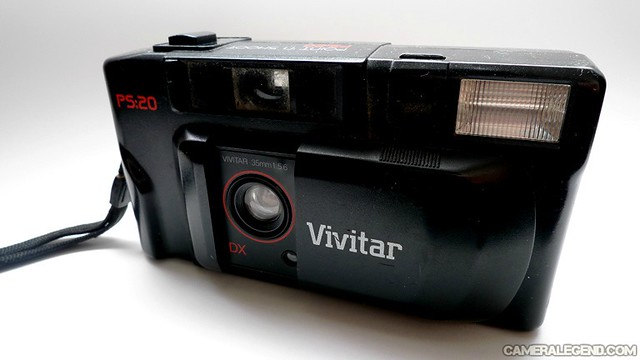
Vivitar PS-20

We live in a different age, different time. Everything is better. Cars, television sets, cameras. Heck, even the camera on your phone is likely better than many of the high end cameras you once had. Here’s a camera I wrote about in 2009:

This is my Vivitar PS-20 from 1987. Bought it for $20 bucks at a now defunct chain store called “Caldor”. This camera took me through the late 80’s and half of the 90’s, providing some of the most memorable (if techincally poor) images of my life.

It was part of my two camera kit in my simpler (and poorer) days of the 80s when I had only the Minolta X-700 and one lens, the MD 50mm f/1.7 plus this camera, the Vivitar PS-20. Somehow, I feel like I was much more focused than I am now with the countless cameras I have used. I long for those two camera days, and who knows, maybe that’s going to be a project for me…get rid of everything, use two cameras, and be a happy photographer again 🙂

Ladies and gentlemen, this camera is the quintessential point ‘n shoot. It is what I would call a “SLC” or a “Super Low Class” camera. It is the ULTIMATE “Poor Man’s Camera!” It is poor, it is cheap, it is what people used to think of when they think of a point ‘n shoot camera. In fact, it says “Point ‘N Shoot” on the top of the camera! 🙂

IT’S NOT ABOUT THE CAMERA

Today, lucky us, we have point and shoot cameras that can do so much more than this old Vivitar. Yet in some way, these new point and shoot cameras seem to have lost track of what it means to be a point and shoot!

That’s why I love this old Vivitar PS-20. It can’t do 30 megapixels. It doesn’t have a Zeiss or “GR” lens. It can’t do HDR. It can’t do HD Video. It’s not a “luxury” point and shoot. It makes no pretenses about being anything other than a point and shoot camera 🙂

140343323.fVR6yepL.DSC_1288Zoe

“Joy Of Point ‘N Shootin” 2009. Baby Z gets a kick out of Papa’s old camera 🙂

While this article is about the Vivitar PS-20, it is really not about the camera itself. It’s a tribute to the lowly point and shoot cameras of yore. To the thousands of lousy, but charming old point and shoots out there. The ones that are worth next to nothing, but have more heart and soul than a $3000 point and shoot.

The Vivitar PS-20 “Point ‘N Shoot” may never be a Camera Legend, but taken as a collective with its thousands of peers, they all could be considered Camera Legends.

SPECIAL NOTE ABOUT THIS CAMERA

This is the funniest thing, except it’s really not funny. A few years ago, some seller on Amazon apparently decided to swipe (steal) this pic from my Flickr stream and use it. You can see the Amazon ad in this link HERE.

I never made a big deal out of it because it’s not an award winning picture or anything and this camera is worth next to nothing. In fact, before I wrote about this camera back in 2009, I don’t believe there was any information on it anywhere on the web because I always do a little research before writing about anything.

As I said, I’m not mad or anything, but I do find it humorous. But if I, by some chance, had an award winning shot and someone used it without my permission, sure I would be pissed.

But this, nah, it’s something I’ve accepted as part of the deal when you post pics on the internet. When you post something to the internet, remember this is part of your “contract.” I’m sure the person who used the photo didn’t know any better.

The main thing people should remember here is, just as Napster once opened the MP3 Pandora’s box, so too do you when you post pictures to the internet.

I’ve always accepted that once you post something, it’s subject to theft or anything by anyone. So please, if you feel you have an award winning picture, DO NOT post full sized images. Put some kind of watermark or something.

If it’s just an average, everyday picture no need to do anything, no one will care. I hate watermarks or copyright logos actually. The only reason I put them here is so that people can remember the website, which is always a wise thing when you’re running a relatively new site.

More cameras to come, have a great week! 🙂


The Best Camera I Never Knew Part III: The Contax Tix APS Film Camera

DSC01104sC

The Contax TiX from 1997. Perhaps the most beautiful Contax point and shoot, but doomed by being born an APS film camera.

I have to admit I’m a big fan of Contax point and shoot film cameras from the 90s. There was just something special about the whole series.

While I stand by what I wrote in earlier articles about the fragility of Contax cameras and their brittle electronics, I loved the concept, the feel, and execution despite the feeling that I could never really rely on them completely.

THE CONTAX Tix

The Contax Tix (pronounced T…i…x as opposed to Tix, I think!) is a high quality point and shoot camera introduced by Kyocera in 1997.

The camera featured a Carl Zeiss 28mm f/2.8 Sonnar T* lens and used the infamous and now defunct APS (Advanced Photo System) film system. The camera was the smallest of the Contax film point and shoots.

The camera has autofocus, a shutter speed range of 15 seconds to 1/1000, and came with a data back for date imprint. It was powered by one 3V CR-2 battery.

WHY IT DIDN’T JIVE WITH ME?

The last two cameras I profiled (Rolleimatic and Rollei A110) didn’t jive with me because they didn’t work. That was NOT the case with the Contax Tix.

A little history…I got my first Contax point and shoot, the original Contax T, in 1997. That was a superb little manual focus rangefinder and I got some wonderful shots from that thing. Basically, after the Contax T, I was hooked on Contax for a while!

I got the Contax Tix some time in the mid 2000’s, mainly as a curiosity and to add to my collection. I did not expect to use it often because even at the time of the introduction of the APS film system in 1996, I was never really interested in that format. Even back then, I wondered why would anyone bother with this over 35mm?

The 35mm format already had its limitations vs medium and larger formats and I felt like APS was a step backwards.

The negatives were smaller and despite the stuff you were able to do with it, ie, the three image formats, 16:9, 3:2, and 3:1 aspect ratios, as well as the quasi-panoramic mode, I wasn’t into it. I just thought they were gimmicks, but even if they were useful to some, I would take the larger negative of the (already relatively small) 35mm standard over APS any day.

So back to the Contax Tix. Yes, the camera worked and worked well. I used it for two or three rolls of snapshots expecting good quality, but most of the shots from this camera looked excellent!

I’m sorry I have no pics to show you now because as mentioned in the last couple of postings, I am without my main working computer and using a 10′ Chromebook. I would still need to scan these prints.

My assessment of the 28mm f/2.8 Zeiss Sonnar on the Tix is this…The lens is excellent, as expected. It is very sharp. Not as bitingly sharp as the lens on the Contax T3, but still sharper than most point and shoots. But my favorite part is that the lens seemed to have more of a classic look, a soft/sharp kind of thing like the 38mm f/2.8 Sonnar on the original T or T2. So, in my opinion, the lens on the Tix was in between that of the T3 and T/T2. That’s almost perfection right there!

So the camera itself was never a problem. The fact that it used APS film was what didn’t jive with me and why I got rid of it.

If looking for one of these, prices have been trending steady for years at a low of $70 to around $150 with an average of around $90. The camera came in silver or black which is a bit more rare.

If I were to seek one out today, I don’t think it would take me too long to find one. And there are apparently places that will still develop APS film if you send the film out to them. But I’m already dealing with enough dead or outdated systems like Polaroids, 127mm, 110mm, etc that I wouldn’t bother with APS film right now.

BOTTOM LINE

The Contax Tix is a beautiful, jewel-like camera. I feel that this camera could’ve been THE best of all the Contax point and shoots, but unfortunately it was and will forever be hindered by the format it was born with, the APS film system, which is probably one of the biggest flops in film history.

Now before any APS film fans get mad at me, I want to say the concept, and indeed the quality of APS film was not bad. If I recall correctly, there were even some APS films that equaled or exceeded its 35mm equivalents in magazine tests.

In many ways APS was “pre-digital” film. It wasn’t designed for ultimate quality, but instead was made for easier development (with machines specifically designed to take APS film, of which one can guess the companies also hoped to make money selling) and promised smaller, lighter cameras. It foresaw almost all that we see in digital point and shoots today!

But APS wasn’t friendly for the home developer. I’m sure someone must have done it, but I haven’t met anyone who actually home developed APS film. You actually had to bring that film into the store as each film cartridge was locked and coded. The main problem for APS film was timing. It was introduced in 1996 right around the time the first wave of digital cameras were coming in.

In only a few short years it was killed by digital, but somehow managed to hang on till 2011 when Fuji and Kodak, the last two APS film manufacturers ceased production of this film forever.

Again, in many ways, APS had some key concepts that made its way into digital such as switchable aspect ratio, smaller cameras and lenses, and of course APS lives on in our memories by the APS-C sensors which is approximately the same size as APS film. This is the lasting legacy of the APS film system I guess.

The Contax Tix was one of those cameras that I loved as a camera. It had a wonderful lens and beautifully small proportions. The Tix is probably at the apex of APS point and shoot cameras. It is no doubt a camera that added to the Camera Legend of Contax/Yashica.

It is a camera which was only held back by the APS format that it was created for and a camera of which I was never able to realize its full potential. The Contax Tix is a superb camera that unfortunately became one of…the best cameras I never knew 🙂

Note: Still waiting for my Mac in repair, but the show must go on! While I have created a workflow with this Chromebook, I have noticed it is becoming painfully slow the more I use it. Thanks to all who continue to visit, I appreciate it, and I continue to write about cameras for you my friends.

The Rolleiflex Black Baby 4×4 Camera

SamRolleiFACBKPS

“Black & Quack” 2015. With the “Black Baby” Rolleiflex 🙂

The Rolleiflex “Baby” models are twin lens reflex cameras made by Rollei. This particular model is the post war “Black Baby” and was made in 1963. The Rolleiflex “Baby” lineage goes all the way back to 1931 and ended around 1968.

The camera takes 127 film or otherwise known as 4×4 (cm) which is considered an obsolete or “dead” format because 127 film is no longer made, at least not in bulk or by major manufacturers.

You can find 127 film quite easily on eBay, but most of these are outdated and overpriced, and usually sold by Eastern European sellers. However, hang around and I’ll tell you where you can buy some fresh 127 film.

I have not used this camera extensively so this is by no means an official “review.” I initially got this as a collector’s piece knowing that I would not be doing much shooting with it.

THE CAMERA

The camera as is stated is pretty much a “baby” Rolleiflex TLR. You focus through the waist level finder using the knob on the left hand side and wind the film with the right hand knob. It’s basically a miniature Rolleiflex TLR.

DSC00614RolleiPSC

“Size Matters” 2015. The Black Baby Rolleiflex on the left, and the Rolleiflex 2.8C Xenotar for size comparison.

The shooting lens is a 60mm f/3.5 Schneider Kreuznach Xenar which is basically a Tessar type lens that should be quite sharp and contrasty.

In my experience, you can’t go wrong with either Zeiss or Schneider lenses and on these Rollei cameras, they are top notch.

The camera feels well built, but may be a little awkward to hold and use especially if you are used to “normal” sized TLR’s.

BOTTOM LINE

The Rollei “Baby” models are quite popular with collectors, with the “Baby Grey” being the most popular and abundant. These can go anywhere from $50 to $250 if priced fairly.

The Black Baby goes for a bit more. I personally find this one to be the most desirable model because it is the one that looks closest to a modern Rollei TLR.

I got mine for a little over $300, but I’ve seen sellers asking over $1000 for them. However, those over $1000 usually do not sell. Why? Because people aren’t stupid! They know that 127 film is virtually gone and you can get a 6×6 Rollei for that price. A fair price I would say would be from $300-450 for this particular model.

Even though 127 film is basically obsolete, you can now get 127 film, fresh, from…B&H! Yes, that’s right, good old B&H. The film is only available in ISO 100 speed and is called “Rerapan 100” and it is a little pricey at $11.99 for each roll. If you go in there, tell ’em Sam sent you 🙂

Although I would greatly prefer the added versatility of ISO 400 film and a lower price, I’m happy to have at least one source of fresh 127 film.

Some folks have taken the widely available 120 medium format film, cut it down and re-spooled it into 127 film. I have not had the time, the skills, nor the inclination to do that however, not that it seems that hard.

Needless to say, at $11.99 a roll, this camera will not be a daily shooter for me. As I said in the beginning, I basically bought it for my collection, and to be able to actually shoot it is an added pleasure.

I still have my first roll of 127 film in this camera. When I get the results, and if they’re good enough, I will update you on another posting.

While most of these “Baby” Rollei cameras are sought for collections, they are also great shooters, and they are an interesting part of the Camera Legend that is Rollei.

The Best Camera I Never Knew Part I: The Rollei Rolleimatic

SamRolleiFACBK

We can’t always have winners…

In the first post of this series, I take a look at cameras that I have come across, which may or may not be Camera Legends, but somehow they didn’t work out for me.

I’m sure there are cameras that many of you have used, that you heard a lot (or a little) about, you wanted them, and eventually got them, but for some reason or another they didn’t live up to your expectations.

First up is…

THE ROLLEI ROLLEIMATIC

The Rolleimatic is a uniquely designed camera introduced by Rollei around 1980, I believe. It was designed by the famous camera designer Heinz Waaske.

The camera features a 38mm f/2.8 Tessar type lens lens and relies on scale focusing.

The camera’s claim to fame is a rather odd design where the “flap” that covers the lens also doubles as a film advance mechanism.

The camera looked very cool to me, certainly stands out among point and shoot cameras of its era. I love anything retro, so at under a hundred bucks, I had to give it a try. With the legendary Rollei name, you would think this would be an instant winner. However, for me, it wasn’t.

WHY IT DIDN’T JIVE WITH ME

Information on the Rolleimatic is scarce on the web. One great review I read was from a cool guy named Mike Elek, also a classic camera aficionado, and he stated that the camera is a little fidgety to load film.

Well, he was right and then some! I couldn’t get one roll of film to load in this camera! 🙂

Ok, so I thought…maybe there’s something I’m doing wrong. So I found the online manual, I tried and retried, and retried…couldn’t get a damn roll to stick in this camera.

Sometimes, I would get close and it would latch on for like two winds, then the film came loose and I’d have to start over again.

The problem is there is no “slit” in the film take-up like other cameras. Instead there is a “film like thingy” in there that you’re supposed to hook the film up to. I should’ve taken a picture of it, but the best way I could describe it is that the part looks like a piece of 35mm film, but stronger, and is removable. It has “teeth” that is wrapped around the film advance roller and you’re supposed to get your film under the “teeth.” Well, that I did, but it still didn’t work!

Being that he was the only person who seemed to know anything about this camera, I emailed Mike and he was kind enough to write me back. He even made a YouTube video to show how to load the film, what a good guy!

Anyway, despite all his help, I couldn’t do it. Maybe something was wrong with my particular camera.

The camera looked awesome cool, but all it gave me was a headache 🙂

BOTTOM LINE

The camera was sent back for a refund. I’ve been using film for more than thirty years, this was the first camera that I couldn’t load. I’m convinced that it was the ‘funkiness’ of the design 🙂

Mr. Waaske, God Rest His Soul, was a brilliant and creative camera designer. A Legend. I have nothing, but respect for his creations. However, sometimes being too creative might not be such a good thing.

If hunting for one of these, and I’m not sure that’s a good idea, prices are trending at $50-160. So they are not expensive, but they do seem scarce.

The Rolleimatic is one of the Best Cameras I Never Knew. But it is not alone. There will be more to come 🙂

Classic Cameras: The Nikon SP

The Nikon SP is a fantastic shooter and a Camera Legend.


The Nikon SP is a classic rangefinder camera, introduced in 1957. It is the apex of all Nikon rangefinders. Actually, the black Nikon SP 2005, a reissued limited edition of the SP would probably be considered the Holy Holy Grail! I recently saw the SP 2005 camera and 35mm f/1.8 kit come up for sale at KEH for $3799. Unfortunately, I don’t have that kind of cash. Needless to say, it sold quickly.

imgNikonSPMomZoe015PS

“Dreamtime” 2014. Nikon SP, 35mm f/1.8 W-Nikkor, Holga 400 film. It’s New Year’s Eve 2014, and ho! Looks like Grandma the babysitter is falling asleep 🙂

I used a Nikon S2 rangefinder with the 50mm f/1.4 Nikkor S mount lens a few years back and loved it, which led me on a chase for the SP. And the lens I wanted was the 3.5cm (35mm) f/1.8 W-Nikkor, which is probably the one most Nikon S users want. It took me a couple of years, but I was able to get the camera and lens separately for under a $1000. You gotta have patience! 🙂

NikonSPAmericanaFA

“Slices Of America” 2015. Nikon SP, 35mm f/1.8 W-Nikkor, Holga 400 film.

The SP is Nikon’s first professional grade camera. That alone gives it a lot of historical significance. It is the camera that precedes the pro Nikon F single lens reflex. In fact, if you look at the top plate, the SP is basically a Nikon F in rangefinder form. Shutter speeds are up to 1/1000 plus B and T. The Nikon S mount lenses and the Nikon F lenses are NOT compatible.

The SP as compared to a Leica M is a little more fidgety in use. The lenses and lens mount need to be aligned a certain way for the lenses to be attached. The focus wheel is cool, but is much slower in actual use. Fortunately, you can focus lenses the old fashioned way by using your hands on the lens.

The shutter is smooth and the build is solid, as you’d expect from a Nikon and I have been able to get sharp shots with speeds as low as 1/30th in low light on ISO 400 film.

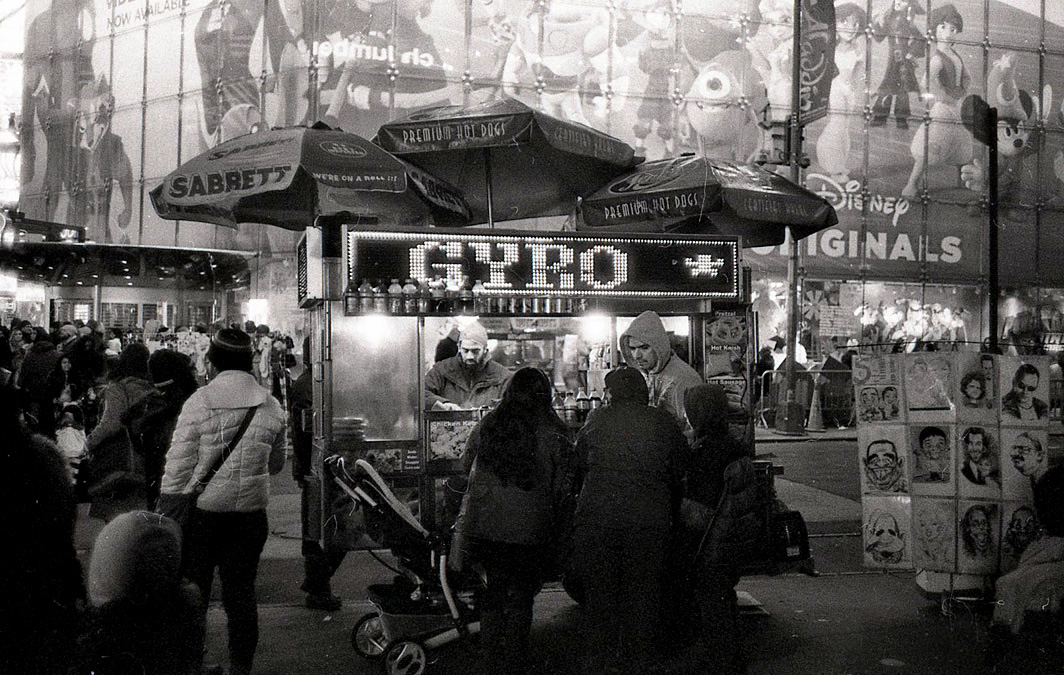
NikonSPGyroPSI

“Gyro” 2015. Nikon SP, 35mm f/1.8 Nikkor, Holga 400 film.

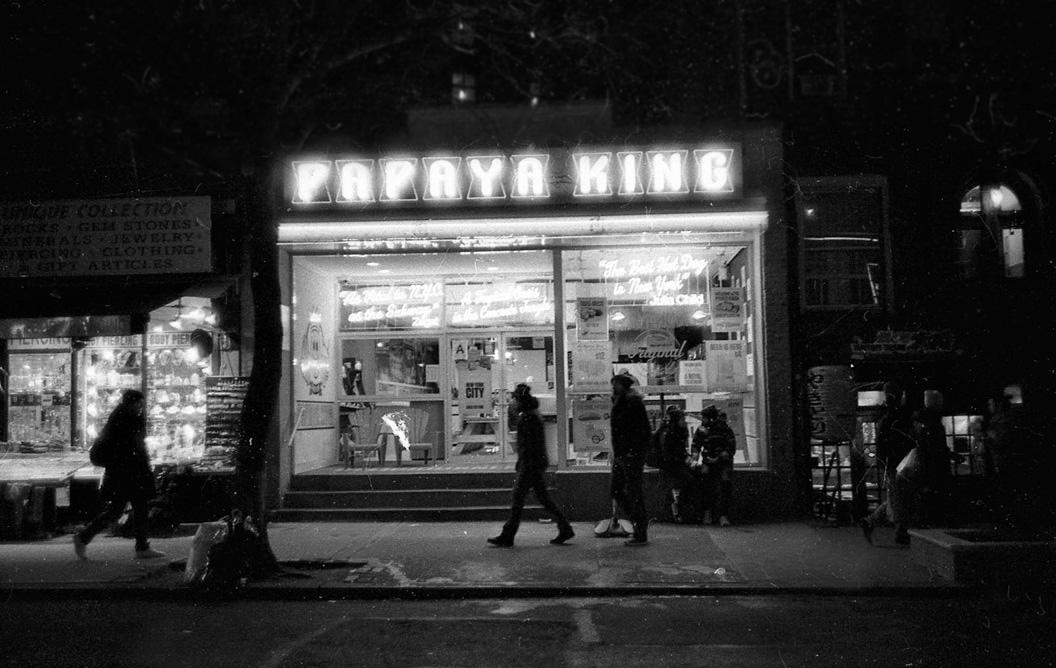
NikonSPJan19Papaya

“Papaya King” 2015. Nikon SP, 35mm f/1.8 W-Nikkor, Holga 400 film.

If looking for an SP, prices are trending from $600 (plain jane chrome body only) to almost $4000 for rare editions such as the SP 2005 with the 35mm f/1.8 Nikkor.

Despite its quirks, especially when compared to the smoothness of a Leica M, the Nikon SP is one of my favorite rangefinders to use. When paired with the awesome 35mm f/1.8 W-Nikkor lens, it is a street shooters dream for film.

NikonSPCPS

“New Years Lady” 2015. Nikon SP, 35mm f/1.8 W-Nikkor, Holga 400 film.

The Nikon SP is a Camera Legend and definitely worth your time to seek one out. I haven’t shot much film in the last few months, but I noticed the last three rolls of film I shot were all on the Nikon SP. For me, that says it all.

NikonSPSam026FA

“The Crazy Duck” 2015. Nikon SP, 35mm f/1.8 W-Nikkor, Holga 400 film.

Note: The Holga 400 film was not my first choice for this camera. I had shot the first couple of rolls on Ilford XP2 (chromogenic), but just as I was done, my local C41 developer stopped developing color film! I had a roll of Holga 400 black and white film and decided to try it out. I think it’s a good film, but developed in D76, it was a bit too grainy for me. Don’t get me wrong, I love “grainy” but with the SP and 35mm f/1.8 I wanted a film that would get more out of the combo. I think the Holga film would be perfect where it belongs…in a Holga camera 🙂

The Olympus Pen F/FT Series

The Olympus Pen FT with the 35mm f/2.8 Zuiko pancake lens.

Classic half-frame camera from the brilliant mind of legendary Olympus camera designer Yoshihisa Maitani.

The camera takes two frames on one 35mm frame. That’s why it’s called a “half-frame” camera. So on a 24 exposure roll, you get 48 shots.

You might be inclined to think that this would lead to inferior quality photos as compared to a full sized 35mm shot.

However, in my experience, the quality of the Zuiko lenses for the Pen F film system were so good that you really can’t tell the difference.

Mr. Maitaini was such a brilliant, brilliant camera designer and his Pen F/FT creation lives on in the Olympus Digital Pen series of cameras.

Note: Sorry this was meant to be a short post. I will be updating this with images from the Pen film cameras in the near future. Thanks for stopping by!