Breaking News: The Pentax K-1 Full-Frame Digital

K-1_004_2470_hood-3a-wm_WM

The K-1 full frame digital camera, the new “King Of Pentax.” Pictured with the HD Pentax-D 24-70mm f/2.8 SDM WR lens. Pure Pentax heaven! Picture courtesy of Ricoh/Pentax Corporation.

Ho! I thought I was on a week long sabbatical but this one is a must! Ricoh/Pentax has finally introduced their full-frame digital called, appropriately the K-1.

Just from looking at the specs, key features: 36.4mp CMOS sensor, no AA filter (better sharpness), built in 5-axis stabilization, ISO 204,800, 1080p 24/30fps HD video, rugged build and tilting screen. Of course, there’s a lot more to it.

All the cameras we have today are like super computers in many ways. They have like gazillion features and you know I’m not the kind of guy who wants to repeat all the technical specs. If you’re interest in the technicalities you can read them HERE.

I’m sure there will be a lot of Pentax fanatics who will be picking this thing up. In fact, I KNOW some fanatics who will be looking hard at this one 🙂

THOUGHTS ON THE PENTAX K-1

Everything seems right with this camera. Specs are great, however things seem familiar. 36.4 megapixels? Hmm, probably that Sony sensor we saw in the Nikon D800/D800E and Sony A7R. No AA filter? Cool, seems like everyone is doing away with that “wicked” AA filter that used to be so important for the first fifteen years of digital. ISO 204,800? Cool, but I never go anywhere near that ISO so I wouldn’t know.

I guess what I’m saying is…the specs are great, awesome even, but many of these things we have seen since 2012 so it’s not mind-blowing anymore (to me anyway). Nothing against Pentax, as I’ve said a few times before, it’s really hard for me to get excited about the latest and greatest these days. But I love the build and handling of the top Pentax cameras and this one looks to be the best of the best.

PentaxK01C

“Pentax Camera Art.” Before the K-1, we had a funky little thang called the K-01! Wow, what a close call with the names 🙂

Despite what I said about the specs, the main thing that we should remember is that while the rest of the world have seen these high specs before elsewhere, Pentax users have not had these specs till now so this is enough reason for Pentaxians to rejoice.

And heck, based the fact that all your Pentax lenses in the 35mm format can now be used as they were intended and even based on the specs as they are, this could probably be the only Pentax digital anyone could ever want or need! Here’s a cool and interesting video on the new K-1:

As I said in an article not too long ago, many have waited for this day since we heard about the Pentax MZ-D in 2000. The first full-frame Pentax digital that never was. Today, nearly sixteen years later they have officially announced the K-1. Whether it succeeds or fails this camera is bound to be a Camera Legend. All I can say is…Pentax, thank you.

Note: The Pentax K-1 was introduced with three new lenses. You can check out all the specs to the K-1 and see the new lenses HERE.

WHOA, WAIT A MINUTE, THERE’S ALSO THE CANON EOS 80D 

I didn’t put this in the headlines because I didn’t want to take anything away from the Pentax K-1, which many have waited so long for and is in a different league of cameras, but I’m sure many Canon fans will be happy to hear that there’s a new “enthusiast-class” body out, the EOS 80D.

Just quickly off the specs: new 24mp sensor, 45 point AF, updated dual-pixel AF, mirror vibration control.

I don’t really want to get too much into it, but I’m sure it’s going to be a killer little camera.

You can check out the specs HERE.

Celebrating Ten Years Of JuJu

DSC_9567JJ

JuJu @ Six Months. 2006. Nikon D1X. Cannot remember the lens, it just shows as 300mm on the exif viewer. A straight jpeg from the D1X, no treatment done. Although it was only 5mps, I really loved the D1X!

No “Tuesday Titans” today. Instead, we are celebrating a “titan” of our personal world. He is the first kid of the new generation of our family. Today, we celebrate my nephew JuJu who just turned ten recently. He was, in a way, my first beta tester for so many of the cameras that came into my possession in the years following his birth. Thanks for joining me in the celebration and for my fellow gear heads, take comfort in the captions which will reveal some the cool cameras used during this ten year period. Happy Birthday JuJu!! 🙂

80313978.Y6P5wTjM.JoeJU1CPba

“Boy From NYC” 2006. Bessa R3a, CV 40mm f/1.4 Nokton Classic, Kodak BW400CN. I had just fixed the rangefinder on this camera, it was the first rangefinder adjustment I’d ever done. Shortly thereafter, I sold this camera, but now looking at the results from this combo, I kinda regret it!

124288972.KEsjHcuK.PenZoeJuJu1_SerenityCalamity

“Order & Chaos” 2009. Olympus Pen FT, Zuiko 35mm f/2.8 Pancake lens, Kodak Tri-X 400 developed in T-Max developer. Two frames from the half frame Pen FT camera showing how order can turn into chaos in a minute 🙂

1614239_10202970154807201_8424783835683906259_o

“My Brother’s Keepers” 2014. Nikon D1X, 35mm f/2.4 MIR Russian lens.

10917057_10205025856438457_737518350959434799_o

“Rockabilly Ju” 2013. Fuji X-Pro 1, Canon FD 55mm f/1.2 Aspherical lens. JuJu rocks around the clock! 🙂

10295047_10202961627314019_3801333893296660026_o

“Happy” 2014. Panasonic DMC-GF1, Lumix 20mm f/1.7 ASPH lens. Go ahead people, clap along if you feel like a room without a roof! 🙂


Tuesday Titans: The Mighty Minolta XK Motor

DSC00181XKMotorCCC

The Legendary Minolta XK Motor of 1976. Sorry for this funky Instagram pic, I’ll probably replace it 🙂

Hi everybody. Let’s start 2016 off with a bang with this ultra-rare Camera Legend, where info is scarce even on the best Minolta/Rokkor sites…

Somewhere in the deep, dark corridors of my camera memory lurks a giant. A giant that frightened and fascinated me at the same time. That giant is the Minolta XK Motor.

The XK Motor is a 35mm SLR introduced by Minolta in 1976. It was marketed as a professional camera and was Minolta’s answer to the Canon F-1 and Nikon F/F2.

The XK Motor is ultra-rare and hard to find in today’s market.

MY MEMORIES AND DREAMS OF THE MINOLTA XK MOTOR

As a kid, I still remember seeing this gigantic brute of a camera in magazine articles and ads. It was a camera that seemed frighteningly large, muscular, and complicated to a young boy. Yet at the same time, for a skinny young kid, this camera’s muscular build signaled “power” in my mind.

I wanted it bad, but I knew I’d never get one. Or so I thought…


HOW I CAME ACROSS THE MINOLTA XK MOTOR CAMERA

Fast forward some thirty plus years. About four years ago in 2012, I saw two XK Motors listed on KEH Camera in BGN (bargain) condition, priced at about $500 each. Right away, knowing the rarity of these cameras, I had to get one!

Fortunately, it was one of those rare times when I actually had enough in the bank. Sure it still hurt to part with $500, but hey man, this was the Minolta XK Motor! Gotta have it! 🙂

So I got one, and if I had the funds, I’d probably have gotten the other too, but I didn’t have any funds left and it quickly went to someone else.

Though I can’t check 24/7, I do check KEH’s site fairly often. I’ve never seen the XK Motor before or since on KEH’s site. My theory is someone sold these two from their collection to KEH and it quickly went up for sale.

THE XK MOTOR BODY

When I first got the camera, I was in awe. This thing was solid, heavy, and just as in my dreams, seemingly powerful.

The body feels blocky, much like other cameras of its time such as its slated competitors, the Nikon F/F2 and the Canon F-1.

Unlike those two cameras, the motor drive is permanently attached on the XK Motor. The motor drive was capable of a (then) “high” of 3.5 frames per second at its top speed.

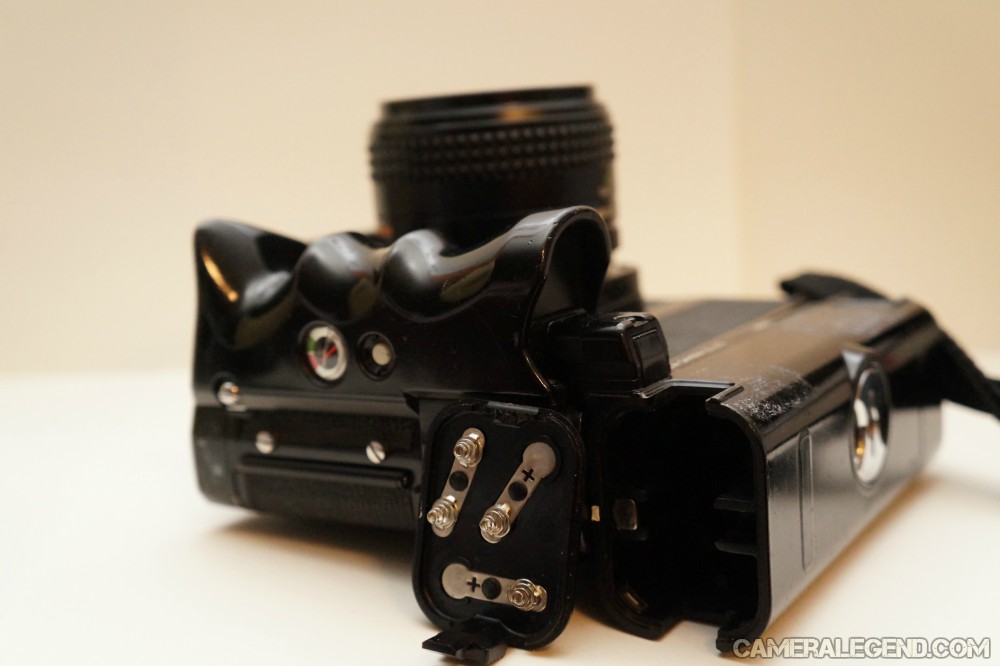
The camera required two EPX-76 or S-76 alkaline or silver batteries for the body and ten, count ’em, TEN AA batteries for that motor drive. With batteries installed, this camera got heavy fast!

The camera had electronic shutter speeds of 16 seconds to 1/2000th of a second and mechanical shutter speeds of 1/100 and B.

ISSUES

Shortly after I got the XK Motor, I realized it is not without issues. While my first roll of film went off without a hitch, I quickly realized there was one glaring achilles heel (or heels in this case) with this giant.

That fault is…the battery clips that hold the epic ten batteries are brittle and worse, they eventually break rendering the great “motor” portion of the camera virtually useless. They broke off on both sides of my XK Motor and believe me I did not do anything rough to cause it.

DSC00184MC

“Chipped Clips” The battery clip issue is the main thing that ruined my XK Motor experience. If seeking one of these cameras, be aware that this is an unfortunately common thing with these cameras.

And if that wasn’t enough, trying to find a replacement for these clips is harder than finding a needle in a haystack!

Sure, I have tried the old fashioned method of taping the broken clips. As you can see from the pics, that is exactly what I did but it didn’t work well. The tape would eventually come off and one time the battery compartment on one side got incredibly hot and I had to quickly remove the batteries for fear of fire.

If you think the broken battery clips were just my error, take a look at this link from KEH BLOG from 2011.

They had an XM Motor for sale in EX+ condition for $1950 with one catch…”battery door broken” 🙂

WHY I SOLD THE XK MOTOR

I recently sold this camera to a private buyer who was willing to buy it as is for the same price I bought it for. The great thing about these old legendary cameras is that you could almost always sell them without much of a loss.

It may seem unscrupulous to sell the camera in worse condition for the same price I bought it, but these babies are rare and the last one I saw was on eBay where it was sold as a parts camera. Bidding went over $500, so I definitely think I gave a fair price.

It became an unusable paperweight for me and the climax of a dream that became a nightmare.

This camera could have easily become one of my “Best Cameras I Never Knew” but it’s such a rare camera that I was honored to have had a chance to hold and use one in the flesh, fulfilling one of my childhood fantasies.

X-1 XK XM DIFFERENCES

There is actually a non motor driven version of this camera. The ones sold is the USA are known as the XK and known elsewhere around the world as the XM or X-1.

While the XK Motor is ultra-rare, the standard XK/XM/X-1 are not as rare. Many people mistakenly buy these thinking they are the XK Motor, but they are not, and they do not command the same high prices.

Cool you say, couldn’t I just buy an old motor drive and turn my XK/XM/X-1 into an XK Motor? In theory, you could’ve, but sorry there was no motor drive option for these cameras which is one of the reasons the XK Motor still holds its place among the Camera Legends of Minolta.

BOTTOM LINE

The Minolta XK Motor was a dream camera for a young boy that turned into hard reality for a grown man.

It was Minolta’s answer to the Canon F-1 and Nikon F/F2. Unlike the Canons and Nikons, the Minolta XK Motor had one glaring and seemingly incomprehensible fault…weak battery clips!

Despite their ability to make some of the world’s finest cameras and lenses, there IS a reason why Minolta never made it to the top in the world of Canon and Nikon pro bodies. A flaw such as weak battery clips is totally unacceptable for a professional grade body such as this.

If you search the internet for the XK Motor, you will find precious little information from actual users. You will not see much on the battery clip issue either. Why? Because there is not much info on this camera in general, it’s that rare.

In usable form, the Minolta XK Motor is a dream camera to hold and use. It was a culmination of Minolta’s dream to rule the professional camera world. It was a dream ruined by flawed execution, but that doesn’t matter in the end. The Minolta XK Motor represented the power of Minolta and what could have been. It is, without a doubt, a Camera Legend.

WHERE TO BUY?

If looking for an XK Motor, and I’m not sure that’s a good idea, prices are very hard to calculate due to its rarity on the market.

I got mine for $500 at KEH Camera in Bargain condition. But they also had one five years back in EX+ condition for $1950. The last one I saw on eBay was an “as is” parts camera which went for over $500 in 2013.

So I would say in pristine working condition, these cameras could easily fetch anywhere from $1500-2000 and maybe more.

If you want a taste of the XK Motor without using a fine toothed comb, you could easily get the ‘regular’ XK/XM/X-1. Prices for these can go anywhere from $50-300. I would not pay more than $100 for one. In fact, I got one of these for $56 bucks! 🙂

Note: I do have pics from my test roll with this camera and the 50mm f/1.2 Rokkor. But it’s not on a hard drive, it’s on a photo CD and I can’t find it. I do not think these test pics are worthy of your time, but I am still looking for them and may or may not post them. But it is proof that at one time, the Mighty XK Motor worked and gave me some nice pics!


Camera Spotting Part I

SonyA6000C

Spotted this Sony A6000 while walking around Best Buy. Wow, this camera looked so much better in silver/black than I thought it would! I personally find silver digital cameras a little cheesy looking, but this one is HOT! 🙂

I was going to do this one as a Flashback Friday post, but I really can’t because these are not “flashback” cameras. Instead, they are very current cameras that are riding on this “retro” trend that we have seen in the past few years. Anyway, I am not in the market for these cameras at the moment, but I liked seeing them.

Have you seen a camera at a shop or hanging on someone’s neck that really caught your eye? If so, I would sure love to hear about it or drop me a link to your photo pages.

I hope to expand this series in upcoming postings. Have a good weekend my friends 🙂

CanonG9XCC

Spotted a new Canon G9X is silver/orange trim. Cool and funky and indeed “dramatically different.”

SOME NEW CAMERA DEALS

Our friends at Adorama passed along some current deals they are having. Just quickly running through them, I said, wow wish I had the money. Especially on that G16, that’s a very nice price for a hot camera!

Some serious savings in here if you’re in the market for any of this stuff. I’m just going to pass along the information as I got it:

Canon PowerShot G16 Compact Digital Camera Bundle

$249 after $350 MIR

CANON G16.

This is quite a deal, every other place has the G16 for at least $379!

___

Canon EOS Rebel T5i DSLR Camera with EF-S 18-55mm f/3.5-5.6 IS STM Lens

$399 after rebate

Canon EOS Rebel T5i and EF-S 18-55mm Kit.

___

Canon EOS Rebel T5i DSLR Camera with EF-S 18-135mm f/3.5-5.6 IS STM Lens

$599 after Rebate

Canon T5i and EF-S 18-135mm Kit.

___

Canon EOS Rebel SL1 DSLR Camera with EF-S 18-55mm f/3.5-5.6 IS STM Lens

+ Canon EF 75-300mm lens

$399 after rebate

Canon SL1 with EF-S 18-55mm f/3.5-5.6 STM.

____

Free Assassin’s Creed Syndicate & 32GB Evo+ MicroSD Card with the Purchase of Select Samsung SSD Drives.

Black Friday pricing is still active on the SSD’s!

Link to all:

Free Assassin’s Creed Syndicate & 32GB Evo+ MicroSD Card with the Purchase of Select Samsung SSD Drives.

Free Shipping. Expires Sunday 12/06

Hope some of you can take advantage of these savings!

Pocket Power Phone: The Nokia Lumia 1020 41mp Cell Phone Camera

NokiaC

The Nokia Lumia 1020 cell phone from 2013. “Is that a banana in your pocket or are you just happy to see me?” Mae West might have said of the yellow Nokia 1020 with all of its 41 megapixel glory 🙂

It may seem out of place on this site where classic film and digital cameras are profiled but as the first cell phone camera with a headline grabbing 41 megapixels, the Nokia Lumia 1020 is actually a perfect fit here.

The Lumia 1020 was introduced in 2013 as a modern day smartphone that runs on Windows 8. It has a touch screen and is capable of doing almost anything else a phone from 2013 could do. Its main distinction from the competition was that the phone held a 41 megapixel sensor inside. Yes, 41 megapixels in a cell phone! In 2013, that was more megapixels than almost any consumer camera on the market, point and shoot or DSLR.

To keep the record straight, the Nokia 808 Pureview was the first Nokia with a 41 megapixel sensor. However, it ran on the Symbian operating system which a lot of people don’t know about, and this probably kept a lot of people away. The 1020 aimed to go after the market that the 808 missed.

When I first heard about this phone, I was interested in it, as any gadget freak would be. However, as a photographer and lover of traditional cameras, I was more than a little skeptical.

AS A CAMERA

The Nokia 1020 has a 41 megapixel sensor, a 4.5″ display, and a 26mm f/2.2 Carl Zeiss lens and optical stabilization. Just on those specs alone, it sounds killer!

The camera does have a front facing camera as well, but that one only does 1.2 megapixels of resolution.

While the camera does have a 41mp sensor inside for the main camera, the actual highest resolution that the camera churns out is about 38mp. Due to slight cropping from the aspect ratios available, some pixels are lost. There may be more to this technically, but that’s how I understand it. However, 38mp is close enough to 41mp that you’d not likely notice the missing 3 megapixels 🙂

Hey listen, I won’t claim to understand all the thingamajigger behind this technology. Wiki has an excellent page on it and there are other reviews out there that can explain it much better than I can.

For easy file sharing, the 1020 uses an over-sampling technology where the 41 megapixel images are reduced to a 5 megapixel files without loss of quality. You can get the full resolution of the camera when using Nokia’s photo transfer app.

As a camera, it is very slow. The shot to shot time, the AF, the shutter lag. All slow. You will not be taking any action shots with this camera, even at low resolution.

If you hit the “shutter” icon, it will sometimes miss its target while focusing. The best way I have found to get consistently sharp shots with the 1020 is to first tap the screen at your target to achieve focus, then hit the shutter. This will give you many more sharp shots than just hitting the shutter “button” and because the camera is slow anyway, you’re not really going to lose any more time doing it this way.

There is a definite lag between shots, reminds me a lot of the lag time in old digital point and shoot cameras.

AS A PHONE

Don’t ask. I don’t use it as a phone. I use my iPhone which is definitely more intuitive to me. I was going to say the Nokia “sucks” as a phone, but that might be unfair! Just so you know that I’m not an Apple fanboy and I don’t hate Nokia, fifteen years ago, in the early days of mass consumer cell phones, Nokia was my choice 🙂

The phone has a dual-core 1.5ghz processor, 32gb of mass memory and 4G LTE according to the official specs.

Battery life is not great and it seems to get worse over time. I’ve had the phone for over a year now and I find myself charging it more frequently. I can’t really give you numbers because everyone uses their phone differently. This is not my main phone, I don’t make phone calls or play games with it, I just use it as a camera. With sporadic usage, a charge will last about a day or so just to give you an idea.

IMAGE QUALITY

At its best, the Nokia 1020 gives an impressive output. At full resolution, images are very crisp and has amazing detail. But that’s “at its best” which means just like the Sony A7R or any high resolution camera, you don’t see the advantage all the time, especially if you’re just taking quick snapshots.

NokZCCC

“Baby’s Nest” 2015. Nokia Lumia 1020. This image shows some of the strengths and weaknesses of the Nokia 1020. On one hand it’s colorful and sharp. On the other hand, you can see the clipped and unrecoverable highlights on the sweater showing the camera’s limited dynamic range. I believe the casual viewer would not see anything objectionable with this image. As for the subject, I was walking around when I found a baby chickadee on the foot of a giant tree! 🙂

And unlike the A7R or its siblings, the images do not hold up as well at 100 percent, and I did not expect it to. Apples and oranges. You have to be realistic; I mean this is a cell phone camera with a small high resolution sensor. Not to degrade the 1020, it’s an amazing cell phone camera, but it is still a cell phone camera. The A7R is a true digital camera with a high resolution full-frame sensor. The Nokia costs roughly $180 give or take, the Sony costs $1800 give or take! Be realistic with your expectations and you will love the Nokia 🙂

NokTreesC

“Autumn Legs” 2015. Nokia Lumia 1020. The Nokia Lumia is capable of very colorful images. This one was tweaked and may be a little too funky! I am no longer using Photoshop and am still trying to hone my post processing skills on a new program, please forgive me 🙂

Ok, so it doesn’t hold up well against a high end full frame camera. How does it do against a high quality point and shoot like the Ricoh GR (16mp) or Sony RX100? I find that at 100 percent, the images from the two cameras mentioned look better than the Nokia. Tones look smoother, image definition holds up better on the high end point and shoots.

NokTreesHi

This is a 100 percent crop of the previous image straight out of the 1020. No processing was done to the image. Please click on the image for a better view. Note the softness and almost “painterly” look at 100 percent.

Taken on its own merit, the Nokia makes a fine secondary camera or even as your main point and shoot camera. While the images can be very sharp, dynamic range seems limited which means you need to be careful with exposure and the files are not highly pliable which means they won’t take a lot of messing around with in your post processing. It doesn’t take a lot to turn the files bad fast.

The files, which can be beautiful, appear to have a distinctly ‘digital’ look, perhaps due to the limitations of putting such a high res sensor on a small 2/3″ sensor.

Some of you know that I had a hard drive crash recently that knocked out a lot of my files. I was able to recover most of them and will be adding photos I took with the Lumia 1020 in 2014, so this page will get another update soon.

A lot of the readers of this site also know that I’m a fan of that elusive “film-like” digital file and this is a subjective thing, but I don’t see that with this phone. But hey, there’s nothing wrong with it. It looks digital because it is digital and yes, digital files can be fine too 🙂

Low light shots are surprisingly good. Not 5D Mark III good, but very good for a phone camera. It may sound vague, but any experienced photographer will have an idea of what I’m saying.

NokSamII

“In The Midnight Flower” 2015. Nokia Lumia 1020. An available light sample from the 1020. I tried to extract the exif info for you so we could see what ISO the camera selected, but no exif would show on the programs I used. Please click on the photo for a larger view.

BOTTOM LINE

I got this phone over a year ago primarily to use it as a camera. Once I got over the frustration of using it as a camera, I’m able live with its weaknesses because I’m attracted to its strengths, which is a sharp lens and high resolution files.

In many ways, this is the same reason why people are attracted to Sigma cameras. They are slow as a turtle, but the image quality makes up for it. Some can live with that, some can’t.

If the 1020 was my only camera phone, I probably couldn’t live with it, which is why I use the camera on my iPhone 5 more often. However, as a specialty tool for static subjects, the Nokia is fine.

Cell phone photography has come a long, long way. It is the number one method of choice for most of the world’s population today. I don’t remember the numbers, but more people take and share photos with their phone cameras than any other type of camera by a wide margin. You don’t even need a poll to know this. You can see it every day!

To me however, cell phone camera quality still lags behind the best point and shoot cameras, but it is getting there.

It may be too soon to call the Nokia Lumia 1020 a Camera Legend, but if any cell phone camera deserves a spot on the list of legends, the Lumia 1020 should definitely be considered.

WHERE TO BUY

The Lumia 1020 is now easily found and the prices very affordable. If looking for one of these, prices are trending at $100-200 on eBay, with $200 on the high end. You may even find them under $100, but these usually have cracked screens and other flaws.

Your best bet for a safe purchase on the 1020 is probably through AMAZON. Especially since today is CYBER MONDAY I would definitely check for deals if I were in the market for this phone!


The Best Camera I Never Knew Part Four: The Exakta 66 Mod III Medium Format Camera

ModIICCC

The Exakta 66 Mod III. A dream camera of West German/Russian heritage and one of the best cameras I never knew 🙂

Sometimes your lust over-rides your head and clouds your better judgement. This was certainly the case with the next camera in “The Best Camera I Never Knew” series.

THE EXAKTA 66 MOD III

The Exakta 66 MOD III (model III) is a medium format camera introduced in 1997. Though the original Exakta 66 was produced by West German company Ihagee, the exact origins of the MOD II and MOD III are somewhat unclear.

The main thing you need to know is that all these Exakta models are a variation of the Pentacon Six, so they are all 6×6 mechanical SLR cameras that use 120 medium format film. They resemble, from afar, the Pentax 6×7 and look like a giant 35mm camera on steroids.

There is a great website http://www.pentaconsix.com that will tell you the differences between the models, and anything else you might want to know about them.

In the context of my story here, just know the MOD III was considered the “ultimate” as far as variations of the venerable Pentacon Six goes. It was the last model so it technically had all the upgrades and enhancements that was done to the basic Pentacon that it’s modeled after. One enhancement was the inclusion of a mirror lockup.

Another reason for its desirability is that the Exakta 66 Mod III is sometimes paired with the superb 80mm f/2.8 Schneider Xenotar lens, though the Exakta 80mm f/2.8 or 80mm Russian Volna or Biometar lenses are more commonly seen.

WHY IT DIDN’T JIVE WITH ME?

Ok, so in 2013 I came across the Exakta 66 Mod III body on KEH Camera’s website. A used body only for around $300.

I hesitated at first, knowing that it was basically a glorified Pentacon Six or Kiev 60, but the camera lust took over me and I thought I had to have it! That, despite the fact that I already had a Pentacon Six TL and a Kiev 60. Both bodies combined, cost me less than the Exakta alone!
I’m drawn to extremes…the best camera, the worst camera, the last model, the smallest model, the strangest one…you get the idea 🙂

Anyway, I said to myself…if I get the Mod III, I won’t need any other Exakta or Pentacon. And perhaps I could cut my losses by selling the Pentacon and Kiev once I got the Exakta.

Ok, this is getting too long, so to cut to the chase…

I got the MOD III. I press the shutter. The mirror goes up. Stays up. No big deal. If I recalled correctly, the Pentacon did that too. All that it requires is for you to wind the lever and the mirror comes back down. So I did that.

Surprise! The film advance lever won’t move so the mirror won’t come back down!!

So without damaging the camera, I was trying all the emergency remedies I knew. Tried to gently move the mirror down, it didn’t move. Tried to toggle the mirror lockup, no go. Tried to press the shutter release again, nothing.

I then took out my Pentacon Six and pressed the shutter release. Mirror goes up. Stays up. I wind the film advance, mirror came back down. Now I knew for sure something was wrong with the Exakta.

Knowing that I would probably have to return it to KEH, I stopped myself from messing with it further. I did some research online and found the email of a noted authority on repairing these cameras. For the sake of privacy, I will refrain from leaving a name, but if you need one of these cameras repaired drop me a line and I will give you his contact.

Anyway, his advice was to first try to gently bring the mirror down with my fingers which I had already done. I don’t remember everything else he told me, but he tried the best he could to help me through email and I appreciated that very much, but nothing worked.

Finally, he told me I should return the camera because they were well known to have “issues” and he had seen a fair share of them for repair. He said these cameras go bad quite easily and parts are no longer available and/or are hard to find.

I believe him, though I wished I had seen something online about that before I purchased it. I did not find much negative on this camera in my pre-purchase research. Indeed, I did not find much positive feedback either!

I recall finding only a few nice shots of the camera on Flickr from some proud owners, but other than that there wasn’t much as far as real world users. In fact, if you did a search now you will see a few of the pretty pictures I’m talking about 🙂

THE REVELATION

Ok, so I really wanted to keep this camera! Never mind that I didn’t have the elusive 80mm f/2.8 Xenotar. I could use the Biometar and other Pentacon Six lenses I already had first.

So before I wrapped it up to return to KEH, I decided to take one last shot at making this thing work. I played with the advance lever. I felt that this was the root of the problem. I had a thin nail file and I poked it in the thin sliver underneath the film advance lever. It hit something and wallah…

The film advance moved and the mirror came down! 🙂

But, this does not have a happy ending. When I pressed the shutter again, the mirror became stuck once again. The nail file worked once again,  but there was no way I was going to use the camera if I had to do this for every shot!

So back it went to KEH, and before I shipped her off, I took this shot. I should’ve taken more, but I took this at a Fedex Kinko and making a review of this camera two years later was the last thing on my mind.

To show you how much I wanted to keep this camera, I even told KEH if they could repair it, I would take that over a refund. They tried, but in the end they gave me a refund.

Just want to put in a good word about KEH Camera. They are the best used camera dealer out there, I even prefer them over eBay because of their great products, prices, and return policy.

Even though this Exakta 66 Mod III turned out to be a dud, I cannot blame them. Things happen and especially so when you’re dealing with the kind of photographic volume that they deal with on a daily basis. I’ve been buying from them for maybe twenty years or more and over 90% of my purchases have been satisfactory or better. They took this camera back with no hassles.

BOTTOM LINE

If looking for one of these, and I’m not sure that’s a good idea, prices are trending at over $1000 for the body and Exakta, Volna or Biometar 80mm lens and probably quite a bit more with the 80mm f/2.8 Xenotar lens.

I am certainly no camera repair expert and I am sure it’s a good possibility that I just got a bad sample and there’s a lot of good working models out there.

However, based on the information I got from the veteran Pentacon/Kiev/Exakta camera repair man, I would have to say Exakta 66 cameras are not a good buy in my opinion.

You are better off with a Pentacon Six or Kiev 60. They are not without issues either. Many have the same problems with film advance, film spacing, etc. However, they are much cheaper than the Exaktas and parts more readily available should you need a repair.

The Exakta Mod II and Mod III may be cooler, prettier than the brutes that the Pentacons or Kievs are, but they are in essence the same cameras.

I knew this before I made the purchase. However, I went ahead and bought it anyway. I should’ve listened to my head but as Emily Dickinson and Woody Allen said…”The heart wants what it wants” 🙂

If you’re looking at the Pentacon Six or Kiev cameras, then the Exakta 66 Mod III is the ultimate medium format camera from that West German/Russian/Eastern European heritage.

However, it gave me nothing but headaches and wasted time and became one of…the Best Cameras I Never Knew.


Fright Night Special: Friday The 13th

544070_10200333288007179_615567326_n

“Black Cat” 2011. Canon EOS 5D Mark II, EF 85mm f/1.2L in Bangkok, Thailand.

Yes, it’s Friday the 13th. It is a day that causes fear, hesitation, and all sorts of other anxieties in people. Heck, they even made movies and a tv series out of this! Here is a little tribute to Friday the 13th. I hope it is full of good luck for everyone! 🙂

164622_10200989284806689_2037741741_n

“Bad Asses” 2011. Ricoh 8.1mp GRD in Chinatown, NYC. It’s “Child’s Play” for Chucky, Scarface and the entire badass crew 🙂

1743724_10204461306485061_8624589383073931463_n

“The Camera Monster” 🙂

12036658_10206879677222818_42288699852716121_n

“Flashback Fri…” No, no, wait a minute. This is NOT Flashback Friday. For Samuel J. Voorhees, every freakin’ day is FRIDAY!! shh…shh…shh…shh…shh… 🙂

The Rolleiflex Black Baby 4×4 Camera

SamRolleiFACBKPS

“Black & Quack” 2015. With the “Black Baby” Rolleiflex 🙂

The Rolleiflex “Baby” models are twin lens reflex cameras made by Rollei. This particular model is the post war “Black Baby” and was made in 1963. The Rolleiflex “Baby” lineage goes all the way back to 1931 and ended around 1968.

The camera takes 127 film or otherwise known as 4×4 (cm) which is considered an obsolete or “dead” format because 127 film is no longer made, at least not in bulk or by major manufacturers.

You can find 127 film quite easily on eBay, but most of these are outdated and overpriced, and usually sold by Eastern European sellers. However, hang around and I’ll tell you where you can buy some fresh 127 film.

I have not used this camera extensively so this is by no means an official “review.” I initially got this as a collector’s piece knowing that I would not be doing much shooting with it.

THE CAMERA

The camera as is stated is pretty much a “baby” Rolleiflex TLR. You focus through the waist level finder using the knob on the left hand side and wind the film with the right hand knob. It’s basically a miniature Rolleiflex TLR.

DSC00614RolleiPSC

“Size Matters” 2015. The Black Baby Rolleiflex on the left, and the Rolleiflex 2.8C Xenotar for size comparison.

The shooting lens is a 60mm f/3.5 Schneider Kreuznach Xenar which is basically a Tessar type lens that should be quite sharp and contrasty.

In my experience, you can’t go wrong with either Zeiss or Schneider lenses and on these Rollei cameras, they are top notch.

The camera feels well built, but may be a little awkward to hold and use especially if you are used to “normal” sized TLR’s.

BOTTOM LINE

The Rollei “Baby” models are quite popular with collectors, with the “Baby Grey” being the most popular and abundant. These can go anywhere from $50 to $250 if priced fairly.

The Black Baby goes for a bit more. I personally find this one to be the most desirable model because it is the one that looks closest to a modern Rollei TLR.

I got mine for a little over $300, but I’ve seen sellers asking over $1000 for them. However, those over $1000 usually do not sell. Why? Because people aren’t stupid! They know that 127 film is virtually gone and you can get a 6×6 Rollei for that price. A fair price I would say would be from $300-450 for this particular model.

Even though 127 film is basically obsolete, you can now get 127 film, fresh, from…B&H! Yes, that’s right, good old B&H. The film is only available in ISO 100 speed and is called “Rerapan 100” and it is a little pricey at $11.99 for each roll. If you go in there, tell ’em Sam sent you 🙂

Although I would greatly prefer the added versatility of ISO 400 film and a lower price, I’m happy to have at least one source of fresh 127 film.

Some folks have taken the widely available 120 medium format film, cut it down and re-spooled it into 127 film. I have not had the time, the skills, nor the inclination to do that however, not that it seems that hard.

Needless to say, at $11.99 a roll, this camera will not be a daily shooter for me. As I said in the beginning, I basically bought it for my collection, and to be able to actually shoot it is an added pleasure.

I still have my first roll of 127 film in this camera. When I get the results, and if they’re good enough, I will update you on another posting.

While most of these “Baby” Rollei cameras are sought for collections, they are also great shooters, and they are an interesting part of the Camera Legend that is Rollei.

Canon T90: “The Tank”

SCFA

“The Tank” 2013. My war-torn Canon T90 and 55mm f/1.2 Aspherical. They may be in “ugly” condition, but damn I love this combo!

The Canon T90 is a 35mm SLR introduced by Canon in 1986. It was their most advanced model in the classic Canon FD mount.

One look at the T90 and you can see that it was THE bridge camera to the Canon EOS line of cameras, which was introduced only a year later in 1987 with the Canon 650.

DSCF0648CanonT90MKIIC

“All In The Family.” The Canon T90 from 1986, side by side with the EOS-1D Mark II digital from 2004. Note the family resemblances, despite the incompatible lens mounts.

THE FD MOUNT OUTRAGE

Although Canon introduced a Cosina made T60 model in 1990, the FD line was effectively over with the introduction of the EOS mount in 1987.

At the time, there was a bit of outrage from loyal Canon FD owners who now had their lenses rendered useless on the new incompatible EOS mount. They felt betrayed, and many even switched to “the enemy” Nikon, pledging they’d never use Canon gear again. Even today, I still hear of people who never forgave Canon for abandoning the FD line. Talk about crazy passionate! 🙂

Anyway, as great as the FD mount was, I believe that time has proven Canon right in their decision to change to the all electric EOS mount. With this mount came super-fast and near silent “Ultrasonic” motor autofocus lenses, super telephoto lenses, and some very unique “L” lenses such as the 85mm f/1.2L, the 135mm f/2L, and the 200mm f/1.8L, which are among some of the finest lenses ever made by anyone.

The larger EOS lens mount also made it possible to mount “alternative” lenses such as Olympus OM, Nikkors, Leica R, and Contax/Yashica mount lenses to name a few, which was not possible with the FD mount.

BUILD AND HANDLING

If you ever used an EOS camera, and most of you probably have, then you’d be pleasantly surprised to see and feel how much the T90 handles like an EOS camera with its buttons and front right hand dial.

The camera is built well, although it feels a little plasticky with its polycarbonate body. It is however solid and rather heavy, especially with the required four AA batteries and a lens attached.

The body is molded as if there was an accessory battery grip built on to the camera, so if you’re one who likes those bulky add on grips, you’ve got one built-in with the T90. It’s a beast! They didn’t call it “The Tank” for nothing 🙂

PERFORMANCE

I’ve used a couple of these cameras over the years and they have always provided near perfect exposure in aperture priority or program modes.

a0033_33babyjpfa1

“Village Of Love” 2013. Canon T90, 55mm f/1.2 Aspherical on expired Kodak Ektar 100. A little bit of love going on in NYC’s Greenwich Village! This image I think has a bit of that 80s look to it. My method of creating “vintage” modern photos is to use “old” equipment vs apps or filters.

The T90 has a brilliant metering system, which included center-weighted, average, partial, and spot metering, highlighted by its famous “multi-spot” metering which will allow you to spot meter several readings in a scene and have the camera average them out for an accurate reading. You also have TTL flash with compatible Canon flashes.

There are only a handful of film cameras with multi-spot capabilities, the other two that I can think of offhand would be the Olympus OM-4/4Ti and Canon’s own EOS-3.

This is also useful if you’re one of those Ansel Adams acolytes who embrace the Zone system.

IAsleepBWPba

“I, Asleep” 2003. Canon T90, 50mm f/1.4 FD lens, film unrecorded. NYC is known for being a dynamic city, but with a gig this boring…hey! 🙂

I think the reason multi-spot is less of a selling feature these days is simply because with digital, you can just retake the photo if it didn’t come out the way you wanted. Progress has made life for us photo bugs easier, if not necessarily better photographers, technically anyway.

imgT9055Shaft'047Cam

“The Mac Is Back” 2013. Canon T90, 55mm f/1.2 Aspherical on expired Kodak Ektar 100. Legendary NYC photographer Louis Mendes. Lou is a well known figure on the streets of New York. Even if you don’t know him, you probably have seen him if you walk around the streets of Manhattan enough. With his throwback “Shaft” look and his iconic Speed Graphic, Lou takes one of a kind instant portraits and has made a living and a legend out of it. When I saw Lou again about a year later, he actually remembered that I shot him with a T90. Sharp man!

BOTTOM LINE

The Canon T90 and the vast line of FD and older breech mount lenses are among the best value in film photography today.

If you’re a student, new to film, or an old pro looking to rekindle your photographic passion, and you love electronic cameras, the T90 and a couple of lenses would be a good place to start.

ZJT90Cam

“That Aha Moment” 2013. Canon T90, 55mm f/1.2 Aspherical on expired Kodak Ektar 100. Colors fading and shifting…a “natural” Instagram! 🙂

If shopping for a T90, prices are dirt cheap these days and trending at $20 to $100 depending on condition. Anything more is a ripoff, unless a really good lens is included.

One problem well known with the T90 is the famous “EEE” error message which usually indicates a sticking shutter. Be forewarned that many T90’s develop this problem as they age. How do you get around this if your T90 develops this problem? Well, first I’d try putting in a fresh batch of batteries. If that does not work, the best solution is to pick up another one, preferably cheap. You’d probably pay more trying to repair it, and that is if anyone would even be able to repair the T90 these days. As I said, just pick up another one 🙂

You should also fire the shutter from time to time if the camera is not in use for long periods, as with all film cameras. This can, but is not guaranteed to help avoid the EEE error.

Despite this one potentially serious flaw, there can be no denying one thing that is true…

The Canon T90 is a Camera Legend and considered by many to be the best camera Canon ever made. At the prices they’re going for today, you could have one of the greatest, most technically advanced film cameras in your hands for the price of dinner. Not a bad deal in my book!

CANON T90

PROS: Well built and sturdy; Takes cheap and awesome FD glass; Excellent metering; Multi-spot metering capabilities; Plentiful on the used market; dirt cheap 🙂

CONS: Prone to the infamous EEE error, mostly due to a sticking shutter problem; Electronics that do not age well; A bit confusing to use without user’s manual; Bulky and heavy with lens attached and batteries installed.

Classic Cameras: The Nikon SP

The Nikon SP is a fantastic shooter and a Camera Legend.


The Nikon SP is a classic rangefinder camera, introduced in 1957. It is the apex of all Nikon rangefinders. Actually, the black Nikon SP 2005, a reissued limited edition of the SP would probably be considered the Holy Holy Grail! I recently saw the SP 2005 camera and 35mm f/1.8 kit come up for sale at KEH for $3799. Unfortunately, I don’t have that kind of cash. Needless to say, it sold quickly.

imgNikonSPMomZoe015PS

“Dreamtime” 2014. Nikon SP, 35mm f/1.8 W-Nikkor, Holga 400 film. It’s New Year’s Eve 2014, and ho! Looks like Grandma the babysitter is falling asleep 🙂

I used a Nikon S2 rangefinder with the 50mm f/1.4 Nikkor S mount lens a few years back and loved it, which led me on a chase for the SP. And the lens I wanted was the 3.5cm (35mm) f/1.8 W-Nikkor, which is probably the one most Nikon S users want. It took me a couple of years, but I was able to get the camera and lens separately for under a $1000. You gotta have patience! 🙂

NikonSPAmericanaFA

“Slices Of America” 2015. Nikon SP, 35mm f/1.8 W-Nikkor, Holga 400 film.

The SP is Nikon’s first professional grade camera. That alone gives it a lot of historical significance. It is the camera that precedes the pro Nikon F single lens reflex. In fact, if you look at the top plate, the SP is basically a Nikon F in rangefinder form. Shutter speeds are up to 1/1000 plus B and T. The Nikon S mount lenses and the Nikon F lenses are NOT compatible.

The SP as compared to a Leica M is a little more fidgety in use. The lenses and lens mount need to be aligned a certain way for the lenses to be attached. The focus wheel is cool, but is much slower in actual use. Fortunately, you can focus lenses the old fashioned way by using your hands on the lens.

The shutter is smooth and the build is solid, as you’d expect from a Nikon and I have been able to get sharp shots with speeds as low as 1/30th in low light on ISO 400 film.

NikonSPGyroPSI

“Gyro” 2015. Nikon SP, 35mm f/1.8 Nikkor, Holga 400 film.

NikonSPJan19Papaya

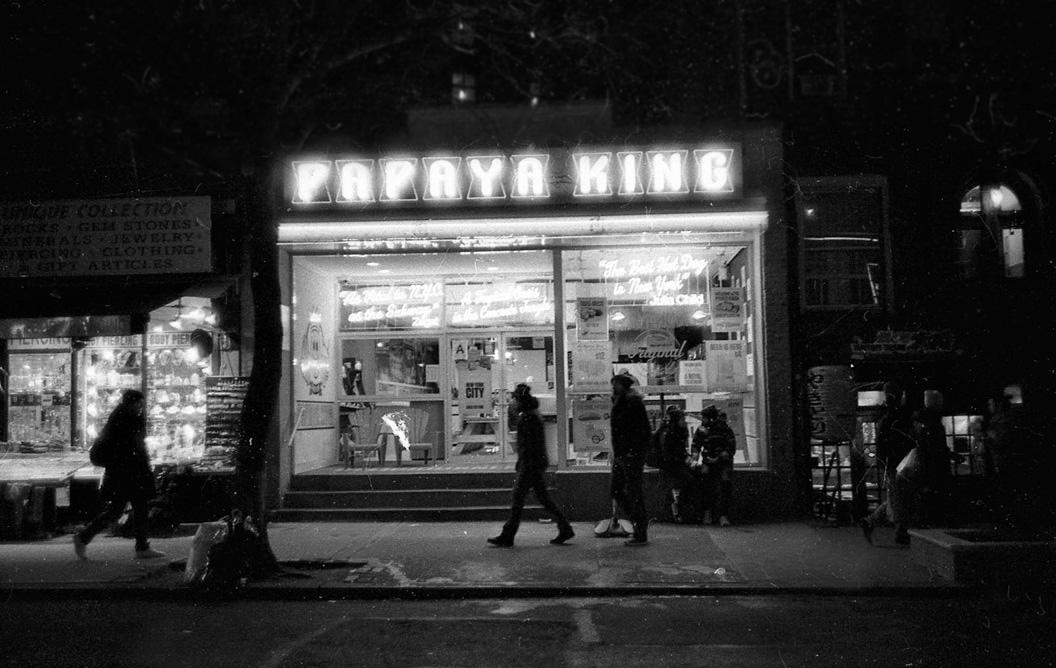
“Papaya King” 2015. Nikon SP, 35mm f/1.8 W-Nikkor, Holga 400 film.

If looking for an SP, prices are trending from $600 (plain jane chrome body only) to almost $4000 for rare editions such as the SP 2005 with the 35mm f/1.8 Nikkor.

Despite its quirks, especially when compared to the smoothness of a Leica M, the Nikon SP is one of my favorite rangefinders to use. When paired with the awesome 35mm f/1.8 W-Nikkor lens, it is a street shooters dream for film.

NikonSPCPS

“New Years Lady” 2015. Nikon SP, 35mm f/1.8 W-Nikkor, Holga 400 film.

The Nikon SP is a Camera Legend and definitely worth your time to seek one out. I haven’t shot much film in the last few months, but I noticed the last three rolls of film I shot were all on the Nikon SP. For me, that says it all.

NikonSPSam026FA

“The Crazy Duck” 2015. Nikon SP, 35mm f/1.8 W-Nikkor, Holga 400 film.

Note: The Holga 400 film was not my first choice for this camera. I had shot the first couple of rolls on Ilford XP2 (chromogenic), but just as I was done, my local C41 developer stopped developing color film! I had a roll of Holga 400 black and white film and decided to try it out. I think it’s a good film, but developed in D76, it was a bit too grainy for me. Don’t get me wrong, I love “grainy” but with the SP and 35mm f/1.8 I wanted a film that would get more out of the combo. I think the Holga film would be perfect where it belongs…in a Holga camera 🙂