Classic Cameras: The Nikon SP

The Nikon SP is a fantastic shooter and a Camera Legend.


The Nikon SP is a classic rangefinder camera, introduced in 1957. It is the apex of all Nikon rangefinders. Actually, the black Nikon SP 2005, a reissued limited edition of the SP would probably be considered the Holy Holy Grail! I recently saw the SP 2005 camera and 35mm f/1.8 kit come up for sale at KEH for $3799. Unfortunately, I don’t have that kind of cash. Needless to say, it sold quickly.

imgNikonSPMomZoe015PS

“Dreamtime” 2014. Nikon SP, 35mm f/1.8 W-Nikkor, Holga 400 film. It’s New Year’s Eve 2014, and ho! Looks like Grandma the babysitter is falling asleep 🙂

I used a Nikon S2 rangefinder with the 50mm f/1.4 Nikkor S mount lens a few years back and loved it, which led me on a chase for the SP. And the lens I wanted was the 3.5cm (35mm) f/1.8 W-Nikkor, which is probably the one most Nikon S users want. It took me a couple of years, but I was able to get the camera and lens separately for under a $1000. You gotta have patience! 🙂

NikonSPAmericanaFA

“Slices Of America” 2015. Nikon SP, 35mm f/1.8 W-Nikkor, Holga 400 film.

The SP is Nikon’s first professional grade camera. That alone gives it a lot of historical significance. It is the camera that precedes the pro Nikon F single lens reflex. In fact, if you look at the top plate, the SP is basically a Nikon F in rangefinder form. Shutter speeds are up to 1/1000 plus B and T. The Nikon S mount lenses and the Nikon F lenses are NOT compatible.

The SP as compared to a Leica M is a little more fidgety in use. The lenses and lens mount need to be aligned a certain way for the lenses to be attached. The focus wheel is cool, but is much slower in actual use. Fortunately, you can focus lenses the old fashioned way by using your hands on the lens.

The shutter is smooth and the build is solid, as you’d expect from a Nikon and I have been able to get sharp shots with speeds as low as 1/30th in low light on ISO 400 film.
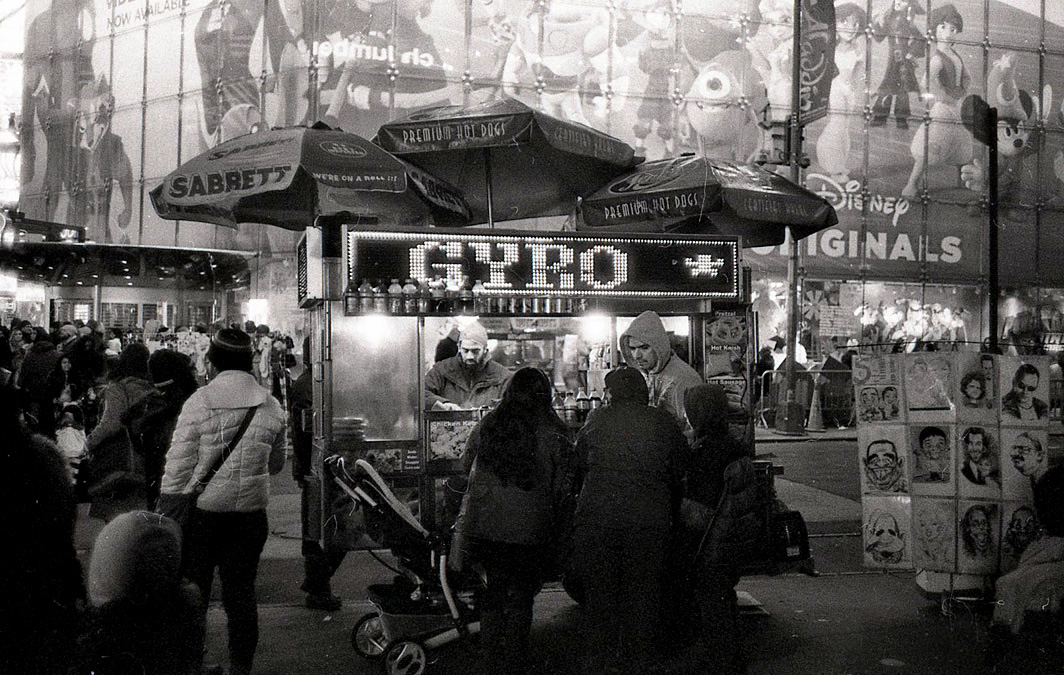
NikonSPGyroPSI

“Gyro” 2015. Nikon SP, 35mm f/1.8 Nikkor, Holga 400 film.
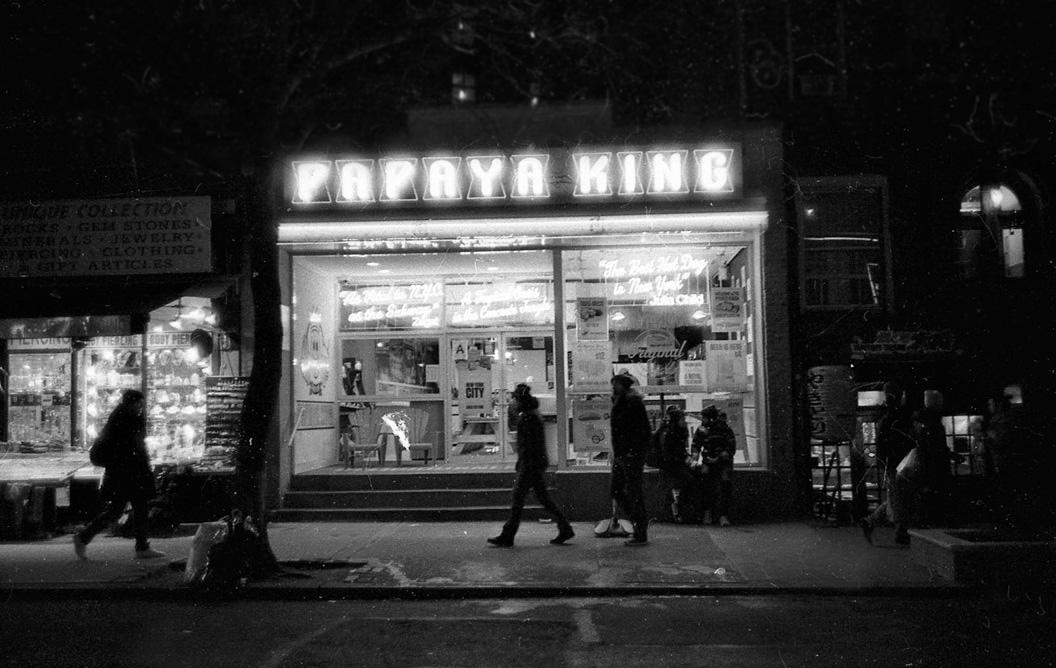
NikonSPJan19Papaya

“Papaya King” 2015. Nikon SP, 35mm f/1.8 W-Nikkor, Holga 400 film.

If looking for an SP, prices are trending from $600 (plain jane chrome body only) to almost $4000 for rare editions such as the SP 2005 with the 35mm f/1.8 Nikkor.

Despite its quirks, especially when compared to the smoothness of a Leica M, the Nikon SP is one of my favorite rangefinders to use. When paired with the awesome 35mm f/1.8 W-Nikkor lens, it is a street shooters dream for film.

NikonSPCPS

“New Years Lady” 2015. Nikon SP, 35mm f/1.8 W-Nikkor, Holga 400 film.

The Nikon SP is a Camera Legend and definitely worth your time to seek one out. I haven’t shot much film in the last few months, but I noticed the last three rolls of film I shot were all on the Nikon SP. For me, that says it all.

NikonSPSam026FA

“The Crazy Duck” 2015. Nikon SP, 35mm f/1.8 W-Nikkor, Holga 400 film.

Note: The Holga 400 film was not my first choice for this camera. I had shot the first couple of rolls on Ilford XP2 (chromogenic), but just as I was done, my local C41 developer stopped developing color film! I had a roll of Holga 400 black and white film and decided to try it out. I think it’s a good film, but developed in D76, it was a bit too grainy for me. Don’t get me wrong, I love “grainy” but with the SP and 35mm f/1.8 I wanted a film that would get more out of the combo. I think the Holga film would be perfect where it belongs…in a Holga camera 🙂


The Best Point & Shoot Camera In The World


IMG_5938

The Sony RX100 (as well as the RX100II and RX100III) has the great distinction of being called “The Best Point & Shoot Camera In The World.” And it has been since the introduction of the first model in 2012.

DSC00281ZoeHulk

“Save Me” 2014. Sony RX100, ISO 1000 in available light.

This is not a title to be taken lightly. The last camera that was universally known as “The Best Point & Shoot Camera In The World” was the legendary Contax T3 of 2001. The last great point and shoot from the film era.

The Sony RX100 feature a larger than average 1″ 20.1 mp sensor, a 28-100mm f/1.8-4.9 Zeiss lens, and excellent image quality in stills and HD video.

The latest “III” version features a wider and faster 24-70mm f/1.8-2.8 zoom lens, electronic viewfinder and tilting screen.

Personally, for a point and shoot of this size I could live without the wider, but shorter ranged lens and the EVF. I chose the Mark I version because I got it cheap 🙂

Anyway, they are great little cameras that can take near DSLR shots in a wide range of lighting conditions.

DSC00336PauNYC

“New New Yorker” 2014. Beautiful Pau loves her first New York experience. Sony RX100, ISO 2000 in available light.

I found the AF to be very good and accurate even in less than ideal lighting conditions. The color palate is very “Sony” and consistent with other Sony cameras, which means skin tones should be nice. And of course, the camera is very pocketable.

I personally just leave the camera on aperture priority and auto iso. It’s a point and shoot after all and it does a fine job most of the time.

DSC00054NYCZoeSamPic

“The Peace Keepers” 2014. Sony RX100, ISO 125.

If you want the best of the best, get the RX100III. But if it’s going to be your secondary or “fun” camera, I’d save the money and seek out the original which should run you about $300 either used or if you’re lucky, “new old stock.”


It’s hard to imagine that a camera could dethrone the mighty Contax T3, but the RX100 series, while an entirely different animal (Film vs digital, fixed lens vs zoom) was able to become the CM Punk of the camera industry. That is…”Best In The World.”

Note: Yes, I know this digital era, the era of millions of “disposable” cameras. And for these digital cameras, they’re only as good as their last megapixel and they know it 🙂

Some of my Instagram followers stated to me that the 16mp APS-C sensor Ricoh GR is actually “best in the world” and they may well be right! Then others will say it’s the Nikon Coolpix A. Of course, there’s the Sony RX1/RX1R, but that’s in another league! Oh yes, we can’t forget the Fuji X100/X100S/X100T, you catch my drift. In reality, the digital cameras we have today are so damned good, there is really no “best.” You just have to find the one that’s right for you.

Right now Amazon has the best selection of the Sony RX100. Everyone and their mothers buy from Amazon and you can never go wrong with them.
http://www.instagram.com/camera_legend

Happy New Year 2015!

_MG_5172Sam

Happy New Year 2015 to everyone! I apologize to my good friends, the good readers and fellow Instagram cohorts for the long time lapse since the last posting. I also apologize for not getting back to some of you who have left me messages on Instagram. I will try to get back to you all.

The holidays, work and family have kept me really busy and writing a decent blog takes time so I don’t want to give you a half-assed effort.

I am working on some new stuff for you guys and gals in 2015, including more medium format, Polaroids, and film stuff, as well as some of the latest and greatest digital cameras and lenses.

In the meantime, I want to wish you all a Happy, Healthy, and Prosperous New Year. May all your photographic dreams come true!

The Polaroid One Step Rainbow

PolaroidOneStepC

The Polaroid One Step Rainbow. This camera is cheap AND iconic at the same time! A rare combination.

This may not be the greatest picture taking camera in the world, with its plastic lens and plastic build, but the iconic Polaroid One Step SX-70 Rainbow is one of the Polaroids to have if you collect cameras.

And they are quite cheap on eBay. Never pay more than $40 for one of these. As a Camera Legend though, that it is! I think this is the model that inspired the Instagram logo. I mean look at that Instagram logo…The Polaroid One Step Rainbow IS Instagram!

The Instagram icon.

With its fixed focus lens, and virtually no ability to manually control this camera, save for the lighten/darken switch, this camera is perfect for those “ugly” photos I wrote about here. You know, those washed out, faded, blurry photos that people find “artistic” 🙂

Note: The only thing this camera has in common with the original SX-70 I featured before is that it takes SX-70 film, which is much less common that the 600 series film. Other than that, the cameras are night and day in quality.

SX

The original SX-70. The differences in quality between the One Step and the original SX-70 are night and day. The one thing they share in common is that they both take SX-70 film, which today means film from the Impossible Project.

The Minolta TC-1

MTC1

The Minolta TC-1 is a compact “luxury” point and shoot camera from 1996. It features a brilliant Rokkor-G 28mm f/3.5 lens. The lens is superb, and a rare version of the lens can be found in Leica screw mount, but that lens is scarce.

The camera can be quite fragile in my opinion. I had one that died on me in four months. Fortunately, the shop in Japan where I ordered it from gave me a prompt refund.

I loved the size and jewel-like feel of the camera, but prefer cameras I can toss in my pocket and not have to baby.

Prices are trending from around $450 to over $1000 for the rare black version. Most of the vendors selling this camera on eBay are from Japan. Don’t let that put you off; I have bought many items from Japan and have always found the items to be as described, and the shipping prompt, less than a week to the USA in many cases.

I am currently looking for another one of these to give it a proper workout. I did get some great shots from the one that broke down on me, but the photos are mostly family stuff and boring test shots, so I won’t bore you with these.

The TC-1 is a beautiful camera to look at and to use, but the finish scratches easily, and again, I feel the camera is quite fragile. By that I mean the electronics, motor, and moving parts seem quite delicate. And let’s not forget, this is an older camera that may be in need of a CLA. I’ve heard that Konica/Minolta in Japan may still service the TC-1, but that it would cost close to the price of just buying another one.

All that aside, the TC-1 is one of the most desirable and collectible Minoltas ever made and a point and shoot classic.


The Olympus E-1

OLYMPUS DIGITAL CAMERA

“Cuckoo” 2014. Olympus E-1, Zuiko Digital 25mm f/2.8 pancake lens. Sorry for the funky treatment…one really did fly over the cuckoo’s nest 🙂

The Olympus E-1 is a digital slr that was introduced by Olympus Corporation in 2003.

It was their first digital interchangeable lens slr and an attempt to tap into the prestigious pro digital market that was dominated by giants Canon and Nikon.

The E-1 was also the first dslr to sport the new “Four Thirds” or 4/3’s sensor that was heavily promoted at that time by Olympus and Panasonic.

If you want to get into all the technical aspects for the 4/3’s sensor, just go to the Wikipedia page http://en.wikipedia.org/wiki/Four_Thirds_system

Basically, 4/3’s is a sensor smaller than full-frame or APS-C, but still much larger than any point and shoot camera in 2003. The sensor has a 2X factor, meaning for example, a 50mm lens will translate to a 100mm lens on the E-1 and other 4/3’s cameras. Olympus definitely went against the stream on this one, as they did many times in the past. I’ve always been an Olympus fan, so this is one for the “little guys” 🙂

TheFlyPBaseSC

“The Fly” 2005. Olympus E-1, Zuiko 90mm f/2 macro.

The E-1 used a 5mp Kodak sensor, back in the days when Kodak made some amazing sensors. In fact, one of the main reasons for the E-1’s cult-like following is due to what Olympus enthusiasts like to call “those Oly colors” and of course, a large part of that is due to the Kodak CCD in the camera. The mount was also highly adaptable to use with “alternative” lenses and I greatly enjoyed using the camera with various Leica, OM, and Contax lenses.

E1ZC

“Evergreen” 2009. Olympus E-1, Leica 90mm f/2 Summicron-R. My little girl used to pick flowers for me. How I miss those days 🙂

The E-1 had superb build quality utilizing a magnesium-alloy, “splash-proof” body. I found the ergonomics to be great with the controls nicely laid out. The AF was sure and speedy in daylight, but struggled a bit in low light conditions. The ISO range was from 100-800 with ISO 1600 and 3200 available in the settings as “ISO BOOST.” I tended to stay within the 100-800 range as I found the “boosted” settings too noisy for me.

OlyE1FlowerC

“Sprouts Of Life” 2005. Olympus E-1, Zuiko 90mm f/2 macro.

OLYMPUS DIGITAL CAMERA

“Fields Of Gold” 2007. Olympus E-1, Panasonic 14-50mm f/2.8-3.5 Vario-Elmarit, ISO 800. Note the “noise” beginning to show. I don’t find it objectionable, but some might.

The E-1 also had one of the most quiet and smooth shutters I’ve ever used in a camera, and one of the most effective dust reduction systems. I’ve never seen a speck of dust in my E-1 images and I’ve used these cameras a lot over the past ten years.

If you’re looking for one of these, prices are trending at $65-200, with the average around $100 or less for the body alone which I feel is a killer deal for a fantastic camera.

Masterkiller1Cam

“The Kill Master” 2005. Olympus E-1. For less than $100, the E-1 is a “killer” deal for a Camera Legend.

Around 2004, I was in the (sadly) now defunct J&R electronics store in lower Manhattan. There were a lot of beautiful prints hung up on the wall of their photography department. Still a firm believer in film at the time, I was marveling at the prints and saying to myself…wow, look at what people are giving up by not shooting film! Guess what? All those shots I admired were done with an Olympus E-1 🙂

It’s hard to believe that the Olympus E-1 was introduced almost twelve years ago. It still remains a favorite among Olympus fans for its great color, superb build, and reliability. Although 4/3’s is now a dead system, it doesn’t mean you can’t use those cameras and lenses to take great shots.

The Olympus E-1 was the first of its kind and it has left a legacy that continues today with its successful Micro 4/3’s offsprings, which became the true fruition of what 4/3’s was supposed to be. The Olympus E-1 is a classic and will go down in history as a digital Camera Legend.

Pros: Superb build quality, splash-proof; Colors; Good AF in good light; Cheap in today’s world, a bargain!

Cons: “Only” five megapixels; Slow start-up; Slow write times to CF card; Digital grain begins to get objectionably “noisy” at ISO 800 and up; Part of the now dead 4/3’s system.

Important Note: While they share the same sensor size, please remember that 4/3’s and Micro 4/3’s are not compatible. For example, if you have a mirrorless OM-D EM-1 or EM-5, or a Panasonic Micro 4/3’s camera, you CANNOT use your Micro 4/3’s lenses on a 4/3’s body like the E-1. You CAN however use the 4/3’s lenses on Micro 4/3’s with the right adapter. Thanks for stopping by!

The Olympus Pen F/FT Series

The Olympus Pen FT with the 35mm f/2.8 Zuiko pancake lens.

Classic half-frame camera from the brilliant mind of legendary Olympus camera designer Yoshihisa Maitani.

The camera takes two frames on one 35mm frame. That’s why it’s called a “half-frame” camera. So on a 24 exposure roll, you get 48 shots.

You might be inclined to think that this would lead to inferior quality photos as compared to a full sized 35mm shot.

However, in my experience, the quality of the Zuiko lenses for the Pen F film system were so good that you really can’t tell the difference.

Mr. Maitaini was such a brilliant, brilliant camera designer and his Pen F/FT creation lives on in the Olympus Digital Pen series of cameras.

Note: Sorry this was meant to be a short post. I will be updating this with images from the Pen film cameras in the near future. Thanks for stopping by!

The First 35mm Full-Frame Digital SLR: The Contax N Digital

DSC_0582CNDIC

Introduced in 2000 and brought to market in 2002, the Contax N Digital is the world’s first 35mm full-frame DSLR.

Many people mistakenly believe that the popular Canon EOS-1Ds of 2002 was the first, but it wasn’t. The 1Ds may have caught the public’s attention in 2002, but the short-lived N Digital was actually the first.

The Contax N Digital sported a 6mp full-frame sensor made by Phillips of the Netherlands. The camera was designed to take lenses from the Contax “N” series of Carl Zeiss autofocus lenses. As expected, many of the lenses were outstanding.

KICX0085ZPic

“Z 3D” 2013. Contax N Digital, Zeiss 50mm f/1.4N Planar, ISO 50. I think you might see some of that famous Zeiss “pop” in this image. Please click on the photo for a larger and better view.

In 2013, I was able to procure the use of the N Digital through a good friend. The camera, as might be expected from a camera from 2002, was a bit limited in its ISO range. It had a cool ISO 25, but only went up to 400.

BZPic

“Jok” 2013. A rice porridge that is a Thai comfort food. Contax N Digital, Zeiss 50mm f/1.4N Planar, ISO 400.

I was not expecting much from such an old sensor, but found the images to be superb when mated to the 50mm f/1.4N Planar and with reasonably good light, although as always, I tried to stretch its abilities to see what I could get.

FenceCND

“The Fence” 2013. Contax N Digital, Zeiss 50mm f/1.4N Planar, ISO 100. One of my “boring test shots” as I call them. Contrary to what a lot of people say, I usually find Zeiss bokeh to be “busy” but eye catching. You can get “smooth and silky” bokeh, but you need to get in close without a lot of clutter in the background.

The Contax N Digital is pretty rare on the used market, although they show up once in a while on eBay, and once in a blue moon on KEH’s website. Prices are trending at $2K or above for minty, working samples.

Now here’s the CAVEAT…A few months after giving back the camera, my friend reported that the camera had a sensor failure! Thankfully, I was not to blame 🙂

With my help, we sent the camera back to Tocad, who were still servicing Contax cameras at the end of 2013. I am not sure if they still are.

Anyway, Tocad sent the camera back to Kyocera in Japan for servicing. Guess what? It came back a couple months later, UNREPAIRABLE. I guess if the sensor is gone, you have $2000 brick as a souvenir 😦

I felt bad for my friend, but he took it all in stride. Still, this is a lesson to be learned especially when buying older and expensive digital cameras. They are not a good buy.

And while I loved the Contax brand, there has always been one thing I’ve known since using Contax film cameras in the 90s: They are fragile. They may feel tough and well made, but the insides are brittle, especially the electronics which are prone to failure.

I still use Contax film cameras now and then, but would never buy a Contax N Digital unless the price was really, really good. That said, there is no denying that the Contax N Digital was a pioneering camera. It was full-frame digital before anyone even thought about full-frame digital! In working condition, when mated to those spectacular Zeiss lenses, the N Digital is capable of superb images. And with its distinction of being the very first 35mm full-frame digital, well that alone makes it a Camera Legend.

The Koni-Omega System

KoniC

Koni-Omega Rapid 100 and 90mm f/3.5 Super-Omegon

Awesome and affordable brute of a camera.

This was my first medium format camera back in the 90s. The system itself dates back to the 50s, although the Rapid 100 was a later production model, maybe 70s or early 80s. There are numerous bodies including the Konica Press, Rapid, Rapid M, and maybe a couple older bodies. The Rapid 100 and 200 seem to be the later models and probably better buys than the older models.

In the 90s, I became interested in medium format photography after reading a book by the late Leif Ericksenn called “Medium Format Photography.”

He had some photos from the Koni-Omega that he used on a tv production and I began to seek one out.

The Koni-Omega is a rangefinder camera system that consisted of several bodies and interchangeable lenses. The lenses are sharp. They make for excellent images on 6×7 negatives or slide film.

They are not expensive, but big, bulky and a bit fussy to use, which is probably why I sold it. However, the Koni-Omega system is capable of excellent results at a bargain price. The lenses have built-in leaf shutters and the cameras do not need batteries to operate. But again, they are BULKY and I suspect that is the reason they end up getting sold by owners who sell them.

Prices are trending anywhere from $50-200, depending on body, lens, and other accessories.

If you want to get your feet wet in medium format photography without breaking the bank, this is it.

Note: Sorry I do not have any photos from the Koni-Omega to share with you. As mentioned, I got it in the 90’s and at that time, there was no such thing as a great economical home photo scanner, at least not one that could do medium format on a budget. However, I do remember having prints that were done for me by a photo lab, and if I can find them, I’ll be sure to scan them in and update this article. Thanks for stopping by.


The Hasselblad 500C and 80mm f/2.8 Planar

HassyC

I took this shot in 2005 to sell this outfit when I was broke and desperate for money. Needless to say, it worked and off she went to a better home.

However, I have fond memories of the Hasselblad 500c and 80mm Zeiss lens. It’s a modular system and a little bit fiddly to play with, especially if you’re new to medium format film cameras, but the results were superb.

79859294.0wUnA13p.HollywoodBabyPbase1

“Hassy Baby” 2005. Hasselblad 500c, 80mm f/2.8 Planar. Do not remember the film unfortunately. I used a Softar filter to give the “glow” to this photograph.

Prices are trending at $550-800 for this outfit, and $1000 or more for the 500cm with the 80mm Planar. Find the best one you can afford because if you love film, this will be a keeper…Unless you go broke like I did 🙂

This is a tribute to the days when Hasselblad were the pinnacle of medium format cameras and not the company that today sells rebadged Sony cameras as “lunar” or “anniversary” editions for ridiculously high prices.

Hasselblad is a Camera Legend with a rich legacy that I absolutely respect, so let’s forgive the Sony rebadges 🙂