How To Scan Film Using Your Phone & Tablet Plus Low Budget Phone Scanning vs Low Budget Flatbed Scan

Just like many of you, I scan my film as a labor of love. It started as something I enjoyed to something that became more like work. Just natural when you have time constraints due to family and job. It can be time consuming but when the results are good, they’re definitely worth it. And sometimes when I get a really good scan I’m reminded of just good film can still be in terms of resolution and detail.

However those of us familiar with using a flatbed scanner for scanning negatives know that sometimes it really can take a lot of time going through even one roll of film if you want or need to make the necessary corrections to get the best out of the images.

Over the years, I’ve experimented with “alternative” scanning methods, primarily as a way of saving time. I’ve tried all the things people try, from DSLR to Mirrorless to Phone camera.

ContaxBuddha

“Big Buddha” 2005. Contax G1, 28mm f/2.8 Zeiss Biogon. The image was “scanned” with an Olympus E-1 and 90mm f/2 Zuiko Macro lens via adapter.

Above is an early attempt at “alternative” scanning. The original photo was taken with a Contax G1, and 28mm f/2.8 Biogon taken on Fuji Velvia film in 2005. I “scanned” this image in 2005 using an Olympus E-1 5mp camera with 90mm f/2 Zuiko Macro lens via adapter. The vibrancy and detail were amazing but setting up the tripod and getting the light right was somewhat cumbersome so I didn’t use this method much.

It’s funny that back in 2005, DSLR “scanning” didn’t really catch on but it’s very popular today, especially with today’s high resolution cameras. But in my opinion, 5mp was perfectly acceptable and I made a nice 8×10 print from the above photo!

CLZoeP

“Time Out” 2009. Leica CL, 40mm f/2 Leitz Summicron. Also “scanned” using the Olympus E-1 5mp and 90mm f/2 Zuiko Macro Lens.

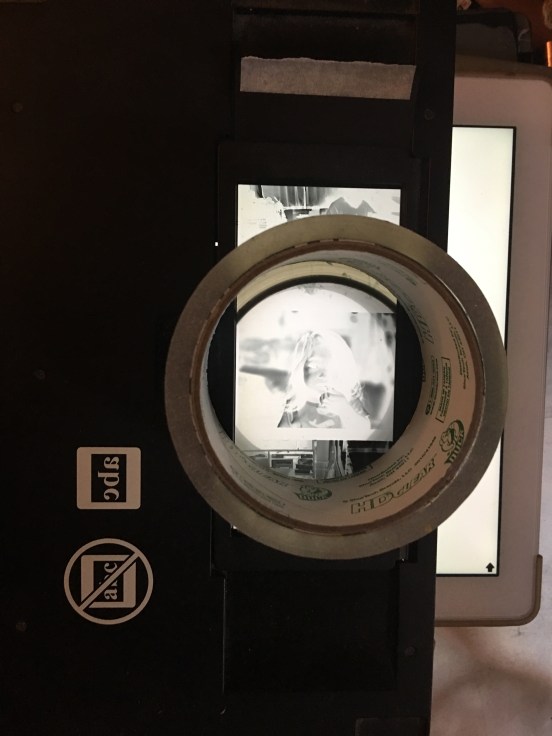
Recently I tried a low budget scanning method using my iPad as a light box and using my iPhone to “scan” the images. You can find a few tutorials on YouTube on how to do this. It seems everyone does it a little differently.

Here’s what I did:

1) Use white background on iPad as a lightbox.

2) Use one roll of tape as a spacer so the film is not too close to the iPad. Too close and the brightness of the iPad or tablet may wash out details or show its pixels.

3) Put film on top of the first tape roll. I use the negative holder from my Epson scanner to keep the film flat. If you don’t have a holder you should find another way of keeping the film flat. Thin glass might help.

4) Put other roll of tape on top of the film and position the image you want to scan. This might require some moving around as most of the cameras on our phones are not placed in the center of the phone itself. The tape roll also acts as support to keep the phone steady.

5) Tap the image on your phone to focus and take a few shots to ensure that at least one is sharp

5) Import into editing program on your phone.

Below is a step by step photo show and comparison. The original image was taken with a Mamiya AF-D and 80mm f/2.8 Mamiya AF lens on Tri-X 400 in 2016! Yet another camera I’ve used but never profiled. It was a great camera system if you need to know!

My flatbed scanner is a now very old Epson V500. I reckon it must be at least eight or nine years old!

My low budget iPad/iPhone scanner! See details in the article on how to do it.
A closer view of a possible Medium Format scan.

An image scanned using the iPad/iPhone method then opened in the Adobe Photoshop Express app.
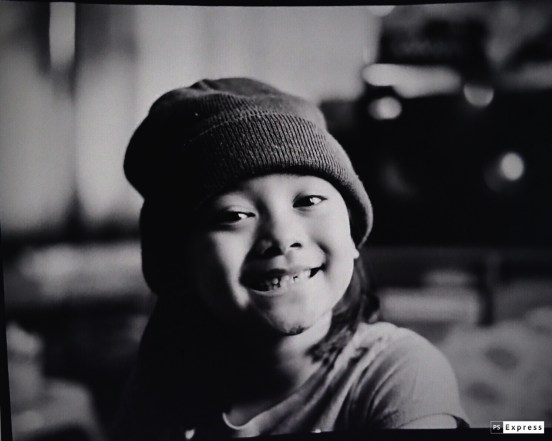
The final image using the iPad/iPhone scanner. The negative needs to be inverted to reveal the positive image. I then processed the image using the sliders and controls in PS Express.

A close up of the above image. This might be fine for a lot of people, and certainly for a quick preview. But as you’ll see below, it’s no comparison to a flatbed scanner.

Same image scanned using an Epson V500 Flatbed Scanner.
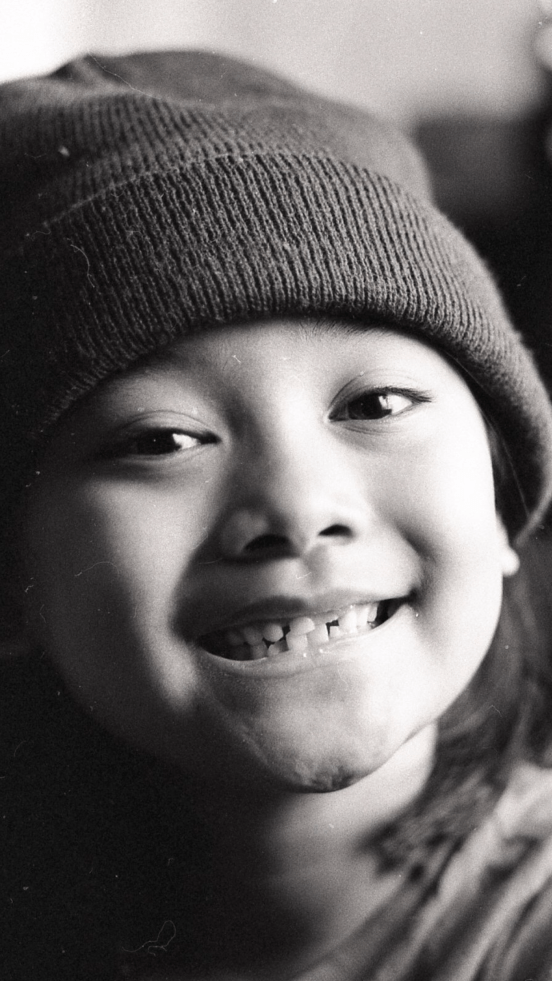
Close up of the Epson V500 scan. Note the details in the fabric of the ski hat, the eyes, the teeth. There’s really no comparison!

WHY DO THIS?

Why use your phone to scan you might ask? I can think of a few reasons but probably most important is that it’s incredibly faster. If you just want to get an idea if the image is worth scanning on your flatbed scanner this will do it. It takes literally seconds to scan using the phone camera vs minutes using the flatbed. If you’re pressed for time this adds up!

Also using this method and a photo editing app such as Adobe’s Photoshop Express or Lightroom, you can do it all on your phone and not need to turn on your computer.

CONCLUSIONS?

Well, based on my initial testing the iPhone scans are surprisingly usable as a quick preview. Heck some might even be able to use these scans for posting to social media etc.

However, as expected, the scans from a “real” scanner such as my old Epson V500 are still infinity better. I’ve included crops from both the phone scan and the Epson for you to see.

Check for details in the fabric of the ski hat, and in the face and teeth. There’s no comparison really! But if you want to see images in a pinch, this works!

Now some of you might say, oh well, an optical scanner is evenΒ betterΒ than the flatbed and yes, I agree cause I had that covered too! Had an optical scanner in 2003 or 2004 and the scans were superior to the flatbed. To this day, I regrettably sold it but the flatbed is a good compromise. For the record, I’ve never used a drum scan so I leave it up to YOU to tell me about it! πŸ™‚

Next step is for me to do a comparison with the Epson flatbed scanner vs using a modern high resolution DSLR or Mirrorless with a macro lens. This should be closer!

Till next time happy Sunday good peeps!
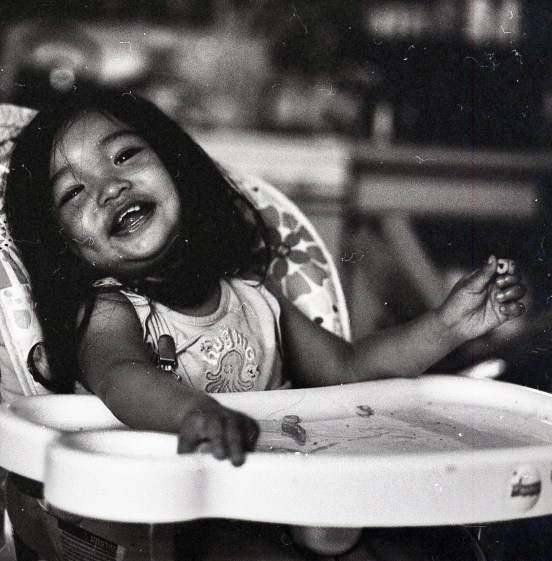
“Happy Sunday!” 2016. Mamiya AF-D, 80mm f/2.8 AF, Tri-X in D76. Zayda doesn’t want to be left out! She wishes everyone a happy Sunday morning good peeps! πŸ™‚

Photo Of The Day: “Cold Cold Morning” Agfa Ambi Silette & 55mm f/2 Solagon Lens Plus New YouTube Video

imgAgfaSolaKentRyeP189

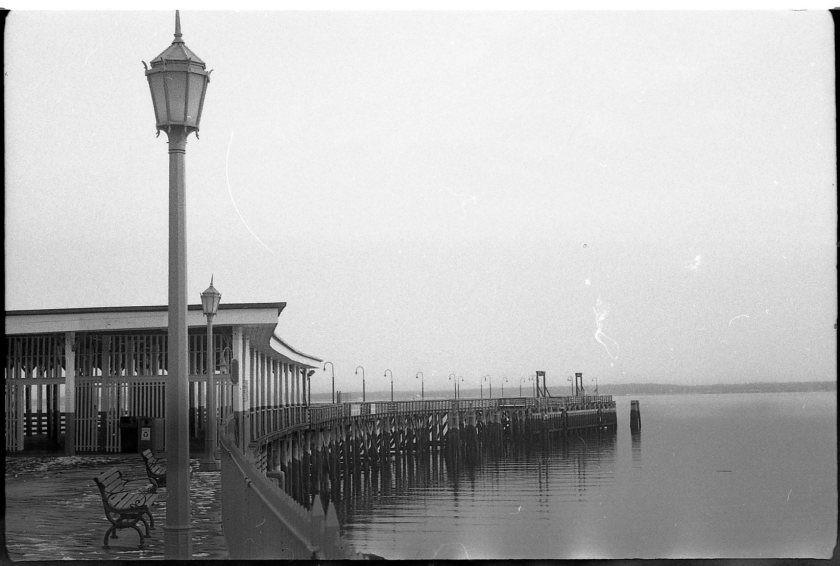
The above photo was taken on a cold overcast day in 2018 using a vintage Agfa Ambi Silette 35mm camera and the mythical Agfa 55mm f/2 Solagon lens. The film was Kentmere 400 developed in D76 developer.

I got the camera outfit primarily for the lens which is like a scarce cult favorite not known by many. There’s just very little on the web about it and I would like to add to that knowledge base if I could.

The internet has a way of distorting reality and since there’s so little on this lens, I was well prepared to shoot down all the praise I read online as maybe “over enthusiastic” love from a handful of people. Not that I didn’t believe them but there’s just not enough of them.

But now that I’ve seen the results for myself, I’m inclined to say they might be right! Even in the above photo, the lens shows excellent sharpness and very little distortion. Considering it’s an older vintage lens, I think it’s performance is quite exceptional!

Now I haven’t shot enough rolls to make a full judgement but for now I think it’s safe to say, it’s a great lens!

NEW YOUTUBE VIDEO

As I mentioned here before, the slowdown in my postings here has a lot to do with me making it a priority to provide new content to our Camera Legend YouTube channel.

Today I posted a video on one of my favorite cameras of all time, the Rolleiflex 2.8C with the Schneider Xenotar lens. Consider it a complement to our 2017 review of the camera.

You’ll see some additional photos including one I took while having dinner in 2009 with famous photographer Manuel Libres Librodo, aka Manny Librodo. Great guy!

Eventually, I hope to have most of the cameras I’ve reviewed here on YouTube as well.

Making these videos AND writing a blog while also managing work and family can certainly burn you out and I discuss that as well in this video. This is why I’m seemingly only online when I post something πŸ™‚

I do apologize for that! Do not run too many projects, it’ll burn you out!

It’s a one man operation but I’m determined to give you the best I got. Thanks for your support!!


Celebrating Four Years Of Zay Plus Fuji Raising Film Prices & COSMOS?! πŸ˜€

Good morning guys! Hope you don’t mind if I indulge a little in celebrating and wishing my daughter Zay a very Happy 4th Birthday!! A wonderful child, couldn’t ask for a better baby, we’ve been blessed. Love you lots kid πŸ˜πŸŽ‚βœŒπŸ»

Sorry if you’ve seen some of these pictures before but they just happen to be some of my favorites among many.

Time marches on so fast! Sometimes I get sick when I remember like yesterday it was 1999 and now you telling me it’s twenty years later?!

Friend, it doesn’t get any slower. In fact, anyone above the age of forty can tell you it moves faster every year! Cherish the day and take lots of pics!

Zay at three months. 2015. Canon EOS 5D Classic, EF 50mm f/1.8 II.

“Lost” 2016. Leica M8, 50mm f/2 Summicron-M.

imgCMZayda042

Zay at around four months. 2015. Leica CM, Ilford FP4 in D76.

Zay & Zoe, 2016. iPhone 6s Plus.

“A Portrait Of Zay” 2016. Olympus OM-D EM-5, 45mm f/1.8 Zuiko Digital lens.

“Eskimo Pie” 2019. iPhone 6s Plus

FUJIFILM, FUTURE REVIEWS & COSMOS?!

I posted this a couple of days ago, sorry for the late update. In our latest “Trends” video, we look at the news that Fuji will be raising the prices of their films by thirty percent. I’m not too happy about this. Yes, I understand they are a business and prices do not stay the same forever. However, a thirty percent increase is pretty steep and in my opinion, they haven’t felt the love for the “film” portion of their name for a long time now. I wouldn’t be surprised if they eventually get rid of all their 35mm and 120 film and focus squarely on their Instax line which makes them a lot of money.

I will also show you some of the cameras and lenses that I plan to review. Actually, I already have drafts for most of them! My issue is that I tend to be too cautious with what I say or write so I just keep editing. I just want everything to be accurate. This explains part of the reason why it takes so long between reviews. Sorry about that! My reasoning is that once these reviews come out you cannot take back what you said so you must get it right!

Thank you guys for reading and as this is the last day of February, I guess I’ll see you all next month!

Throwback Thursday: The Nishika N8000

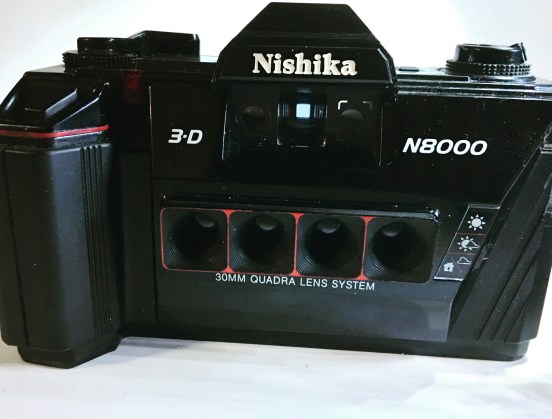
Nishika N8000 3D Camera

For your Throwback Thursday here’s a time machine from the 1980s! Now friend I need to ask you…do you live in a 2D world? Or do you live in a 3D world? The answer is neither! You live in a 4K, heck even 8K world! πŸ˜€

The Nishika N8000 was introduced in 1989 riding off the 3D wave of the 1980s sparked by Nimslo and their famous or infamous 3D camera.

3D photography is something the photo industry has tried to sell for years and while it’s cool, truth of the matter is it doesn’t ring with the masses.

I have to admit, I just don’t love the workflow involved with this camera or it’s cheap feel. I do love seeing other people’s 3D work, just not my own. I’ve had this for some time but it’s just another collectible I got cheap 😊

Why no pics? I’ll say straight up I’m not happy with my results with this camera. And if I think it’s junk why would I waste your time and post them? πŸ˜€

Happy TBT good peeps! πŸ˜ŽπŸ“·βœŒπŸ»

Flashback Friday: β€œGimme Your Best!” πŸ˜€

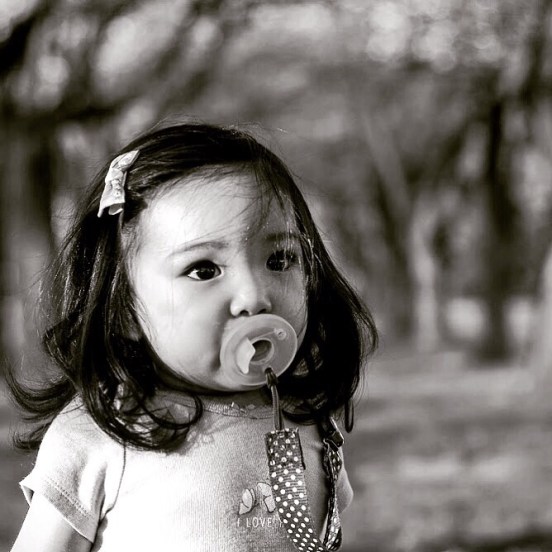
This photo was shot about two, almost three years ago in 2016. I said to Zay, give me your best smile and this is what she gave me! Ah the baby’s already a natural in my biased opinion πŸ™‚

Sure yes I know it’s not a real “flashback” but hey when you’re a 3 year old toddler, yeah it’s a flashback! πŸ˜€

I wonder though, could anyone figure out the camera setup being used in the picture? Hint, it’s not something I ever alluded to on these pages before lol but perhaps this is the year for it! This is the year we go BIG…or is it not? Haha

Happy February good camera loving peeps! 😊😘

The Worst Cameras Of All Time #2: The Kodak Disc Camera

Ah man, I hate doing this! I hate doing this so much that it’s been almost three years since the last time I wrote one of these “worst camera” articles. Most of you regular readers know that I am proud and fond of saying I love all cameras right?

Well, I do, I really do! That said, we can’t always have winners, not even in the camera world! So today we have another candidate for worst camera of all time, and again, as a prerequisite for me, it is another camera I have used.

Our first recipient of this distinction was the Nikon N70 film camera with its “FAN” shaped thingy! The reason I feel bad writing this today is that when I first wrote the article on the N70 in 2016, I never expected that the article would still show up on Google’s front page whenever someone types in “Worst cameras of all time.”

How could I have known that nearly three years later it would still be there?! It makes me feel bad. It makes me feel like I have “wronged” the Nikon N70 in some way!

It’s not the worst camera ever, but it might just be the worst designed Nikon and so I stand by my writings.

Today, we will take a look at a camera that I think most camera nuts and historians would agree should certainly be on this “distinguished” list and that camera is the Kodak Disc Camera.

img_8551

INTRODUCTION

The Kodak Disc Camera system was introduced by Kodak in 1982. There were several different models, of which the best known was probably the Disc 4000, the cheapest model. Other models included the 4100, the 6000, the 8000, and even a telephoto model called the Tele Disc.

If you want specifics on any on these models, please do a search on them. It is not my intention to review each model here.

MY RECOLLECTION & EXPERIENCES WITH THE KODAK DISC CAMERA

The year was 1983. My Mom, perhaps noticing my budding interest in photography got me a Kodak Disc 4000.

Now I’m not sure if I was pestering her for it or she did it herself, but somehow she brought home a Kodak Disc 4000 camera one day.Β As Mom had no photographic inclination, I would imagine me and my brother nagging her about it!

I remember well, Kodak had a big television and print advertising campaign on this camera! They even used celebrities if I recall correctly. It was indeed their next big thing…or so they wanted us to believe.

Using the camera was the simplest thing in the world. You drop the film in and the camera did the rest! You press the shutter and the camera winds, rewinds, decides whether or not to use flash, etc. It’s a straight up point and shoot in the best sense of the word!

YOUTUBE VIDEO

For those of you who prefer watching videos, here’s our video on the Kodak Disc Camera. The only thing missing in this article that’s on the video is me explaining how I feel about Kodak in an era where a rap star “Kodak Black” is more well known than Kodak the film company! That’s nuts! πŸ™‚

THE KODAK DISC FILM

I don’t want to jack some picture off the internet so please do a search if you’re interested. I’ve always told people that the Kodak Disc film reminded me a lot of those circular slides they used in the children’s ViewMaster toys. You know, that classic red binocular looking toy that would illuminate slides of animals and such for children.

The disc/film itself was quite solid and thick. It didn’t bend like a 35mm negative would. It felt like a plastic disc. Apparently the thickness of the Kodak Disc film was comparable to 4×5 sheet film though it felt more solid to me, if I recall correctly.

The negatives were about 10mm x 8mm and you got 15 shots per disc. To get the best out of this film the labs had to utilize special Kodak lenses for printing, but apparently a lot of places did not use these special purpose Kodak lenses which may or may not account for lowered quality in the final print.

THE PICS

Here are just a few shots I took using the Kodak Disc 4000 circa 1983-1984. A lot of these images are like a 1980s time capsule! They are not artistic masterpieces. However, if you look at the photos you will see quite a few legends of the era in there! Plus I also think this camera helped me learn how to capture “the moment” so to speak.

Ed Koch, NYC Mayor, 1983. Kodak Disc Camera. I shouted “how am I doing?” to mimic Ed Koch’s famous slogan and he repeated it back to me! Haha!

You got to remember this was like a 13 or 14 year old kid with his first camera living in a time, pre iPhone, pre digital camera. I could not take a thousand photos and edit them to find the ones I liked best.

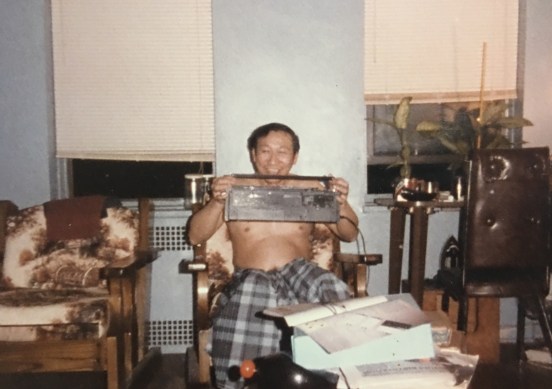
“Daddy Boombox” 1983. Kodak Disc 4000. Just like Archie Bunker, Dad sits on “his” couch and plays around with the new Panasonic Boombox he just bought us. The 1980s were an awesome time for electronics!

I was shooting not to post online because there was NO online! I was learning photography and shooting the moments in life, the “Kodak Moment” and I loved it! πŸ™‚

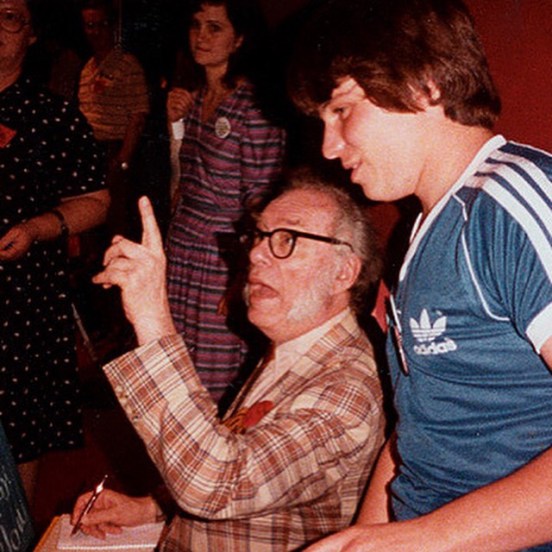
Science Fiction Legend Isaac Asimov, 1983. Kodak Disc Camera. I shot this at a little known event in Manhattan called the “Comic Convention.” Today I believe this has grown into a huge mega-event called “Comic-Con.”

“Roddy Piper vs Jimmy Snuka” 1984. Kodak Disc Camera. The Pro Wrestling boom started in the 1980s and here Jimmy “Superfly” Snuka is about to unleash on “Rowdy” Roddy Piper!

“JC & Hoss Funk” 1983. Kodak Disc Camera. Ah I miss the 1980s. Fun and friends, that’s what it’s all about!

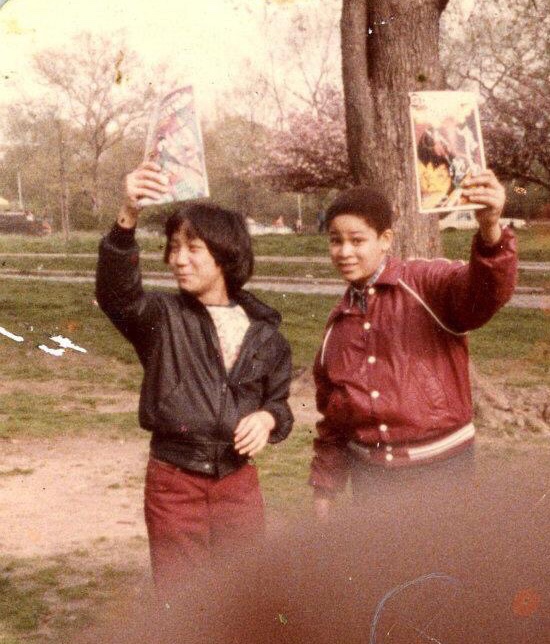
“Brothers” 1984. Kodak Disc Camera. Do you know any of these guys? πŸ™‚

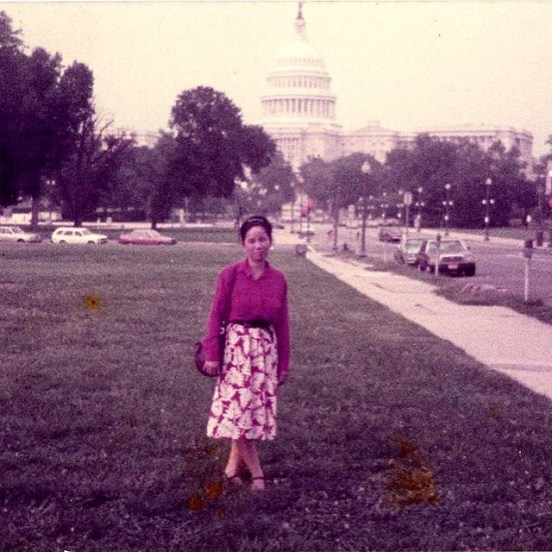
“Mom In D.C.” 1984. Kodak Disc Camera. The soft grainy image works well for this photo of Mom in Washington, D.C., I think.

WHY IS THE KODAK DISC CAMERA ONE OF THE ALL TIME WORST CAMERAS?

I loved the photos I got from the camera, I really did! But on a technical level, yes, I’d have to say the Kodak Disc Camera was one of the worst!

And it’s not so much the cameras themselves. The cameras were thin, sleek, automated. In many ways they were a precursor to today’s digital point and shoots.

Just like the APS Camera System, the main drawback of the Kodak Disc Camera system was the film. The 10x8mm was much smaller than 35mm film. You only got 15 shots as opposed to 24 or 36 shots with 35mm. Plus development costs were high, certainly no cheaper than 35mm.

All these factors added up to another thoughtfully designed but ill executed product. The images were soft and full of BIG GRAIN. They did not enlarge well.

And so most of the Disc cameras were off the market by 1990, though Kodak continued to produce the film until 1999. Personally, I cannot recall anyone past 1988 or so using one!

IN HINDSIGHT

The power of hindsight is a great thing. As horrible and grainy as those images were, I loved the shots I got out of the Kodak Disc Camera!

It may be part nostaligia; yes Mom gave me the camera. Yes, it was kind of like my first “official” camera that I used regularly.

But at the same time, living now in a world of beautiful, noiseless, grainless, homogenized digital images, I can appreciate the Kodak Disc Camera images more.

I would even say that if someone made this camera today, it would be a hit with a certain niche market. Lomography, lo-fi, Polaroid enthusiasts, etc. You know the crowd!

I like that stuff too but not all the time. But yes, I can appreciate it!

PRICE. AVAILABILITY.Β 

If seeking one of these Kodak Disc Cameras, they are plentiful on auction sites and elsewhere for very low prices. The prices are trending anywhere from $3-25 and the films are averaging $8-10.

I wouldn’t pay any more than $10 for either. This is not a product that’s likely to increase in price or regain any appreciation, which is good for us camera geeks!

CAN YOU STILL USE IT? WHERE TO DEVELOP?

Assuming you find a camera in working condition and you’re inclined to take a chance with film that’s been expired for over 20 years, chances are good that you can still get pictures out of this thing!

The development part is a little harder but apparently a few places will still develop Disc film! The one I know off hand is Dwayne’s in Kansas. The shop that famously developed the last official roll of Kodakchrome.

I’ve heard of others developing the discs themselves. I’m not sure if I’ll ever shoot Kodak Disc film again, but if I do, I’d probably try that route.

BOTTOM LINE

The Kodak Disc Camera system was an enthusiastic attempt by Camera Legend Kodak to introduce a new film format along with new cameras to take this film.

It offered conveniences such as autoload, autoexposure, and autorewind, all packaged in (then) new and slick looking cameras that explored the wonders of the electronics boom of the 1980s.

It was ultimately let down by poor image quality and high cost per shot. It gave people convenience over quality.

It was yet another example of a big company making a calculated move, assuming they knew what people are willing to accept and in the end they were dead wrong.

People want convenience, but they want quality too. The Kodak Disc Camera did not deliver the latter and eventually became one of Kodak’s biggest photographic flops and earning it a distinction as one of the Worst Cameras Of All Time!

COUNTERPOINT. COMMENTS?

How do you feel about it? Were we too hard on the Kodak Disc Camera?

Did Kodak try their best to deliver a product that offered a good compromise between convenience and quality?

Or was it yet another example of Kodak’s lack of vision and big company greed? Did they not learn from their attempts to sell and capitalize on the proprietary films (and cameras for them) they developed such as the 126mm or 828mm films?

What do you think? I’d love to know! And please don’t be mad at me for bashing Kodak. I did say that on a personal level, I LOVED the Kodak Disc Camera!


Monday Mystery Images & The Quality Of Walgreens Film Scans

It was bound to happen. I had several rolls of color film to be developed. I’ve been procrastinating.

With b&w film, I take care of the development myself which is probably one of the reasons I prefer to shoot film in black and white. But with color film, I still send them out for development.

I have developed color film at home, but every time I did, it came out “funky.” Either it was too grainy or there were streaks that ruined the images thus I take the trouble to send out color film.

I’m not a big fan of CVS and Walgreens color film development these days because they are no longer returning your negatives, which is one of the main requirements when I shoot film! Since the first roll of film I ever shot as a kid, the golden rule was if you shoot film, you get the negatives or slides back.

Well, we must live in different times because whatever company is developing for CVS and Walgreens have decided it’s too much trouble to return your negatives.

MY FIRST MISTAKE

I generally have a failsafe system of marking my film rolls with a permanent marker after I’m done. Usually, I’ll write the camera used, ie “Leica” or “Canon” etc and the camera model, etc. My first mistake in this saga was using a different marker than the one I usually used. Over time, my writing rubbed off without me noticing it till it was too late.

I was however confident it was a roll that I just finished using a Mamiya U point and shoot. The film is Kodak Gold 400 no doubt about that!

Considering that the film back hatch broke on the Mamiya U and opened on me, I figured I must’ve ruined at least some of the photos so I decided to break my “no Walgreens or CVS processing” rule and said, ok why not see how this turns out? I figured maybe the whole roll was ruined anyway.

THE PICS, THE SURPRISE, AND THE MYSTERY

When I got the photos, after going through about five photos, I realized this was NOT photos from the Mamiya U!! πŸ™‚

I used the Mamiya U in 2018 when I got it. The photos I got back are from 2017. I know that because there are some pics there that I also shot in digital and I remember well the time and place that they were taken.

The thing I can’t remember is: What camera/lens did I use for these photos?!!

“Sisters” 2017. Mystery Camera! The field of view and neutral background blur makes me think this is a 35mm or 50mm lens perhaps with a f/2.8 starting aperture.

“Bunnies” 2017. Mystery Camera! There is a general softness in these images. Some seem due to images being off focus which indicates to me that this is a camera/lens I’m not familiar with or do not use often.

6

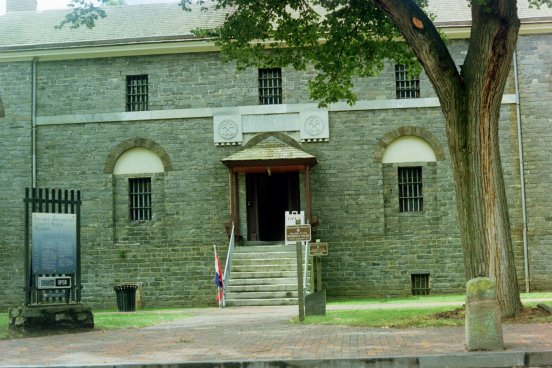
“Burlington County Jail” 2017. Mystery Camera! A historic jail in Burlington County, New Jersey. Even if this were an old camera and old lens that I used, I’m sure I stopped down for this shot which is why it is reasonably sharp.

4

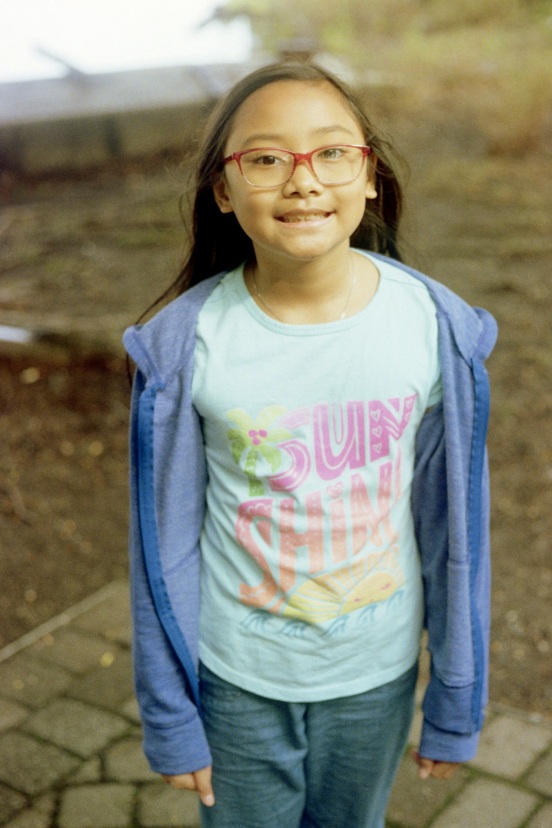
“Sunshine” 2017. Mystery Camera! Check out the bokeh in this shot. It’s very neutral. And to my eyes, quite nice. This looks to me almost like f/2.8 and shot at close range. I feel almost as if it’s very familiar yet I can’t pinpoint what camera or lens I used! Can you?

9

“Olaf” 2017. Mystery Camera! Indoors, I generally shoot wide open. Look at the neutral bokeh. This definitely does not seem to be a 50mm f/1.8 lens as I originally thought. But then again, it could be!

14

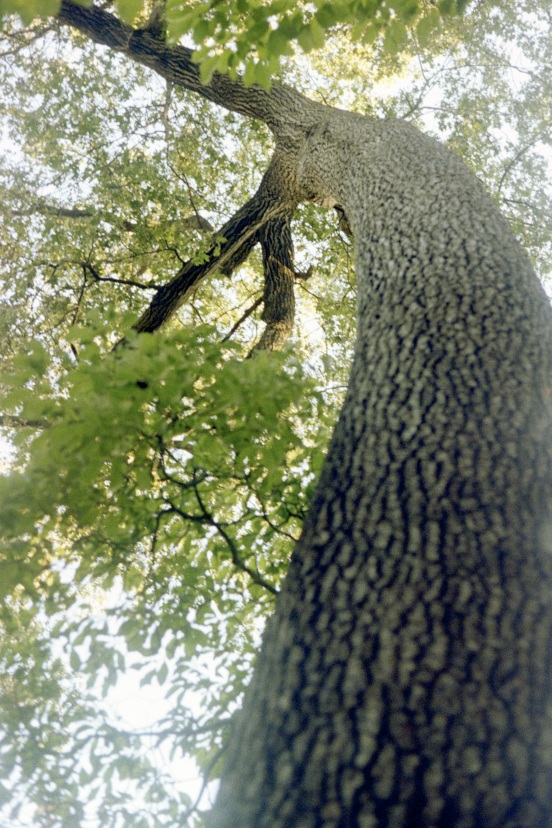
“Curves” 2017. Mystery Camera! Note the “haze” or lack of flare control. As I was on the ground at the base of the tree, is it possible that it’s a 28mm lens?

10

“Zay’s Bokeh” 2017. Mystery Camera! This image was slightly off focus. Note again, the “haze” or lack of flare control. The bokeh on this one has me second guessing that maybe it could be a 50mm f/1.8 or f/2!


WORKING ON THE MYSTERY

Well, doing a little detective work, I can tell that this was indeed one of those rolls where I was specifically “testing” as opposed to taking pictures for the sake of taking pictures. I can tell by most of the subjects I shot. Trees, buildings, and of course, my kids.

I have come to the conclusion that it must be an old camera with either a 35mm or 50mm lens in the f/2-2.8 area. Problem is, that could be ANY number of cameras I could’ve been using lol πŸ™‚

There seems to be some visible “haze” or something causing a “look” in the photos indicating it’s probably a very old lens.

My initial thought was that it might be from the Contax I rangefinder and 50mm f/2 Sonnar that I had been using in the early part of that year. However, I remember well that the very first roll of b&w from that camera was almost blank. Either due to a processing error on my part or it could be me ruining the film with some very old developer. However, I cannot remember if I tried another roll in the camera.

And since some of the images here were from a trip to New Jersey, I seriously doubt I would’ve taken the Contax I since the rangefinder is so dim it would be certain that most of the close up shots would be out of focus.

LESSONS LEARNED

Always make sure your film is marked. ALWAYS! Otherwise, a roll of film with no way of identifying the camera/lens is worse than a digital file! A digital file can almost always be deciphered by its EXIF or codes.

I’ll have to double check every roll I label from now on. How do you manage your films?

CONCLUSION? CAN YOU SOLVE THE MYSTERY?

For now, I have to say that it’s very likely I may never know. I have tried to check the photos for any reflections that may have me in it but I could not find any. I’ve also checked my phone to see if there’s a shot of me and the camera but there’s none to be found.

If the bokeh or any other aspects of the images look familiar to you, feel free to share your thoughts. You might just be right!

If I ever do find out, hey I’ll let you guys know!

HOW ABOUT THE WALGREENS SCANS?

What can I say? They’re decent! Better than I expected. The resolution is 3072 x 2048 which would put it at roughly 6 megapixels. I wonder if they are using one of those popular stand alone scanners that pretty much use a CMOS sensor similar to that on a digital camera?

On my scans, the images run a little cool or blue. I did no color correction on these photos.

Anyway, if you’re sure you don’t have that once in a lifetime shot, I’d say the scans are perfectly usable for testing purposes.

How about the price? I believe it was around $14 for the scans and prints. There did not seem to be an option for scans alone and a lower price. I think it would cost less if shots didn’t come out or not all your shots are scanned.

Honestly, for this price you’re probably better off sending it to a place like the Darkroom out in California.

Why didn’t I do that? Because I thought it was going to be a wasted roll and sending it out to California would cost me an extra week! The Walgreens scan took six days with the Christmas holiday. Generally they say it takes a week from the time you bring the film in.

Thanks for reading and Happy Martin Luther King Day! Respect to a good man and let’s remember that.


Photo Of The Day: β€œCold Cold World” Part II Sony A7r & Contax 35mm f/2.8 Biogon

In anticipation or celebration of the complex snow storm that’s hitting the Northeast here’s a shot from my latest test lens. According to the weather report, it’s going to be much colder than this in the next couple days!

It’s the 35mm f/2.8 Carl Zeiss Biogon. No it’s not one of the new modern day iterations. It’s the old lens made for the Contax rangefinder cameras.

The Sony A7r was one of my last major purchases when it came to modern day digital cameras. I bought it in 2014. I mainly use it to test out vintage lenses. It gives me an idea what I might expect when I use the lenses on film bodies.

As I said many times here, I’ve always found the 35mm f/2.8 a rather “boring” lens in the sense that a 35mm f/2 is much more interesting to me. There were so many generic 35mm f/2.8 lenses back in the film era that I’m convinced it’s not that hard for a decent optical manufacturer to build a good one and thus it shouldn’t be expensive.

That’s why, as I explained in my Contax T2 video, even the 38mm f/2.8 on the T2 is quite a general lens which was only made special due to the Zeiss design and T* coatings. However, for the old Contax rangefinder this is about as wide as I’m going to get without spending a fortune so it completes my set for the Contax RF, ie, 35mm/50mm/135mm 😊

There’s more to this lens and its history, including several different versions of the same lens and compatibility issues with some Contax bodies, of which I’ll get to in a future posting.

For now what I will say is that it’s a very good lens, surprisingly good on the A7r. A bit boring on digital which tells me it’ll be GREAT on the Contax film bodies I’m currently shooting it with!

Till next time, stay safe and have a great day!

Monday Mystery Camera…Solved! πŸ˜€

If you’ve been through as many cameras as I have, chances are you’re going to forget some of them! I know some of you folks have been through this!

Here’s a shot from a few years back. I’m going to say maybe 2010 or 2011?

Because it was out of focus, I never posted it and in a moment of brain fog I had a hard time figuring out which camera it was.

I originally thought it was a Yashica GSN or Olympus SP or maybe even a Nikon S series rangefinder, but I quickly figured it wasn’t one of those.

I posted this a couple of months ago on my Instagram account to see if other camera lovers would chime in and help me figure it out.

I think everyone who chimed in made an educated guess and I was impressed with their answers. I came to the conclusion that it was probably a Leica M3 based on a guess of what I was shooting with at the time.

So what is this “Mystery Camera” in the blurry photo? As it turns it really is the Leica M3! The M3 and 50mm f/2 Summicron-M.

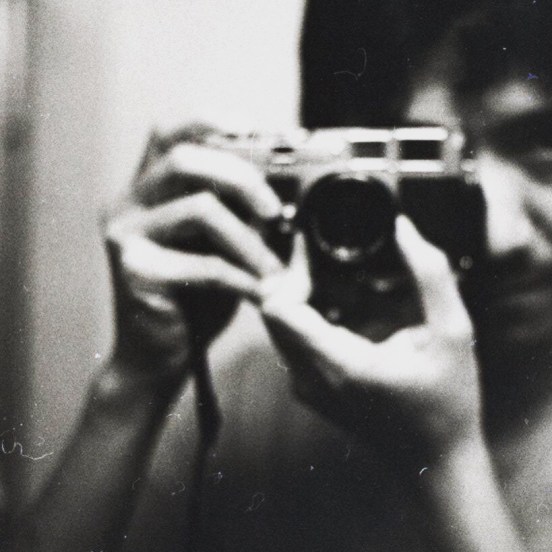
As it turns out, I had another frame that I scanned and hadn’t seen in years. I cannot locate the original negative but I’m willing to bet this photo was sequential to the above photo. The hair might look different but sometimes I part my hair out of my eyes πŸ™‚

I’m not sure if you can see it here but the “M” can be partially seen above my right middle finger. And the lens says “Leitz Wetzlar” very clearly.

The smaller rangefinder windows in the blurry photo is just an optical effect, an optical illusion.

I always tell people, even though I doubt they believe me, but my camera selfies are not a narcissistic love fest! πŸ™‚

Firstly, I’ve done them for years as a way of checking critical focus. Secondly, as in the case here, they help me remember the camera and lens I used! And the fact that people like looking at photos of cameras? Well, that’s just an added benefit!

Happy Monday folks!

Happy New Year 2019!

I know I’m like six days late on this but HAPPY NEW YEAR 2019! 😊😘

I’m working on some new projects for you all but at a loss as for where to begin!

Would you like to see something on the venerable Contax T? Even though I mentioned why the T2 is not a good buy these days, its predecessor the T is still one of my favorite shooters going back to 1996 or 1997 when I got my first copy.

Would you like an article or YouTube video on the Lomography ‘Instant Wide camera?

What happens to me is when I’m flustered by many different things, I just say f*** it and do nothing πŸ˜€

Part of the reason for the lack of postings here is I’ve been prioritizing building up the YouTube channel. I don’t have a lot of subscribers but the views are decent and the subscribers who are there are quite dedicated and so I’m thankful and grateful for that. But I do realize the “meat” of it all belongs on these pages.

Ah I’ll get it together this year! Could things get better? Sure they always could! Will things get better? As our commitment-phobic Trumpster might say “We’ll see!” 😊

I realize I say that every year! I must really be OCD! Happy Sunday camera lovers and have an awesome New Year good peeps! πŸ˜ŽπŸ“·πŸ˜˜