Photo Of The Day: “Strong Coffee”

MamZoeI

“Strong Coffee” 2015. Mamiya C330, Mamiya-Sekor 65mm f/3.5, Tri-X 400 developed in Caffenol straight scan, no enhancements. Messy, dusty, but it worked! ๐Ÿ™‚

If you’re in the blizzard zone and stuck home this weekend, I hope this will give you extra reading material ๐Ÿ™‚

I’ve been developing film for quite a few years and although I don’t consider myself an expert at all, I’m familiar with traditional developers such as Rodinal, D76, T-Max, HC-110, etc, etc.

One developer that I’ve heard about, but never tried till recently was a home brew called “Caffenol.”

This is a process where you use instant coffee, washing soda, and vitamin C powder to concoct a mix that actually develops film.

When I first heard about this years back, I laughed it off thinking it was a big joke. When I investigated further, I was totally shocked that you can develop film with instant coffee!

The photo above is a result of my first Caffenol experiment. Now I know it’s far from an award winning result, probably not the kind of result anyone wants, but to be honest with you, I’m just thrilled that it worked! ๐Ÿ™‚

MamZoeII

A 100 percent crop of the above image. I am unsure why, but I am not getting the option to show the image full size as I used to have. I am trying to get to the bottom of this and will fix it, if possible. If you could see it, you would see the glitter around the glasses well resolved.

Above is a 100 percent crop of the original scan. I adjusted the contrast levels to better show the details. I was quite amazed that the result, while messy, actually holds a lot of details!

The image was shot in 2015 with a Mamiya C330 and a banged up Mamiya 65mm f/3.5 lens that I got for $23. The film was Kodak Tri-X 400 which is my go-to for an easy to develop, classic film.

If you search the web, you will find many fine examples from Caffenol connoisseurs who have posted results much better than this.

As I said, I’m no expert at this. The hardest part is finding “washing soda” so I made it myself by heating up baking soda, not certain whether I did everything right. Also in the darkroom, I made the mistake of turning on the lights when I didn’t have cover on the tank with film in it, allowing for possible light contamination.ย Something I’d never done in all the years that I’ve developed film. Because of these issues, I was even more amazed that it actually gave me something at all!

I am now eager to experiment more and to perfect this process. However, that would mean I would have to waste a lot of rolls of precious memories so I have to be sure that each roll I process with Caffenol is really “disposable” to me, so to speak.

If you haven’t tried this process, take a roll of film that you think you could part with and try it out. It’s a lot of fun and could potentially save you money from buying traditional developers. It’s quite a kick to take the instant coffee on your kitchen shelf and turn it into a film developer, it really is! ๐Ÿ™‚

Have a blessed day and I hope you stay safe in you’re in the zone of this major blizzard.

Best, Sam

Note: I’m not sure if I’m doing something wrong or something changed with WordPress, but people used to be able to click on the photos to see a larger version, but now it doesn’t give me that option. If anyone can tell me why, I would appreciate it!

Celebrating Ten Years Of JuJu

DSC_9567JJ

JuJu @ Six Months. 2006. Nikon D1X. Cannot remember the lens, it just shows as 300mm on the exif viewer. A straight jpeg from the D1X, no treatment done. Although it was only 5mps, I really loved the D1X!

No “Tuesday Titans” today. Instead, we are celebrating a “titan” of our personal world. He is the first kid of the new generation of our family. Today, we celebrate my nephew JuJu who just turned ten recently. He was, in a way, my first beta tester for so many of the cameras that came into my possession in the years following his birth. Thanks for joining me in the celebration and for my fellow gear heads, take comfort in the captions which will reveal some the cool cameras used during this ten year period. Happy Birthday JuJu!! ๐Ÿ™‚

80313978.Y6P5wTjM.JoeJU1CPba

“Boy From NYC” 2006. Bessa R3a, CV 40mm f/1.4 Nokton Classic, Kodak BW400CN. I had just fixed the rangefinder on this camera, it was the first rangefinder adjustment I’d ever done. Shortly thereafter, I sold this camera, but now looking at the results from this combo, I kinda regret it!

124288972.KEsjHcuK.PenZoeJuJu1_SerenityCalamity

“Order & Chaos” 2009. Olympus Pen FT, Zuiko 35mm f/2.8 Pancake lens, Kodak Tri-X 400 developed in T-Max developer. Two frames from the half frame Pen FT camera showing how order can turn into chaos in a minute ๐Ÿ™‚

1614239_10202970154807201_8424783835683906259_o

“My Brother’s Keepers” 2014. Nikon D1X, 35mm f/2.4 MIR Russian lens.

10917057_10205025856438457_737518350959434799_o

“Rockabilly Ju” 2013. Fuji X-Pro 1, Canon FD 55mm f/1.2 Aspherical lens. JuJu rocks around the clock! ๐Ÿ™‚

10295047_10202961627314019_3801333893296660026_o

“Happy” 2014. Panasonic DMC-GF1, Lumix 20mm f/1.7 ASPH lens. Go ahead people, clap along if you feel like a room without a roof! ๐Ÿ™‚


The Best Camera I Never Knew Part V: The Ricoh FF-3 AF SUPER

RicohFFC

The Ricoh FF-3 AF SUPER. One of the great vintage Ricoh cameras that I’ve heard a lot about. One of the best cameras I never knew ๐Ÿ™‚

The Ricoh FF-3 AF/FF-3 AF SUPER is a 35mm point and shoot camera introduced by Ricoh in 1982.

The camera featured a fixed lens 35mm f/3.2 Rikenon lens, shutter speeds from 1/8 to 1/500th of a second. As indicated in its name, the FF-3 AF is an autofocus camera and runs on two AA batteries.

THE RICOH FF-3 AF SUPER IMPRESSIONS

The camera looks retro cool, yet somewhat ugly, but not unlike many cameras from the late 70s and early 80s. Cameras from Nikon, Canon, and Minolta from this era also have a similar look.

It’s small, but not entirely pocketable unless you’re thinking of a coat pocket. As far as I can tell, it’s an autoexposure only camera as expected from most point and shoots of its day.ย The camera also does autowind and auto rewind.

The 35mm f/3.2 is supposedly very sharp with interesting character. Many wonderful images from this camera can be found on the internet, especially on Flickr.

WHY IT DIDN’T JIVE WITH ME

Why? Why, pray tell, do you ask? Because the three of them I tried didn’t work or didn’t work properly ๐Ÿ™‚

Two suffered from “aging motor” syndrome where the autowind motor is super slow or ceases to work at all. The other one had a corroded battery compartment that I couldn’t fix. To be fair, the battery compartment issue is not likely the camera’s fault, but rather the fault of users who left batteries inside the camera for prolonged (sometimes years) periods of time.

BOTTOM LINE

Before Ricoh struck gold in the 90s with the GR-1 film camera, before they won the hearts, minds, and eyes of a large and loving cult, they were making crap cameras like this ๐Ÿ™‚

No, seriously, no offense. I’m as big a Ricoh fan as anyone, if not bigger. I’ve had more people tell me how I help trigger their purchase of the original 8.1mp GR Digital than any other camera from this GRD Review I put up a year ago. Ricoh is now a niche company that has a high degree of respect from a world-wide mass of camera lovers.

But there IS a reason why Ricoh and their Rikenon lenses were once thought of as one of the “low end” brands such as Chinon, Yashica, etc, etc. This camera is one of those reasons. I know Contax/Yashica made a lot of great cameras, so I’m not talking about that. The “regular” Yashica 35mm SLR’s were not known to be of the finest quality and had a history of reliability problems.

All that said, I’m perfectly willing to accept that I got three lemons and I’m currently looking for a usable one.

I don’t think the FF-3 AF has a reputation for a stellar lens or anything. I think most people buying these cameras just love old cameras like I do and perhaps there’s a bit of that cool nostalgia factor in there as well.

I imagined taking cool, vintage looking photos with the Ricoh FF-3 AF. I imagined that, simply out of my love for organic film photography, but knowing in my heart I’d get better pictures with an iPhone and Instagram filters than this camera.

Yet I persisted in getting three of these only to find none working properly and losing sleep trying to fix them, to no avail.

There is the FF-3 AF and a slightly updated one, the FF-3 AF SUPER. I know I have two SUPERS and one “regular” FF-3, but I can’t find it to tell you the differences, if any.ย There may be some very slight differences, but they’re pretty much the same crap cameras.

Again, there IS a reason why Ricoh was not all that well known or highly regarded before the GR-1. The FF-3 AF is probably one of those reasons and without a doubt…one of the Best Cameras I Never Knew ๐Ÿ™‚

WHERE TO BUY?

If seeking one of these cameras, and I’m not sure that’s a good idea, prices are trending at $5-30 so the low prices on these may be tempting too.ย I never spent more than $15 on these. So if you get a junker, you won’t be out all that much.

Your best source for the Ricoh FF-3 and FF-3 AF SUPER is obviously eBay. You can also find them once in a while HERE in the USED section.

Tuesday Titans: The Mighty Minolta XK Motor

DSC00181XKMotorCCC

The Legendary Minolta XK Motor of 1976. Sorry for this funky Instagram pic, I’ll probably replace it ๐Ÿ™‚

Hi everybody. Let’s start 2016 off with a bang with this ultra-rare Camera Legend, where info is scarce even on the best Minolta/Rokkor sites…

Somewhere in the deep, dark corridors of my camera memory lurks a giant. A giant that frightened and fascinated me at the same time. That giant is the Minolta XK Motor.

The XK Motor is a 35mm SLR introduced by Minolta in 1976. It was marketed as a professional camera and was Minolta’s answer to the Canon F-1 and Nikon F/F2.

The XK Motor is ultra-rare and hard to find in today’s market.

MY MEMORIES AND DREAMS OF THE MINOLTA XK MOTOR

As a kid, I still remember seeing this gigantic brute of a camera in magazine articles and ads. It was a camera that seemed frighteningly large, muscular, and complicated to a young boy. Yet at the same time, for a skinny young kid, this camera’s muscular build signaled “power” in my mind.

I wanted it bad, but I knew I’d never get one. Or so I thought…


HOW I CAME ACROSS THE MINOLTA XK MOTOR CAMERA

Fast forward some thirty plus years. About four years ago in 2012, I saw two XK Motors listed on KEH Camera in BGN (bargain) condition, priced at about $500 each. Right away, knowing the rarity of these cameras, I had to get one!

Fortunately, it was one of those rare times when I actually had enough in the bank. Sure it still hurt to part with $500, but hey man, this was the Minolta XK Motor! Gotta have it! ๐Ÿ™‚

So I got one, and if I had the funds, I’d probably have gotten the other too, but I didn’t have any funds left and it quickly went to someone else.

Though I can’t check 24/7, I do check KEH’s site fairly often. I’ve never seen the XK Motor before or since on KEH’s site. My theory is someone sold these two from their collection to KEH and it quickly went up for sale.

THE XK MOTOR BODY

When I first got the camera, I was in awe. This thing was solid, heavy, and just as in my dreams, seemingly powerful.

The body feels blocky, much like other cameras of its time such as its slated competitors, the Nikon F/F2 and the Canon F-1.

Unlike those two cameras, the motor drive is permanently attached on the XK Motor. The motor drive was capable of a (then) “high” of 3.5 frames per second at its top speed.

The camera required two EPX-76 or S-76 alkaline or silver batteries for the body and ten, count ’em, TEN AA batteries for that motor drive. With batteries installed, this camera got heavy fast!

The camera had electronic shutter speeds of 16 seconds to 1/2000th of a second and mechanical shutter speeds of 1/100 and B.

ISSUES

Shortly after I got the XK Motor, I realized it is not without issues. While my first roll of film went off without a hitch, I quickly realized there was one glaring achilles heel (or heels in this case) with this giant.

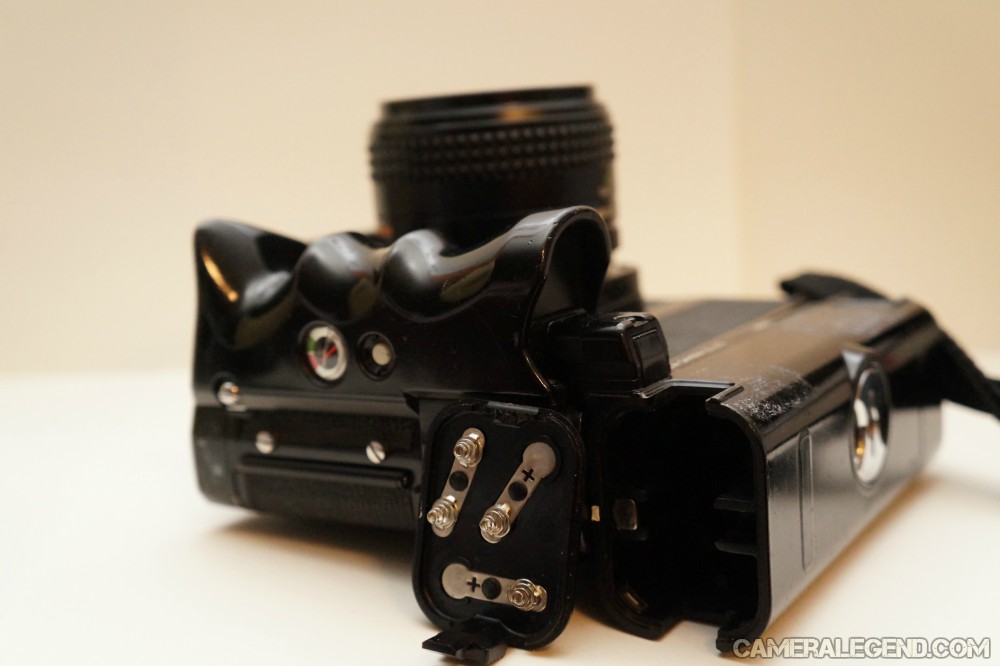
That fault is…the battery clips that hold the epic ten batteries are brittle and worse, they eventually break rendering the great “motor” portion of the camera virtually useless. They broke off on both sides of my XK Motor and believe me I did not do anything rough to cause it.

DSC00184MC

“Chipped Clips” The battery clip issue is the main thing that ruined my XK Motor experience. If seeking one of these cameras, be aware that this is an unfortunately common thing with these cameras.

And if that wasn’t enough, trying to find a replacement for these clips is harder than finding a needle in a haystack!

Sure, I have tried the old fashioned method of taping the broken clips. As you can see from the pics, that is exactly what I did but it didn’t work well. The tape would eventually come off and one time the battery compartment on one side got incredibly hot and I had to quickly remove the batteries for fear of fire.

If you think the broken battery clips were just my error, take a look at this link from KEH BLOG from 2011.

They had an XM Motor for sale in EX+ condition for $1950 with one catch…”battery door broken” ๐Ÿ™‚

WHY I SOLD THE XK MOTOR

I recently sold this camera to a private buyer who was willing to buy it as is for the same price I bought it for. The great thing about these old legendary cameras is that you could almost always sell them without much of a loss.

It may seem unscrupulous to sell the camera in worse condition for the same price I bought it, but these babies are rare and the last one I saw was on eBay where it was sold as a parts camera. Bidding went over $500, so I definitely think I gave a fair price.

It became an unusable paperweight for me and the climax of a dream that became a nightmare.

This camera could have easily become one of my “Best Cameras I Never Knew” but it’s such a rare camera that I was honored to have had a chance to hold and use one in the flesh, fulfilling one of my childhood fantasies.

X-1 XK XM DIFFERENCES

There is actually a non motor driven version of this camera. The ones sold is the USA are known as the XK and known elsewhere around the world as the XM or X-1.

While the XK Motor is ultra-rare, the standard XK/XM/X-1 are not as rare. Many people mistakenly buy these thinking they are the XK Motor, but they are not, and they do not command the same high prices.

Cool you say, couldn’t I just buy an old motor drive and turn my XK/XM/X-1 into an XK Motor? In theory, you could’ve, but sorry there was no motor drive option for these cameras which is one of the reasons the XK Motor still holds its place among the Camera Legends ofย Minolta.

BOTTOM LINE

The Minolta XK Motor was a dream camera for a young boy that turned into hard reality for a grown man.

It was Minolta’s answer to the Canon F-1 and Nikon F/F2. Unlike the Canons and Nikons, the Minolta XK Motor had one glaring and seemingly incomprehensible fault…weak battery clips!

Despite their ability to make some of the world’s finest cameras and lenses, thereย ISย a reason why Minolta never made it to the top in the world of Canon and Nikon pro bodies. A flaw such as weak battery clips is totally unacceptable for a professional grade body such as this.

If you search the internet for the XK Motor, you will find precious little information from actual users. You will not see much on the battery clip issue either. Why? Because there is not much info on this camera in general, it’s that rare.

In usable form, the Minolta XK Motor is a dream camera to hold and use. It was a culmination of Minolta’s dream to rule the professional camera world. It was a dream ruined by flawed execution, but that doesn’t matter in the end. The Minolta XK Motor represented the power of Minolta and what could have been. It is, without a doubt, a Camera Legend.

WHERE TO BUY?

If looking for an XK Motor, and I’m not sure that’s a good idea, prices are very hard to calculate due to its rarity on the market.

I got mine for $500 at KEH Camera in Bargain condition. But they also had one five years back in EX+ condition for $1950. The last one I saw on eBay was an “as is” parts camera which went for over $500 in 2013.

So I would say in pristine working condition, these cameras could easily fetch anywhere from $1500-2000 and maybe more.

If you want a taste of the XK Motor without using a fine toothed comb, you could easily get the ‘regular’ XK/XM/X-1. Prices for these can go anywhere from $50-300. I would not pay more than $100 for one. In fact, I got one of these for $56 bucks! ๐Ÿ™‚

Note: I do have pics from my test roll with this camera and the 50mm f/1.2 Rokkor. But it’s not on a hard drive, it’s on a photo CD and I can’t find it. I do not think these test pics are worthy of your time, but I am still looking for them and may or may not post them. But it is proof that at one time, the Mighty XK Motor worked and gave me some nice pics!


Tuesday Titans: The Pentax MZ-S

PMZSCPSII

The Pentax MZ-S of 2001. Perhaps the best 35mm SLR Pentax ever made.

The Pentax MZ-S was a high end 35mm autofocus SLR introduced in 2001 by Pentax Corporation.

The MZ-S was the last 35mm flagship film SLR from Pentax and wasย marketed as a professional camera.

THE MZ-S CAMERAย 

The first thing about the MZ-S that you’ll notice right away is the somewhat odd and futuristic look to this camera. The MZ-S was apparentlyย supposed to be the Pentax “MZ-D” which was to be the first Pentax full-frame digital SLR and at that time, it would’ve been the first Pentax DSLR full-frame or not. The prototype was shown in 2001, but never materialized in production.

In many ways, the MZ-S looks and feels like a modern digital SLR. Strong, sturdy, but feels somewhat lighter than a comparable film camera such as a Nikon F-100. If the MZ-S was indeed a digital camera, it’s my opinion that this would be the coolest looking Pentax DSLR ever!

With Ricoh/Pentax’s recent (actually a couple of years now) teasers on a full-frame 35mm digital and thinking back to the MZ-D, it does make you wonder nearly fifteen years later on now, will we ever see a full-frame Pentax DSLR?

Of course, we know they have the technology, but one has to wonder what’s taken them so long. Fifteen years and counting guys ๐Ÿ™‚

Anyway, back to the MZ-S. The body is strong with a magnesium alloy chassis and to me it looks great, especially with the BG-10 battery grip attached. But I have heard differing opinions.

This is a story within itself, but aside from their classic M42 and K mount cameras, Pentax has not been known for making the prettiest looking cameras in the modern era. I’ve heard people say that Pentax AF cameras look “atrocious” and “horrific” to, on the other side of the coin, “fantastic” and “magnificent.”

There’s not much of a grey area when it comes to Pentax AF bodies. You either loveย them or you hate them.

The Pentax MZ-S with the BG-10 battery grip attached has a very aggressive look, not unlike the Canon EOS-1 I profiled earlier. In an odd way, it does look like a Pentax version of a Canon 1 Series camera.

Unlike the EOS-1, the MZ-S feels noticeably lighter. And with the grip off, it is a very nice and more portable body. While marketed as a pro body, the MZ-S actually feels closer to a semi-pro or advanced enthusiast class body such as the Nikon F-100 or Canon EOS-3, although I must say these two cameras do feel more rugged to me than the MZ-S. The MZ-S however looks more interesting than the other two ๐Ÿ™‚

The MZ-S featured a 6 point AF system and has a shutter speed range of 30-1/6000s and a flash synch of 1/180s. The camera has mirror lock-up and can do auto-bracketing and multiple exposures.

The MZ-S without the battery grip runs on two lithium CR2 batteries. With the BG-10 attached, the camera will run on four AA batteries.

HANDLING AND OPERATIONS

The MZ-S feels excellent in the hand. Solid, tight, but not too heavy. Controls are well laid out for the most part, but it’s an odd mix of good and confusing.

There are dedicated buttons and switches for AF, Drive, Metering, etc, etc. There is also a dedicated MF/AF switch near the lens mount. When you have clearly marked dedicated dials and buttons, it’s always a good thing.

The cool circular LCD actually has a dial around it that serves as your controller for changing shutter speeds, modes, etc. The funky looking dial on top left of the camera is actually two dials, for ISO, exposure compensation, auto-bracketing, and multiple exposures. This left dial is probably the most confusing part of the camera, but it all makes sense once you get to know it. The camera also has 19 custom functions. This is truly a pro spec’d camera!

PMZSIII

The top deck of the MZ-S. A strange mix of good yet confusing controls, highlighted by that top LCD in a cool circular dial. That’s Pentax for you! Sorry for the dust. I could, if I tried, maybe take a nice studio type shot of this, but I live in the real world and in the real world, there’s dust ๐Ÿ™‚

This camera offers quite a comprehensive feature set and I don’t feel like writing a manual on it. But if you want to figure out all the MZ-S can do, you will probably need a manual for this camera.

While you can figure out many things without an instruction manual, again I will say that I think you do need a manual to completely figure this camera out so it’s not the most intuitive camera I’ve ever used, but to be fair, most complex electronic cameras of the modern era fall in the came category.

PERFORMANCE

imgMZSZoeSmile1051 copy (1)

“Sunday” 2010. A smile to transform an ordinary Sunday into something extraordinary ๐Ÿ™‚ Pentax MZ-S, Pentax FA 35mm f/2 AL lens, Arista Premium 400 film.

The Pentax MZ-S performed very well in the several rolls I’ve shot with it. The camera was quick to focus, albeit a little noisy when focusing. It will sometimes hunt in low light and the noise can be a little disturbing. AF was for the most part accurate.

MJ

“Joe Young” 2010. Pentax MZ-S, Pentax SMCP-FA 77mm f/1.8, Arista Premium 400.

I’ve only used two AF lenses with this camera. The SMC Pentax-FA 35mm f/2 AL, which is an excellent lens, and the SMCP-FA 77mm f/1.8 Limited, which is a superb performer by any standards.

The MZ-S offers six segment, multi-pattern, center-weighted, and spot metering. I usually leave it at the six segment setting where exposures are usually spot on.

MZSZC

“Barbizon” 2010. A star in the making? ๐Ÿ™‚ Pentax MZ-S, Pentax SMCP-FA 77mm f/1.8 Limited, Arista Premium 400.

BOTTOM LINE

Pentax has always been a bit of an eccentric in camera world. They have always been the under-dog company that offered a much needed alternative to a world ruled by two or three big dogs.

They created a legacy that includes not only great 35mm cameras and lenses, but they have also been a force in the medium format world with iconic cameras such as the Pentax 6×7 and now in the digital era with the Pentax 645z, beloved by today’s pros. That’s something neither Canon nor Nikon has done. A true Camera Legend company, no doubt.

As far as camera collecting, the Pentax M42 mount cameras and lenses are hugely popular as well as K mount manual focus bodies and lenses. The Pentax AF 35mm film bodies, not so much.

But the MZ-S is different. It is a highly capable body and in my opinion, perhaps the only Pentax 35mm AF body worth collecting. I hope I’m not offending any Pentaxians out there, but cameras such as the ZX-5n and *ist film bodies, while very capable, are hardly what one would consider collectible.

In recent years, Pentax has had a resurgence of popularity, thanks in part to its merger with Ricoh and great cameras such as the Pentax K-5 of 2010.

The MZ-S may have been the most full-featured and capable film SLR that Pentax ever created. It is a well designed camera that can perform to a very high level and has almost everything you might need. And of course, it is capable of using the fantastic Pentax AF and manual focus lenses, one of the largest and most abundant collection of lenses available for any system.

The Pentax MZ-S may have started its life as the would-be Pentax full-frame digital that never materialized, but ended its life as the last great Pentax camera of the film era. It is without a doubt, a Camera Legend and one of the best cameras ever made by Pentax.

WHERE TO BUY?

If looking for the MZ-S, prices are trending at $150-350, with average prices of around $250 or less. There was a time when these cameras commanded close to $400, but it seems the prices have fallen on these babies in recent years.

You can find them quite easily on eBay, where most of them are being sold from Japan.

KEH Camera has them from time to time, prices are usually a bit higher there, but you would probably get the best one for your money, plus a great warranty and return policy.

I got my first one there, sold it and missed it. Found my second one at Adorama in their used section for around $200 in EX+ when they were going for over $300 at the time. And you can sometimes find a good deal from sellers on Amazon.

Note: Sorry a little late with this post, but I got it in before Tuesday was done ๐Ÿ™‚

Doing this blog is a labor of love, but these late nights were killing me and I really needed to get myself together. Thanks for your continued support my friends, appreciate it!


Tuesday Titans: The Canon EOS-1 Pro Film Camera


CEOS1

The Canon EOS-1 professional 35mm SLR of 1989. The EOS-1 is a titan with a tank like body, super speedy AF, and a futuristic design. ย Aย true Camera Legend among 20th century cameras.

The Canon EOS-1 is 35mm SLR introduced by Canon in 1989 as the flagship camera of their (then) two year old EOS system.

Canon is no doubt one of the legendary names in the camera world. Despite non Canon fans (usually Nikon fans!) attempting to take jabs at Canon by saying things such as “Canon’s main business are its copiers and not cameras” or “Canon’s bodies are made of plastic and feels cheap” everyone that I know equates Canon to cameras first and foremost.

And the camera division is apparently a source of pride for the company. Even though, yes, they make way more selling copiers and other stuff to corporations, they do put a lot of that money back into creating awesome cameras that are often on the cutting edge of technology.

One of the greatest things about loving all cameras is that I’ve never been accused of being a fanboy, not that I know of anyway ๐Ÿ™‚

Anyway, I’m rambling a little bit here, but the main point is that since the 1930’s Canon has had its share of legendary cameras. The Kwanon of 1934, the Canon II of the late 40s and early 50s, the Canon 7 and 7s rangefinders of the 60s, the A-1 and F-1 of the 70s, the T90 of 1986 just to name a few.

Canon is no stranger to making all kinds of cameras. However in 1987 Canon set out to do what many of their loyal customers thought to be the unthinkable; create a whole new series of lenses and cameras and letting go of their FD system whichย enjoyed a tremendousย following and passionย from professionals and enthusiasts alike. And with the introduction of the EOS-1 in 1989, Canon set out to create a new legend. Would their plan work?

dscf0648canont90mkiic

The Canon T90 of 1984 and the EOS-1D Mark II of 2004. The predecessor and successor of the EOS-1 respectively.

This was a very risky move. To take (in 1987) the nearly twenty year old, proven FD system and not only replace it with a whole new system, but also to convince their huge and loyal customer base that they should buy into the new system.

And the new EOS lens mount was NOT compatible with the FD system and vice versa. So in essence, Canon had to say…’Guess what guys? You can’t use all those lenses and accessories you’ve acquired for your A-1, AE-1, F-1, etc, etc if you buy the new EOS system’

As to be expected, it was a hard sell at first. From all I have read on this, many loyal FD fan were totally bummed, even angry at this move. They felt betrayed that their gear would now be “obsolete” and unusable on the new EOS system.

And you have to remember back then was not like today where you could use your legacy lenses on many different cameras with the right adapters. Adapters that allowed the use of one mount to a different mount were precious and few back then. I know of people who switched to Nikon because they were so outraged!

WISDOM OF FORESIGHT AND THE POWER OF TIME

Despite the initial outlash, now nearly thirty years later, I believe that time has proven Canon right in their decision to change from the FD mount to the all electric EOS mount.

With the EOS mount came cameras with super speedy autofocus, and such innovations as quiet USM “ultrasonic” motor lenses, cameras with electronically controlled wheels and dials, offeringย sophisticated levels of control customization. Manyย of these features we see on almost all serious DSLRs today. The EOS lens mount was also large enough to make way for some very unique L lenses such as the EF 50mm f/1L, the 85mm f/1.2L, and 200mm f/1.8L.

I believe Canon, as well as Nikon and other manufacturers saw the promise of the future with the runaway success of 1985’s Minolta Maxxam 7000, the first truly successful autofocus 35mm SLR.

Looking back, you have to give Canon, its camera designers and engineers credit for having the courage and foresight to create a whole new system that not onlyย embraced the technology that was available then and but would also be able to take advantage ofย technology yet unseen in 1987.

THE EOS-1 FILM CAMERA

Two years after the introduction of the EOS system and the enthusiasts’ friendly EOS 650 camera, Canon decided the new system was successful enough to introduce their new pro flagship, the EOS-1 professional system camera.

The EOS-1 is a big brute of a camera and was very much reminiscent of the T90 of 1986 in its design.

However, being designed with professional photographers in mind, the EOS-1 was built to a much higher standard with an extra tough aluminum frame wrapped inside a polycarbonate plastic shell, and weather proofed with o rings, seals, and gaskets.

I remember in the mid 1990s reading an article on the Canon EOS-1 vs the Nikon F4s. I can’t recall if it was Modern Photography or Popular Photography magazine, but it was a great article on the pros and cons of both cameras, and included opinions from two professional photographers who used these cameras for their livelihood.

I also remember at that time, opinions and doubts about Canon’s use of polycarbonate materials on their pro bodies, especiallyย from “heavy metal” camera lovers and pros.

Today, with the power of time, polycarbonate and other hard plastics have been proven to be as durable, if not more so, than the all metal bodied cameras of yore.

The EOS-1ย is an all electronic camera and it operates on one 2CR5 battery. It will not operate without a battery. The electronics in the EOS-1 series of cameras have stood the test to time. The shutter speeds range from 30 secs to 1/8000th of a second and the camera can do a maximum of 5.5 frames per second with the optional Power Booster E-1. The viewfinder has 100 percent coverage. The camera had only one autofocus point which was cross-type and in the center of the frame.

USER EXPERIENCE

I got my first EOS-1 in the mid 90s. I still remember vividly the first time I held the camera. It was one of those magic moments on my camera journey!

I remember the sense of pride and amazement that I had in my possession this huge and powerful pro Canon in my home. Holding my first pro grade body ever was a feeling that, many many cameras later, comes very rarely today. It would take a lot to excite me these days ๐Ÿ™‚

After I got over the initial excitement, I was quickly disappointed to find that the EOS-1’s AF, which was very fast and speedy outdoors and in good light, struggled and hunted in low or even moderately bright indoor lighting.

On top of that, the single central point AF did not have the red light indicator. That feature came with the EOS-1’s 1994 successor, the EOS-1n.

After a few months of use, I quickly sold the camera and moved up to the EOS-1n which was a much better camera in all aspects.

imgCan1Zoe293

“The One” 2012. Canon EOS-1, EF 50mm f/1.8 lens.

THE LEGACY AND LEGEND OF THE EOS-1

Despite my disappointment with the EOS-1, I eventually got another one when the prices became real cheap.

As with many other cameras, I can now appreciate its strengths while avoiding or trying to avoid its weaknesses.

Armed with a very strong selection of Canon EF lenses, the EOS-1 helped Canon to finally take over their rival Nikon in the 1990s as the professionals choice. It would take Nikon many years later to catch up and regain equal footing.

With the EOS-1 came many innovations such as dual input dials, wheels, and the use of polycarbonate and hard plastics on a professional grade body. All these features have made its way to manyย mid and high end cameras that came after the EOS-1.

The Canon EOS-1 is a true Camera Legend of the modern camera world. The EOS-1 is not only legendary, but has historical significance as the first pro body of the EOS line.

All the pro film EOS bodies that came after the EOS-1, including the 1n/1V/3 are all much better performers having taken all the best features of the EOS-1 and refining it to much higher levels, but if you want to experience that early EOS experience, warts and all, and want to pay the lowest price you can for a pro EOS film body, then the EOS-1 is a great choice, even if only to appreciate its design and/or to appreciate the technology of its day.

Note: The Tuesday Titans series was created to profile the huge “Big Guns” or monster sized cameras.

WHERE TO BUY

If shopping for an original EOS-1 film camera, prices are trending from $50-150 with an average under $100.

For a safe purchase with a good return policy, both Adorama in their USED section or Amazon periodically have the camera in stock.

IF YOU’RE JUST READING THIS AND PREFER MODERN CANON CAMERAS

Our friends at Adorama have some great deals for you, just in time for the holidays! Please check the links below to see the savings.

Canon EOS Rebel T5i DSLR Camera with EF-S 18-55mm f/3.5-5.6 IS STM Lens – Special Promotional Bundle – $399 after IR/MIR

BUY HERE

Canon EOS Rebel T5i DSLR Camera with EF-S 18-135mm f/3.5-5.6 IS STM Lens – Special Printer Promotional Bundle – $499 after IR/MIR

BUY HERE

Canon EOS 70D Digital SLR Camera Body – Special Promotional Bundle – $679 after IR/MIR

BUY HERE.

Canon EOS 6D DSLR Camera Body with Special Promotional Bundle – $1449 after IR/MIR

BUY HERE

The Best Camera I Never Knew Part Four: The Exakta 66 Mod III Medium Format Camera

ModIICCC

The Exakta 66 Mod III. A dream camera of West German/Russian heritage and one of the best cameras I never knew ๐Ÿ™‚

Sometimes your lust over-rides your head and clouds your better judgement. This was certainly the case with the next camera in “The Best Camera I Never Knew” series.

THE EXAKTA 66 MOD III

The Exakta 66 MOD III (model III) is a medium format camera introduced in 1997. Though the original Exakta 66 was produced by West German company Ihagee, the exact origins of the MOD II and MOD III are somewhat unclear.

The main thing you need to know is that all these Exakta models are a variation of the Pentacon Six, so they are all 6×6 mechanical SLR cameras that use 120 medium format film. They resemble, from afar, the Pentax 6×7 and look like a giant 35mm camera on steroids.

There is a great website http://www.pentaconsix.com that will tell you the differences between the models, and anything else you might want to know about them.

In the context of my story here, just know the MOD III was considered the “ultimate”ย as far as variations of the venerable Pentacon Six goes. It was the last model so it technically had all the upgrades and enhancements that was done to the basic Pentacon that it’s modeled after. One enhancement was the inclusion of a mirror lockup.

Another reason for its desirability is that the Exakta 66 Mod III is sometimesย paired with the superb 80mm f/2.8 Schneider Xenotar lens, though the Exakta 80mm f/2.8 or 80mm Russian Volna or Biometar lenses are more commonly seen.

WHY IT DIDN’T JIVE WITH ME?

Ok, so in 2013 I came across the Exakta 66 Mod III body on KEH Camera’s website. A used body only for around $300.

I hesitated at first, knowing that it was basically a glorified Pentacon Six or Kiev 60, but the camera lust took over me and I thought I had to have it! That, despite the fact that I already had a Pentacon Six TL and a Kiev 60. Both bodies combined, cost me less than the Exakta alone!

I’m drawn to extremes…the best camera, the worst camera, the last model, the smallest model, the strangest one…you get the idea ๐Ÿ™‚

Anyway, I said to myself…if I get the Mod III, I won’t need any other Exakta or Pentacon. And perhaps I could cut my losses by selling the Pentacon and Kiev once I got the Exakta.

Ok, this is getting too long, so to cut to the chase…

I got the MOD III. I press the shutter. The mirror goes up. Stays up. No big deal. If I recalled correctly, the Pentacon did that too. All that it requires is for you to wind the lever and the mirror comes back down. So I did that.

Surprise! The film advance lever won’t move so the mirror won’t come back down!!

So without damaging the camera, I was trying all the emergency remedies I knew. Tried to gently move the mirror down, it didn’t move. Tried to toggle the mirror lockup, no go. Tried to press the shutter release again, nothing.

I then took out my Pentacon Six and pressed the shutter release. Mirror goes up. Stays up. I wind the film advance, mirror came back down. Now I knew for sure something was wrong withย the Exakta.

Knowing that I would probably have to return it to KEH, I stopped myself from messing with it further. I did some research online and found the email of a noted authority on repairing these cameras. For the sake of privacy, I will refrain from leaving a name, but if you need one of these cameras repaired drop me a line and I will give you his contact.

Anyway, his advice was to first try to gently bring the mirror down with my fingers which I had already done. I don’t remember everything else he told me, but he tried the best he could to help me through email and I appreciated that very much, but nothing worked.

Finally, he told me I should return the camera because they were well known to have “issues” and he had seen a fair share of them for repair. He said these cameras go bad quite easily and parts are no longer available and/or are hard to find.

I believe him, though I wished I had seen something online about that before I purchased it. I did not find much negative on this camera in my pre-purchase research. Indeed, I did not find much positive feedback either!

I recall finding only a few nice shots of the camera on Flickr from some proud owners, but other than that there wasn’t much as far as real world users. In fact, if you did a search now you will see a few of the pretty pictures I’m talking about ๐Ÿ™‚

THE REVELATION

Ok, so Iย reallyย wanted to keep this camera! Never mind that I didn’t have the elusive 80mm f/2.8 Xenotar. I could use the Biometar and other Pentacon Six lenses I already had first.

So before I wrapped it up to return to KEH, I decided to take one last shot at making this thing work. I played with the advance lever. I felt that this was the root of the problem. I had a thin nail file and I poked it in the thin sliver underneath the film advance lever. It hit something and wallah…

The film advance moved and the mirror came down! ๐Ÿ™‚

But, this does not have a happy ending. When I pressed the shutter again, the mirror became stuck once again. The nail file worked once again, ย but there was no way I was going to use the camera if I had to do this for every shot!

So back it went to KEH, and before I shipped her off, I took this shot. I should’ve taken more, but I took this at a Fedex Kinko and making a review of this camera two years later was the last thing on my mind.

To show you how much I wanted to keep this camera, I even told KEH if they could repair it, I would take that over a refund. They tried, but in the end they gave me a refund.

Just want to put in a good word about KEH Camera. They are the best used camera dealer out there, I even prefer them over eBay because of their great products, prices, and return policy.

Even though this Exakta 66 Mod III turned out to be a dud, I cannot blame them. Things happen and especially so when you’re dealing with the kind of photographic volume that they deal with on a daily basis. I’ve been buying from them for maybe twenty years or more and over 90% of my purchases have been satisfactory or better. They took this camera back with no hassles.

BOTTOM LINE

If looking for one of these, and I’m not sure that’s a good idea, prices are trending at over $1000 for the body and Exakta, Volna or Biometar 80mm lens and probably quite a bit more with the 80mm f/2.8 Xenotar lens.

I am certainly no camera repair expert and I am sure it’s a good possibility that I just got a bad sample and there’s a lot of good working models out there.

However, based on the information I got from the veteran Pentacon/Kiev/Exakta camera repair man, I would have to say Exakta 66ย cameras are not a good buy in my opinion.

You are better off with a Pentacon Six or Kiev 60. They are not without issues either. Many have the same problems with film advance, film spacing, etc. However, they are much cheaper than the Exaktas and parts more readily available should you need a repair.

The Exakta Mod II and Mod III may be cooler, prettier than the brutes that the Pentacons or Kievs are, but they are in essence the same cameras.

I knew this before I made the purchase. However, I went ahead and bought it anyway. I should’ve listened to my head but as Emily Dickinson and Woody Allen said…”The heart wants what it wants” ๐Ÿ™‚

If you’re looking at the Pentacon Six or Kiev cameras, then the Exakta 66 Mod III is the ultimate medium format camera from that West German/Russian/Eastern European heritage.

However, it gave me nothing but headaches and wasted time and became one of…the Best Cameras I Never Knew.


The Best Camera I Never Knew Part III: The Contax Tix APS Film Camera

DSC01104sC

The Contax TiX from 1997. Perhaps the most beautiful Contax point and shoot, but doomed by being born an APS film camera.

I have to admit I’m a big fan of Contax point and shoot film cameras from the 90s. There was just something special about the whole series.

While I stand by what I wrote in earlier articles about the fragility of Contax cameras and their brittle electronics, I loved the concept, the feel, and execution despite the feeling that I could never really rely on them completely.

THE CONTAX Tix

The Contax Tix (pronounced T…i…x as opposed to Tix, I think!) is a high quality point and shoot camera introduced by Kyocera in 1997.

The camera featured a Carl Zeiss 28mm f/2.8 Sonnar T* lens and used the infamous and now defunct APS (Advanced Photo System) film system.ย The camera was the smallest of the Contax film point and shoots.

The camera has autofocus, a shutter speed range of 15 seconds to 1/1000, and came with a data back for date imprint. It was powered by one 3V CR-2 battery.

WHY IT DIDN’T JIVE WITH ME?

The last two cameras I profiled (Rolleimatic and Rollei A110) didn’t jive with me because they didn’t work.ย That was NOT the case with the Contax Tix.

A little history…I got my first Contax point and shoot, the original Contax T, in 1997. That was a superb little manual focus rangefinder and I got some wonderful shots from that thing. Basically, after the Contax T, I was hooked on Contax for a while!

I got the Contax Tix some time in the mid 2000’s, mainly as a curiosity and to add to my collection. I did not expect to use it often because even at the time of the introduction of the APS film system in 1996, I was never really interested in that format. Even back then, I wondered why would anyone bother with this over 35mm?

The 35mm format already had its limitations vs medium and larger formats and I felt like APS was a step backwards.

The negatives were smaller and despite the stuff you were able to do with it, ie, the three image formats, 16:9, 3:2, and 3:1 aspect ratios, as well as the quasi-panoramic mode, I wasn’t into it. I just thought they were gimmicks, but even if they were useful to some, I would take the larger negative of the (already relatively small) 35mm standard over APS any day.

So back to the Contax Tix. Yes, the camera worked and worked well. I used it for two or three rolls of snapshots expecting good quality, but most of the shots from this camera looked excellent!

I’m sorry I have no pics to show you now because as mentioned in the last couple of postings, I am without my main working computer and using a 10′ Chromebook. I would still need to scan these prints.

My assessment of the 28mm f/2.8 Zeiss Sonnar on the Tix is this…The lens is excellent, as expected. It is very sharp. Not as bitingly sharp as the lens on the Contax T3, but still sharper than most point and shoots. But my favorite part is that the lens seemed to have more of a classic look, a soft/sharp kind of thing like the 38mm f/2.8 Sonnar on the original T or T2. So, in my opinion, the lens on the Tix was in between that of the T3 and T/T2. That’s almost perfection right there!

So the camera itself was never a problem. The fact that it used APS film was what didn’t jive with me and why I got rid of it.

If looking for one of these, prices have been trending steady for years at a low of $70 to around $150 with an average of around $90.ย The camera came in silver or black which is a bit more rare.

If I were to seek one out today, I don’t think it would take me too long to find one. And there are apparently places that will still develop APS film if you send the film out to them. But I’m already dealing with enough dead or outdated systems like Polaroids, 127mm, 110mm, etc that I wouldn’t bother with APS film right now.

BOTTOM LINE

The Contax Tix is a beautiful, jewel-like camera. I feel that this camera could’ve been THE best of all the Contax point and shoots, but unfortunately it was and will forever be hindered by the format it was born with, the APS film system, which is probably one of the biggest flops in film history.

Now before any APS film fans get mad at me, I want to say the concept, and indeed the quality of APS film was not bad. If I recall correctly, there were even some APS films that equaled or exceeded its 35mm equivalents in magazine tests.

In many ways APS was “pre-digital” film. It wasn’t designed for ultimate quality, but instead was made for easier development (with machines specifically designed to take APS film, of which one can guess the companies also hoped to make money selling) and promised smaller, lighter cameras. It foresaw almost all that we see in digital point and shoots today!

But APS wasn’t friendly for the home developer. I’m sure someone must have done it, but I haven’t met anyone who actually home developed APS film. You actually had to bring that film into the store as each film cartridge was locked and coded. The main problem for APS film was timing. It was introduced in 1996 right around the time the first wave of digital cameras were coming in.

In only a few short years it was killed by digital, but somehow managed to hang on till 2011 when Fuji and Kodak, the last two APS film manufacturers ceased production of this film forever.

Again, in many ways, APS had some key concepts that made its way into digital such as switchable aspect ratio, smaller cameras and lenses, and of course APS lives on in our memories by the APS-C sensors which is approximately the same size as APS film. This is the lasting legacy of the APS film system I guess.

The Contax Tix was one of those cameras that I loved as a camera. It had a wonderful lens and beautifully small proportions. The Tix is probably at the apex of APS point and shoot cameras. It is no doubt a camera that added to the Camera Legend of Contax/Yashica.

It is a camera which was only held back by the APS format that it was created for and a camera of which I was never able to realize its full potential. The Contax Tix is a superb camera that unfortunately became one of…the best cameras I never knew ๐Ÿ™‚

Note: Still waiting for my Mac in repair, but the show must go on! While I have created a workflow with this Chromebook, I have noticed it is becoming painfully slow the more I use it. Thanks to all who continue to visit, I appreciate it, and I continue to write about cameras for you my friends.

The Best Camera I Never Knew Part II: The Rollei A110

DSC01007A110CA

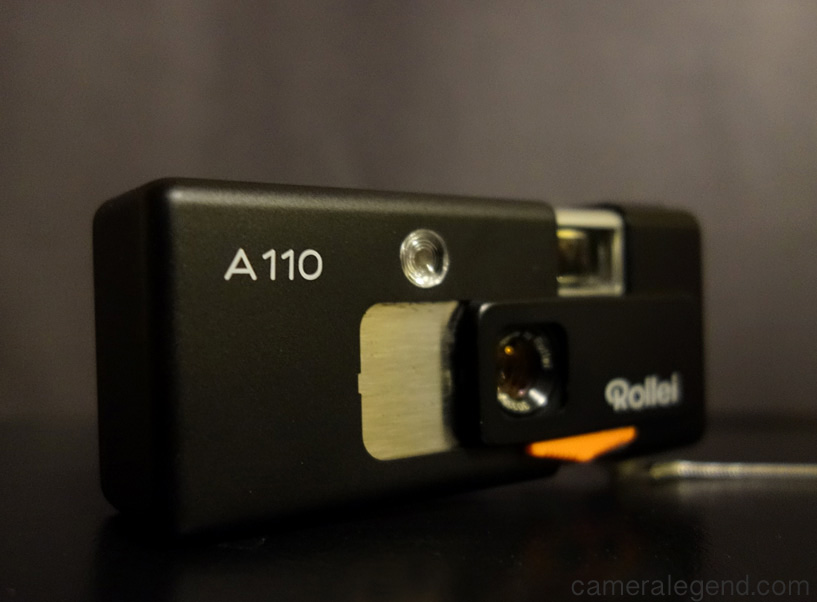
The Rollei A110. One of the Best Cameras I Never Knew ๐Ÿ™‚

I will have more from this year’s PhotoPlus Expo I promise you, but today I’m going back to the core of this site, which is classic, collectible, and interesting cameras.

The first in this series was a camera from Rollei called the Rolleimatic. It was a camera designed by Rollei camera design legend, Heinz Waaske.

Today’s “best camera I never knew” is also…a Rollei! And also designed by Mr. Waaske and his design team ๐Ÿ™‚

It is called the A110 and it is a super cool looking miniature, pocket camera that takes 110 film. I know a lot of people who think 110 film is extinct, but you can still readily get it through Lomography or Amazon.

Lomography will also do the developing if you send the film to them or drop it off in one of their stores.

THE CAMERA

The Rollei A110 was introduced by Rollei in 1975.

The camera is a funky little thing. The camera relies on scale focusing and has a focus range of about 3.2 ft to infinity. There is an orange focusing slide below the 23mm f/2.8 Tessar lens. In the viewfinder are symbols to give you an idea of what you should choose to focus on depending on how far away your subject is. The symbols include one person, a group of people, and a mountain (infinity).

Pulling the camera “apart” and closing it advances the film and cocks the shutter. This is definitely a Waaskeย design trademark!

The camera is auto exposure only and originally took a 5.6v PX27 battery. The modern day replacement for the battery is a S27PX silver battery that is 6 volts. This small difference could effect the exposure, but with the wide dynamic range of most films you should still, in theory, get a usable shot.

WHYย IT DIDN’T JIVE WITH ME?

Why? Why you ask? I got two of them from eBay. Both didn’t work! ๐Ÿ™‚

The sellers swear they were working, but I suspect both sellers did not know much about the camera. Many are probably found in their parents or grandparents camera collection and being auctioned off by people who have no idea what they are selling.

Fortunately, I got both of them cheap. First one for ten dollars, second one fifteen. If seeking an A110, they usually run from $10-50, with an average of around $30. They usually come with a presentation case and a cool chain. If you’re lucky, you can get the whole shebang with presentation case, leather case, chain, and flash.


WHY BOTHER?

With the exception of hardcore film lovers, and I do count myself as one, this camera doesn’t make a lot of sense.

It takes 110 film which is not widely available and of which development is only available in select speciality stores.

The image quality will not exceed what you can get with 35mm film or even today’sย higher end cell phones.

So why did I want one? First, I am a camera hunter and I love old, classic cameras, and even more so if I can find them cheap. The A110 fits that bill. The very first camera I ever used was my Mom’s Kodak 110 camera from the 70s, so there’s a bit of nostalgia in it too.

Secondly, I’m a fan of Tessar lenses, so again, the A110 fits that bill. And lastly, even if the image quality would be less than 35mm, the A110 could possibly give me a unique film look, which is something I’m always after.

So guess what? I’m on my third A110, which I got for $30 and this one IS working! Got film in it now, but it is unfinished. Then when the film is done, I still have to send it out for developing and that might take a while.

So until that day when I can see the results from the quirky, eccentric, classic camera, the Rollei A110 will remain…The Best Camera I Never Knew ๐Ÿ™‚

Note: If you want to see a great review of a WORKING sample of this camera, please check out this review at DOWN THE ROAD a great blog by Jim Grey who also reviews classic cameras with excellent photo samples, as well as elegantly and honestly sharing his personal life experiences. It’s a great blog worth checking out!

PhotoPlus Expo Show Report I: Hands On With The Leica SL (Typ 601)

Ho! There she is…

photo-36 copy 3

Hands on with the Leica SL (Typ 601) and Vario-Elmarit 24-90mm f/2.8-3.5 ASPH at PhotoPlus Expo in NYC. As I handed the combo back to the Leica representatives, I thought of Biggie’s immortal words…”It was all a dream” ๐Ÿ™‚

I’ve been going to PDN’s PhotoPlus Expo show in NYC every year since 2007 to check out the latest and greatest gear. High on my list of priorities this year was to get a glimpse and hopefully try out Leica’s new SL (Typ 601), their new 24mp, full-frame mirrorless system camera.

As I approached Leica’s booth, a little anticipation came over me. I don’t know why, maybe it’s the Leica name, mystique, “German Heritage” or what have you. I was a little worried that I, a mere peon, would be “snubbed” by the people representing this Camera Legend.

I need not have worried. The Leica reps were among the nicest people at the show! Certainly a lot nicer than the Nikon rep I ran into, but I’ll leave it at that for Nikon.

Anyway, I asked the Leica representative if I could try the SL and he handed the camera to me right away.

I actually picked up one with a smaller Leica T lens on it, and he said, “Take this one better” as he handed me the SL and 24-90mm f/2.8-4 Elmarit, which is their full-frame setup.

LOOK, DESIGN, FEEL AND USE

The camera, together with the zoom lens, felt very solid. It did look like a Sony A7 series, but was larger and felt much beefier.

The materials used to cover the camera body felt very nice to the touch, grippy and comfortable.

DSC01035Cams

“The Last & The First.” From left, Leica’s S (Typ 007) digital Medium Format system, the Leica R8 (mine!) and the Leica SL (Typ 601). I asked the Leica representative if I could put my R8 next to the SL and take a photo of them together. He said yes and liked the idea so much, he asked if he could take the same photo! Of course, I said yes ๐Ÿ™‚

The design and controls are very minimalist, very Leica. There were some buttons which I’m not sure were labeled, which could be a problem in usage, and I’m not sure this was a pre-production model or not. If it is, I would hope they will have better labeling and indicators on their final production model cameras.

The view in the EVF looked great. Just like the Sony A7 series, it was very sharp and easy to see. The AF was very fast and accurate on first impressions and easy test targets. If I had more time with it, I probably could’ve selected harder to focus subjects, but time was of the essence so I didn’t have that luxury.

THE LENS

The Vario-Elmarit 24-90mm f/2.8-4 ASPH was huge. If was big and beefy. You have to wonder why in today’s world, a zoom lens of this range has to be so large and heavy.

The zooming action was smooth and the lens focused very fast and accurately on the SL under the bright shows lights of the expo.

As I understand it, this lens has built-in optical stabilization which is always a great thing to have. The Leica representative stated that this lens could do macro mode on both ends of the zoom range, which is quite unique and something you don’t see in many lenses.

As a prime lens lover though, I did ask the Leica representative if they had any primes in the works for this camera.

He mentioned a 90-280mm tele-zoom, and then stated they were going to have a 50mm f/1.4 Summilux lens for this camera that will “set new standards.”

I said, ‘So you’re going after the Zeiss Otus?’ and the answer was “Yes.” Now this I have to see! ๐Ÿ™‚

MYย THOUGHTS

The camera is a beautiful monstrosity! Ugly, but beautiful at the same time. It feels great in the hand and the operations were smooth.

I think the SL is going to be a great camera, I don’t doubt that. However, at $7450 for the body and $4950 for the zoom lens, this is strictly for the hardcore Leicaphilles. I wouldn’t be able to even put a down payment for these ๐Ÿ™‚

I suspect most people will opt for the Sony option, which offers similar and even better spec’d cameras at much lower prices.

Even though I didn’t ask the representatives outright, I do suspect that the SL and especially that 24-90mm Vario-Elmarit to be made by Panasonic.

The lens is very reminiscent of the Vario-Elmarit 14-50mm f/2.8-3.5 ASPH which they released in 2006 as a kit lens for the 7.5mp Panasonic DMC-L1 and Leica Digilux 3 cameras which were 4/3’s system cameras.

That was also a beefy lens. The look, the lettering, everything screams Panasonic. Nothing against Panasonic, they make awesome cameras. In fact, if Panasonic released a twin of the SL under their own name, I’d be inclined to try it!

Leica has made their name as a premium brand, and they earned it. I totally understand that. But in today’s world, with SO many digital camera choices out there, I think they are doing themselves and their fans (myself included) a disservice by pricing themselves right out of the market.

Despite all I’ve said about pricing, there will be one thing I can predict with confidence…the SL (Typ 601) will sell out on its first run! ๐Ÿ™‚

WHERE TO BUY?

If you’ve got serious cash to spend, you can pre-order the Leica SL HERE and the matching Leica Vario-Elmarit-SL 24-90mm f/2.8-4 ASPHย HERE. It’s slated to be released for sale November 20, 2015.

If you get this camera, you’re a CAMERA LEGEND in my book and I want to hear from you! ๐Ÿ™‚