It’s Fall Foliage Time!

It’s that time of the year again. Especially for those of us in the Northeastern part of the country, the autumn leaves are at or approaching their peak. In some parts, they may even be past their peak.

While I haven’t gotten my foliage pics yet this year, I hope to soon. Maybe this weekend or next.

Anyway, I thought this would be a good time to post some fall foliage from years past. Many with gear I no longer have, but how I miss them!

This is a great time to photograph and use some of those Camera Legends in your closet. Don’t miss it!

Update 10/17/15: I did get some shots today, but only have one to post so far. It is the top photo using the EOS-M I reviewed HERE.

IMG_0230AutumnEOSMCA copy

“AutM Leaves” 2015. Canon EOS-M, 22mm f/2 STM.

Autumn5DC

“Change” 2007. Canon EOS 5D, 70-200mm f/2.8L IS.

ZoeLeavesFA

“Fall Fashion” 2014. Nokia Lumia 1020.


AutumnD700NC

“Red, Green, and Gold” 2008. Nikon D700, Hasselblad 110mm f/2 Planar via adapter.

AutumnRollei

“Fall Back” 2007. Rolleiflex 2.8F, 80mm f/2.8 Planar, Kodak Portra 400 UC.

SONY DSC

“Crown Of Thorns” 2012. Sony NEX-C3, 25mm f/1.4 CCTV lens.

10685428_10204953304024692_577397599141384464_n

“It’s Raining Leaves” 2008. Contax 645, 80mm f/2.8 Planar, Kodak Portra 400 film.

The First Sony Cybershot Camera…Plus A Look At The Sony RX1R II

SonySamIIC

“Cyber Cam” The Sony DSC-F1 from 1996 is an 0.3mp digital stills camera and is considered to be Sony’s first digital Cybershot camera.

Sony has just announced their latest Cybershot camera, the Sony RX1R II.

It’s a premium quality fixed lens camera with 42.4 megapixels and a superb 35mm f/2 Zeiss Sonnar T* lens. Wow. To appreciate how far we’ve come in camera technology, let’s take a quick look at the very first Sony Cybershot camera.

THE VERY FIRST SONY CYBERSHOT CAMERA

Now here’s a camera not many of you today remember, heard about or even knew existed. Web searches are scarce, this is a forgotten camera and probably justifiably so. But it was a first for Sony.

The very first Sony Cybershot camera is the Sony DSC-F1 from 1996. This camera featured a 0.3 (!) mp sensor, a fixed 35mm equivalent f/2 lens, and a 1/3″ sensor that produced VGA quality 640×480 pixels. The camera has a unique swiveling lens. This could’ve been one of the first “selfie” cameras 🙂

DSC00989SonyDSCam

From 1996, the DSC-F1, Sony’s first Cybershot camera.

It does not say “Cybershot” anywhere on this camera, but it has the distinction of being the first “DSC” stills camera from Sony which is why it is considered a Cybershot. Before entering the still camera market, Sony had been known for producing quality video camera for years. It is interesting to note that at the time of its introduction, Sony was so new to this that the lens on the DSC-F1 says “Sony Video Lens.”

I got this camera for ten bucks. I have no samples to show you because it requires a hard to find, old school serial PCI type cable to download the images. The camera also has an IRDA port to transfer images wirelessly. Ahead of its time!

If you wonder what that 0.3mp quality would be like, just imagine an old school web-cam. It’s dreadful. That’s what this camera basically is.

You don’t see them for sale often, but they are not worth much if anything. And I don’t know if it ever will be. But being the first Sony Cybershot camera, the DSC-F1 is indeed a Camera Legend. I love the design and the way it looks, that’s the only reason I got it.

Now let’s go into details about Sony’s latest Cybershot camera…

THE LATEST CYBERSHOT: The Sony RX1R II

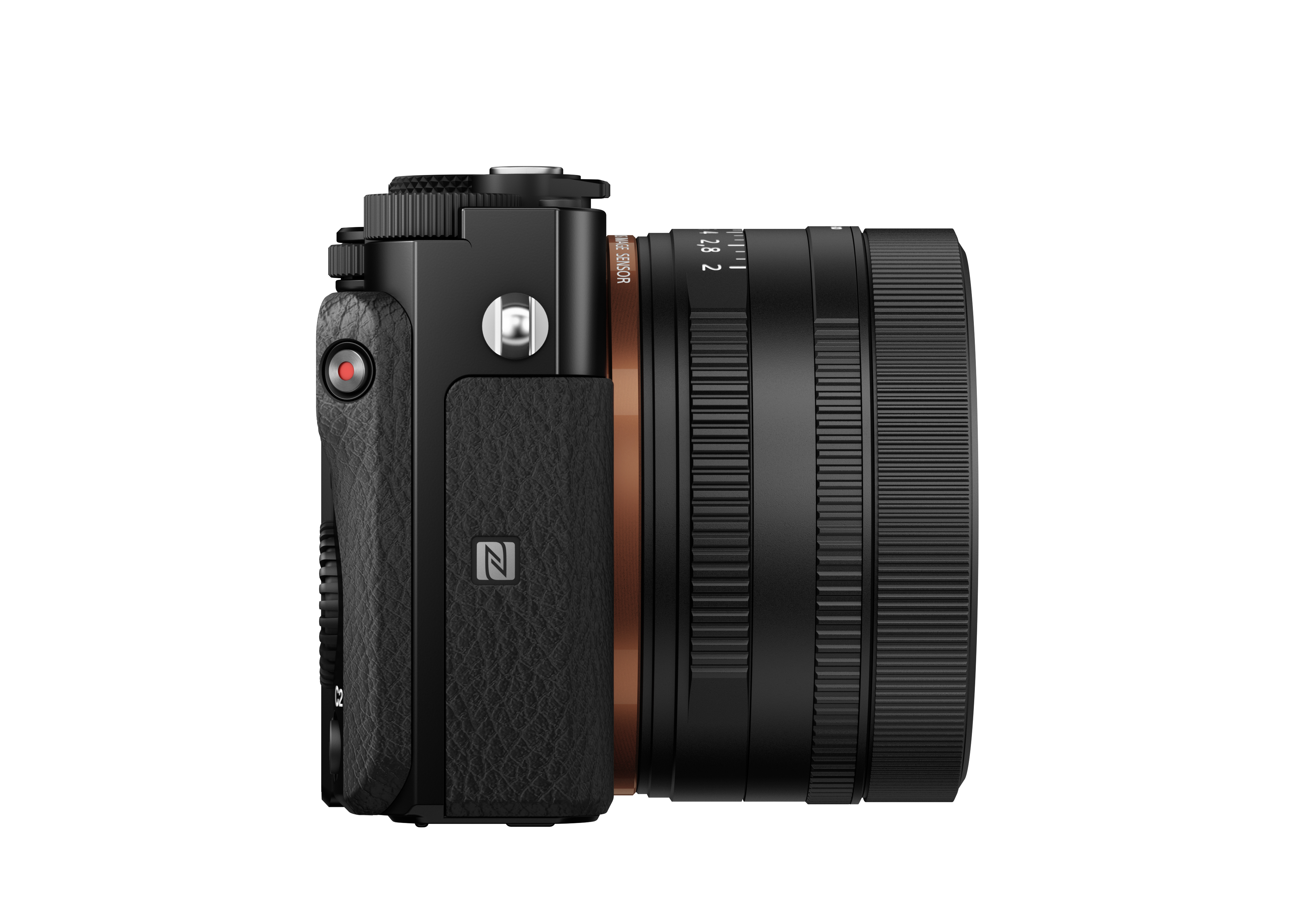
Sony has just announced the Sony RX1R II. Major specs from reading the Sony press release are: 42.4 Megapixel full-frame sensor, apparently the same BSI-CMOS sensor as the A7RII, 35mm f/2 Zeiss Sonnar T* lens, retractable XGA OLED viewfinder, faster AF (same system as A7RII) and the world’s first optical variable low-pass filter. You can actually choose whether or not you want the AA filter in front of the sensor and if so, the levels, i.e., off, standard or high. There is of course a lot more to this camera, but you can find all you need to know by checking Sony’s site or searching the internet.

The original Sony RX1 was a high-end point and shoot camera introduced by Sony in 2012. It is a fixed lens camera with a 35mm f/2 Zeiss Sonnar lens and a 24.3 megapixel full-frame sensor.

I must admit, the Sony RX1 was one of those cameras I coveted, but could never get myself to buy. I loved the way it looked, I loved the way it felt, and I loved the files I saw from the camera. However, I couldn’t plunk down $3000 for a fixed lens digital. I didn’t have the cash and even if I did, I just couldn’t do it.

I buy and sell cameras. I’m not rich and I have a family to feed so I have a budget. For me to afford the next camera I get, I have to sell the last camera I got. And with today’s flooded market, that’s not always easy to do. All the cameras I’ve reviewed here, I bought with my own money. I don’t get cameras sent to me for review and I don’t get invited to press events.

My blog is relatively new and I thank each and every one of you who have stopped by, left a comment, or help support it. It’s just the grassroots blog of a guy who, just like you, loves cameras and wants to share what he’s found along the way. There IS a reason for those horrible low-budget selfies 🙂

As mentioned elsewhere on my blog, I would pay for quality but I like cheap. For me to get an RX1, I would have had to sell off a lot of stuff for a digital camera that would depreciate over time. I would rather get a Konica Hexar or Ricoh GR1 and deal with the hassles of developing film, but that’s just me.

That said, I would have to say the files I saw and downloaded from the RX1 were among the most impressive I have seen from a digital camera or any camera for that matter. The camera felt great and the files had a look, depth, and ‘pop’ that you only see when you have a near perfect camera/lens/sensor combo. The RX1 had it. I’m sure the RX1R II will take this to the next level.

Below are images of the RX1R II distributed by Sony, so you may have seen the images on other blogs as well. While the RX1R II is not available in stores yet, I’m sure it’s going to be a HOT seller. People love this stuff man, we all do! 🙂

Anyway, if you want to sign up for notification when the camera is in stock, you can do so HERE.

But if you’re like me, you’d probably go for a used RX1 or RX1R first version which is a deal at $1200-1500 used. For that I would check Amazon and their vast network of dealers. Even if what you find is showing $2700 etc, etc, etc, when you click on it and scroll down, you will find the USED or REFURBiSHED units. That’s where the deals are.

DSC-RX1RM2_(RX1R II)_front_evf_wLogo

DSC-RX1RM2_(RX1R II)_front_sensor

DSC-RX1RM2_(RX1R II)_rear_evf_eyecup_wScreenFill

DSC-RX1RM2_(RX1R II)_right

DSC-RX1RM2_(RX1R II)_terminal

DSC-RX1RM2_(RX1R II)_top_wLogo

DSC-RX1RM2_(RX1R II)_tilt_hight_wScreenFill

The First Canon Mirrorless: The EOS-M

SamC

The original Canon EOS-M. Trying to look serious, but this camera is fun. Serious Fun! 🙂

With today’s introduction of the EOS-M10 I thought it would be a good time to take a look at Canon’s first mirrorless camera, the EOS-M.

The EOS-M is an 18 megapixel mirrorless, interchangeable lens camera introduced by Canon in 2012.

I got the “M” sometime in 2013 when they were having a closeout on these cameras with a huge price reduction.

IN THE HAND

The EOS-M is physically the size of any average digital point and shoot. It is remarkable that inside lies an 18mp APS-C sized sensor, possibly the same or a variation of the venerable 18mp sensor Canon has used in a number of cameras including the 7D and SL1.

The camera feels light, but the body is surprisingly solid thanks to a magnesium alloy body.

The camera controls are spartan. On the top right by the shutter release you have a mode dial for play, camera, and video. There is no dedicated “P/S/A/M” dial they must be accessed through the menu. The menu thankfully will be a familiar one for EOS users. There is a hotshoe for dedicated flash units, but no built in flash.

The camera does feel a little slippery to the touch and could benefit from a hand grip. I don’t believe Canon makes one for the EOS-M, but you can get a hand grip for the camera from third party manufacturers.

PERFORMANCE

The main complaint people had about the original M is the slow autofocus, which they did not expect from a modern Canon digital.

Canon attempted to rectify this with a firmware update, which was version 2.02 which was to improve AF in one shot mode and also supported the new 11-22mm f/4-5.6 STM.

Yes, the people were right, the camera was slow. And yes, the AF did improve after installing firmware 2.02, but it is still slow by today’s standards. I would put its AF on par with the original Fuji X-100.

I originally thought this camera would work for my street shooting, but it’s a tad too slow for on the fly street work. I now use it as a fine stills and family camera 🙂

12052465_10206889611671173_219641290945445510_o

“M Love” 2015. Canon EOS-M, EF-M 22mm f/2 STM. I originally intended to use the EOS-M as a street cam, and it’s fine for stills, but a tad slow for on the fly street shooting. I do love it for family pics if and when the kids are not on the move 🙂

One of the best features of the EOS-M is the touch shutter. This is a feature we’re used to on our phones, but still not quite the norm on “real” cameras.

IMG_0216CokeCAM

“Legend” 2015. Canon EOS-M, EF-M 22mm f/2 STM. Just a test of the EOS-M’s AF system. In auto, the lens would rack back and forth looking for a target due to the white background. But when switched to the touch shutter, it found its mark easily and accurately. Not super fast, but fast enough.

I became a big fan of touch shutter after using it on the Olympus OM-D EM-5. On that camera, it was incredibly fast and effective, especially for street shots. Sad to say, it’s not that fast nor as effective on the M, but hey it works.

I’m not knocking down the M, the AF is very accurate, but it takes its time and I’ve gotten used to that.

High ISO images are good to about ISO 3200 which is a bit grainy depending on the light, but still usable. Higher than ISO 3200 I would say is good for “artistic” purposes 🙂

Another feature I loved on the M are the built in creative filters. I’m not a big fan of novelty filters, but the filters on the M are quite effective and fun to use. The effects include Toy Camera, Fish-Eye, Miniature, Art Bold, Water Paint, Soft Focus and Grainy Black and White.

I got the M as a fun to use camera, and these filters are a big part of what makes the camera fun. It helps to negate the slow AF and other issues I might have with it. However, these filters are for photos I like to look at myself and not necessarily post because the novelty of these filters wear out quickly.

151859933.nCpjeYH5.IMG_0045JJZoe

“Hey You Mini Me” 2013. Canon EOS-M, EF 22mm f/2 STM. A shot using the “Miniature” effect, one of seven Creative Filters found on the EOS-M.

IMAGE QUALITY

The saving grace for the Canon EOS-M is this…

When paired with the EF 22mm f/2 STM, the image quality is excellent to superb, especially at lower ISO settings and favorable conditions. The lens which is equivalent to 35mm on full-frame is quite an amazing performer on the time tested Canon 18mp sensor.

At low ISO’s you can count on clean, colorful, and detailed images with this combo. The image quality is several notches better than the Nikon V1 (with its much smaller sensor) which I also reviewed some time ago. However, the V1 makes up for its sensor disadvantage by having much faster autofocus, which could make the difference between getting the shot or not.

IMG_0230AutumnEOSMCA copy

“AutM Leaves” 2015. Canon EOS-M, 22mm f/2 STM @ around f/5.

I have not tried any other lens with EOS-M. Actually, I believe I did try some manual lenses with it using adapters, but as the M lacks focus peaking it was neither fun nor productive which brings us to another complaint about the M, the lack of native lenses for it. As of this writing, the lenses available are the EF-M 22mm f/2 STM, the 18-55mm f/3.5-5.6 IS STM, the 11-24mm f/4-5.6 IS STM, and the 55-200mm f/4.5-6.3 IS STM.

To their credit, Canon makes an EOS to EOS-M adapter for using your EOS lenses. I have not used it so I cannot comment. I should have mentioned it earlier, but to be clear you CANNOT use standard EOS lenses on the EOS-M without this adapter.

BOTTOM LINE

The original EOS-M was discontinued and replaced by the EOS-M2 which was basically the same 18mp camera with faster AF and then the EOS-M3 which was much beefier and featured Canon’s new 24mp sensor.

Both these cameras and the new M10, I imagine would offer better AF performance than the original M. However, I like cheap, and the original M is probably your best chance to get a Canon mirrorless cheap 🙂

Used prices for the original M or M2 are trending at $200-300 and they are usually bundled with the 18-55mm zoom or 22mm f/2 STM. If you’re lucky, you might find the body alone for around $150-175.

Although the M and M2 are older models, you can still find them abundantly either used, refurbished, or if you’re lucky, new old stock.

Canon (and Nikon as well) have not shown, until recently, a great dedication to expand or promote their mirrorless division which is why you don’t really think of Canon or Nikon when you think of mirrorless.

The original Canon EOS-M is an enigma from Canon, one of the Camera Legends of photography. On one hand it offers slow and sometimes frustrating AF and ergonomics. On the other hand it offers superb imaging possibilities.

Mirrorless was a relatively new market to Canon and the original M shows that even a giant like Canon will make some mistakes when entering a market pioneered and dominated by Olympus, Panasonic, and Sony.

However, based on the image quality I have seen with the EOS-M, I believe they have just scratched the surface of what they could achieve in this market with a little more love and dedication. If Canon got into this market full throttle, I believe they could have a best selling mirrorless Camera Legend on hand and that would be a great addition for all of us camera lovers.

WHERE TO BUY

You can pre-order the new EOS-M10 with the 15-45mm IS STM lens in BLACK or SILVER. Or go all out with the EOS-M10 plus 15-45mm IS STM and the 55-200mm IS STM from our friends at ADORAMA. Actually, if you’re looking for the original EOS-M, profiled in this post, you might want to check out their “USED” section. There’s a good likelihood that the camera would show up there.

You can also preorder from everyone’s super-store AMAZON with their wide selection.

Anyway you do it, I believe any variation of the EOS-M will bring lots of FUN to your life and a good reason to leave that bulky DSLR home 🙂

Note: I will be updating this post later with more pics from the EOS-M. Just so much to do and so little time tonight. Thanks for stopping by!

Flashback Friday: The Nikon EM

DSC00987NikonEMC

“The Nikon EM” 2015. Nikon’s smallest, lightest, and cheapest 35mm SLR from 1979 seen here with the 50mm f/1.8 Series E lens, which is a great match for the camera.

The Nikon EM is a 35mm SLR introduced by Nikon Corporation in 1979. It was at the time, considered the smallest SLR Nikon had ever produced, and also the cheapest.

The camera was supposedly meant to be marketed to beginners and women in particular, but it wasn’t a hit for either targets. Apparently, many women avoided it with the belief that Nikon’s position of selling them an “easy to use” camera was sexist and insulted their intelligence. You got to remember, this was the late 70’s early 80’s! 🙂

In addition, it alienated some hard core Nikon users who felt the lower quality build of the EM was a sign of bad things to come, especially for a company known for their tough and heavy duty professional cameras.

The Nikon EM is basically an entry-level camera. It relies on two S76/A76 or one 1/3N battery. The camera features aperture priority only camera with no full manual mode. However, it does have something lacking on many Pro cameras and that is an emergency 1/90 mechanical shutter which can be called upon in case of battery failure.

With the EM, Nikon also introduced a set of lenses that matches the EM’s position for price and lowered quality. These lenses were called the “E Series” lenses. While lower priced than Nikon’s AI or AIS equivalent lenses, these E series lenses have developed  cult following for their price to performance ratio.

I have used the Series E 50mm f/1.8 and the 75-150mm f/3.5 zoom and they are both excellent lenses, optically anyway.

While there is nothing particularly special about the EM, I believe that time has helped the EM to achieve a “cute” status when people think of it. I mean, even for me, when I thought of what to profile tonight, the Nikon EM came to mind and I said…oh yeah, that cute little Nikon from the 80s 🙂

IN THE HAND

Despite the negatives, when you actually use the EM, it feels nice in the hand. Small, light yet adequately solid. This is a Nikon that you wouldn’t mind carrying around all day.

And while Aperture Priority may seem limiting, it is in fact the mode that seems to be preferred by most photographers. The fact that it has no manual override, well that I don’t like.

If the camera is too small for you, you can “bulk it up” by using the MD-14 motor drive which not only makes the camera grippier, but also has the added benefit of being about to do about 3.2 frames per second.

MY CONNECTION WITH THE EM

Cameras, like music, are objects that have the very good ability to bring you back to another time in your life.

I remember in 1981, as a kid, my Mom’s brother came from overseas with a couple of friends. They went downtown and came back with a camera, the Nikon EM. I believe it was one of my first encounters with a Nikon camera. My very first Nikon experience actually was being in Rockefeller Center in NYC and seeing this huge Nikon telephoto/telescope which was a 2000mm f/11 Cassegrain telescope. Same as the one being sold in this eBay auction.

http://www.ebay.com/itm/251761280659?_trksid=p2060353.m1438.l2648&ssPageName=STRK%3AMEBIDX%3AIT

BOTTOM LINE

The Nikon name evokes powerfully passionate emotions from photographers and even those who don’t know cameras, they know the Nikon name. It was, is, and probably will always be one of the greatest names in photography.

And while the Nikon EM is not the best representative of a classic manual Nikon SLR, it is a Nikon nonetheless, an interesting one, and perfectly usable in capable hands.

DSC00988NikonEMF4SC

“David & Goliath” 2015. The Nikon EM on the left shown for size with brute of the Nikon family, the F4s. Sorry for the poor quality photo. I didn’t feel like dragging out the studio lights tonight 🙂

Prices on the EM go anywhere from $10-40 and don’t pay any more than that.

The Nikon EM itself may never be a Camera Legend, but it is an interesting tidbit, and time capsule into Nikon’s direction going into the 1980’s.


Some Film Images Part II

I had so much fun going down memory lane last night, I decided to do it again, one more night. This time the focus is on people and portraits. Back to reviewing cameras soon, I promise 🙂

Again, captioned with these images are equipment that I have profiled or am planning to profile. Most of the gear I no longer have, except for the negatives and memories I have of them.

And again, while I love reviewing equipment, I love the equipment even more if it helps me take a decent pic!

Also as mentioned in the last article, a lot of these photos were posted for photo sharing sites long before I started blogging on WordPress. As such, some were resized much smaller than I’d like, but it would take me forever to locate the originals and work on them again. I thank you kindly for taking a look.

141123443.euHZ8DVy.imgT3MamaQuilin243I

“Separate Your Colors” 2011. Contax T3, Fuji Reala. Manila, Philippines.

72199654.3VurRO0j.BNwaPB

“The NWA” 1990. Minolta X-700, miscellaneous brand 80-200mm. No this is not Dr. Dre and the “West Coast” NWA. This is “Nature Boy” Ric Flair and the original NWA 🙂

1186234_10201381547813019_1521540462_n

“The Young & The Restless” 1988. Minolta X-700, 50mm f/1.7 MD lens. Los Angeles, California. I was at the Farmer’s Market in L.A. and checking out magazines at a newsstand when I spotted two (then) very popular soap opera stars, Tracey E. Bregman and Doug Davidson, who were also checking out magazines. They must have been on a break from their show which was being filmed at CBS Studios nearby. I asked them for a photo and they graciously obliged. I was most impressed that they had no movie star “issues” and smiled for a geeky teenager with a camera 🙂

10924621_10205004028452771_2700291808193830651_o

“The Gentle Giant” 2011. Nikon F4s, 28mm f/2.8 AIS Nikkor, Kodak Portra 160. I ran into NYC icon Louis Mendes, a photographer well known for his old school Speed Graphic camera and sharp retro outfits. Lou takes unique Polaroid portraits and has made a living and a legend out of it. I’ve bumped into Mr. Mendes a few times over the years and he has always been a willing a gracious subject for my cameras. Thanks Lou!

CPBrideC

“Bangkok Bride II” 2005. Olympus Stylus Epic, 35mm f/2.8, Kodak High Definition 400 film. Bangkok, Thailand.

160432330.BUW2hQF2

“Native New Yorker” 2015. Leica M4P, 50mm f/2 Summicron-M, Kodak T-Max 400 developed in D76. NYC is a melting pot of cultures. No matter where you come from, you can quickly transform into a New Yorker!


Some Film Images Part I

No dear friends and readers, I have not run out of Camera Legends to profile for you. However, from time to time, I’d like to put up some images I’ve taken over the years, if only to remind myself that I still love photography and also so that readers of this site can see that I actually DO use the gear profiled 🙂

Like many of you out there, I really love cameras and lenses. But just as importantly, I love the equipment more if it helps me take a decent picture.

The photos below are a random sampling of the gear and the photos I’ve taken with them. Some of the cameras used to take these shots have been profiled. Some are previews of possible future postings.

They are not masterworks or anything. Many are from my attempts to learn or test equipment. Most were taken for just the pure joy of photography.

I thank you for taking a look. And not to worry, I have more great gear to profile and review for you coming soon 🙂

Note: Most of these images were posted elsewhere on the web years ago, long before I knew anything about WordPress. As such, some were resized to dimensions much smaller than I’d like to show you, but as I cannot find the originals at this time, this is what I can post. Sorry about that.

139139642.TI4xz9k1.MomDC

“Mom in DC” 1984. Kodak Disc Camera. This image represents one of my earliest attempts at photography, at least the ones I could find. Shot with the long defunct and defiled Kodak Disc Camera, a camera that was bashed by critics and consumers alike. However, I have to say, I really loved that camera and this image brings back a lot of memories.

80259812.xfdWo77e.JoeLit150Pba1

“Ghetto Blaster” 1985. Minolta X-700, 50mm f/1.7 MD lens. My brother and father with our Cutlass Supreme which we called the “Ghetto-Blaster” with its missing hubcap 🙂 Thirty one years in time, but I’ll be darned if that golden light on the print doesn’t still look as golden as the day I took this shot.


86420863.ICEBHFzI.CPhotogPBase

“Bangkok Bride” 2005. Olympus Stylus Epic, 35mm f/2.8, Kodak High Definition 400 film. Shot in Bangkok, Thailand.

80650042.mP0bUQUa.LotusPba

“Holy Petal” 1995. Contax G1, 28mm f/2.8 Zeiss Biogon, Fujichrome Velvia. Taken at a temple in Bangkok, Thailand.

80067916.oS3X1lKl.AddictOM1Pba

“Portrait Of An Addict” 1997. Olympus OM-1, Zuiko 50mm f/1.8, Kodak Tri-X. An attempt to self document one man’s horrible addiction to cigarettes. This photo was accepted to Flickr’s “Film Is Not Dead It Just Smells Funny” group, which is quite a selective bunch so I was honored by their acceptance of this pic.

72203117.MOYkwQ46.BMannequinsPbase1

“Mannequin Fantasy” 2006. Ricoh GR1, Fujicolor Press 800.

99388588.WRfjkUXc

“Lots Of Love” 2008. Leica R8, 90mm f/2 Summicron-R, Ilford XP2. I was honored that this image was profiled on Leica’s LFI “Analogue Masters” Gallery a few years ago.

130716115.ggt0qYRJ.3994821952_832dcc1cda_z1

“Rainy Day Blues” 2009. Leica CL, Canon 50mm f/1.2 LTM, Kodak Tri-X 400 developed in HC-110. I was sloppy and something went wrong with the development and I got the blues after seeing the ‘damaged’ roll . But since photography is such a subjective, sometimes emotional thing, I developed a liking for the look of some of the ‘ruined’ images.

995636_10204084737871081_7481577152814577026_n

“Masked Shooter” 2008. Contax RX, Carl Zeiss 50mm f/1.4 lens. The man with the clandestine figure, the Masked Shooter, has probably shot nearly a thousand cameras 🙂


Flashback Friday: The Olympus M-1 Film Camera

DSC_0669M1CamFAC

The Olympus M-1 35mm slr. Basically an OM-1 with a few external and internal differences. The most obvious give away is the “M-1” logo on the top plate of the camera. Otherwise, the M-1 and OM-1 are cosmetically and functionally the same.

The Olympus M-1 is a 35mm SLR introduced by Olympus in 1972. It is the original OM-1.

The M-1 was originally a part of the Olympus “M System” as they called it. They were all set to go, even having a full set of lenses made to support the M-1. Only one thing they forgot…Leica already had an “M System” out!

From all accounts, Olympus changed the designation of the M-1 to the “OM-1” because Leica protested the use of the “M” and “M System” as it conflicted with their M series rangefinders and their lenses.

The M-1 is basically an OM-1, which is among the finest and most iconic systems camera ever made. A modern masterpiece from the brilliant mind of the late great Yoshihisa Maitani, the genius camera designer of Olympus.

There are some differences between the M-1 and OM-1. Main thing you need to know is that the M-1 says “M-1” on the top plate and it cannot accept a motor drive.

There is a wonderful page that tells you everything you need to know about the M-1 if you google “Olympus M-1 film camera.”

As a camera, it has an all manual 1s-1/1000s plus bulb shutter and originally took a PX-13 mercury battery, which has long been outdated/outlawed. The battery is only needed for the meter and yes, the camera can operate without a battery. You can use a replacement battery and my recommendation would be the Wein MRB625 Zinc battery which at 1.35v is closest to the original mercury cells.

RARITY, PRICE AND COLLECTABILTY

This one is not as easy as it looks. While the M-1 is certainly not as common as the OM-1, I don’t think I would call it rare either. “Rarer” would be a better word I guess.

They don’t seem to come up for sale often, but you do see them at fairly regular intervals on eBay, usually by sellers who stress that it’s “RARE.” I know that sounds like an oxymoron, but you know what I mean 🙂

I got mine for $40. It is not in perfect condition, eyepiece and focus screen looks to need replacing, viewfinder needs cleaning, but the shutter works though I haven’t tested it for accuracy. It’s going to be a fixer-upper for me which should be fun.

I have seen people asking up to $500 for this camera, usually on eBay, but they ain’t getting $500! 🙂

Most camera lovers will know or search and find out that the M-1 is basically an OM-1, a camera you can get anywhere from $10-150 dollars depending on condition and how much you want to spend.

A more consistent and fair price for this camera I think is around $150-250 in excellent condition and preferably with a lens thrown in.

SamOM

“Zuikoholic” 2009. With the black Olympus OM-1 and 40mm f/2 Zuiko lens. As far as I know, the M-1’s were only made in chrome.

Of course, for a collector with money, and if you are a true Zuikoholic you probably wouldn’t mind paying extra just to have that “M-1” in the house 🙂

BOTTOM LINE

The Olympus OM-1 is one of my favorite manual SLR’s of all time. The beautiful styling, mechanical shutter and all manual exposure makes it a pleasure to use just for the pure joy of photography.

When I gave up on my Minolta X-700 from 1985 and after trying Canon and Nikon in the 90s, I settled on a couple of OM-1’s and it carried me through the rest of the decade giving me thousands of precious memories on film. And as the 90s came to an end and digital was dawning, my first digital camera was an Olympus C-3000.

The M-1 being the “rarer” version of the OM-1 makes it just a little more special.

These cameras live on in their OM-D incarnations although I think all the OM-D’s lack the true heft and feel of the classic film OM cameras. As imagers, I think the OM-D’s are great!

DSC_0671M1OMDFAC

“Generations” 2015. The Olympus M-1 film camera on the left and the OM-D EM-5 on the right. Yes, I know that OM-D needs a little dusting off 🙂

In closing, there is no doubt that the Olympus M-1 (and OM-1) is a true Camera Legend that inspired a whole generation of photographers and continues to influence photographers and camera designers, even today.


The Rise Of The “Cheap” Brand Lenses

There was once a time, not so long ago, when brands like Samyang, Rokinon, Bower, Quantaray, Promaster, etc, etc, were laughed at by more “serious” enthusiasts and pros.

Well today, some of them may still be laughed at, but not many are laughing at the lenses being released by Samyang, and also sold under the brand names of Rokinon, Bower, or Vivitar. I’m sure the “Big Boys” of camera lens makers are not laughing at these lenses 🙂

In the past few years, Korean lens maker Samyang has been producing some amazing lenses from ultra-wides to fast telephotos that rival or exceed equivalent lenses from Canon, Nikon, or Sony.

And these lenses are also sold under a variety of other formerly “no name” or “cheap” brands such as Rokinon, Bower, and Vivitar.

Many of these lenses use exotic glass, aspherical elements, and special coatings that were once only seen on lenses from Canon or Nikon. And the best thing? Their prices are significantly lower than the Big Boys. For example, if you look around, the original 35mm f/1.4 Samyang can be found for a little over $300, whereas the Canon equivalent is over $1000.

DSC00604ZayCL

“Not Funny” 2015. Sony A7R, Rokinon 35mm f/1.4 AS UMC. Baby Zay, quite serious and not finding me amusing any more, just like the “Cheap Lenses” from Samyang, Bower, Vivitar, and Rokinon are offering serious performance for the money and no longer something to be laughed at 🙂

But there is a hitch. Well, maybe a few. First of all, these lenses are not built nearly as well as the Canon, Nikon, or Sony equivalents. Not to say the build quality of the Samyang/Rokinon lenses are bad. They’re quite good actually, but I’m not sure how durable they will be. Secondly, as of this time, the lenses being offered are manual focus only. That’s not a problem for me and many others, but surely some would prefer autofocus. And lastly, there have been reports of sample variation and quality control issues.

Still, on the whole, people seem to rave about these lenses. If you get a good copy, you will be pleased. My copy of the Rokinon 35mm f/1.4 is excellent and really surprised the heck out of me when I got it. I was a skeptic at first, but not any more.

SZC99

“Superfly” 2013. Sony Alpha A99, Rokinon 35mm f/1.4 AS UMC. Please double click to see best quality.

This is truly the “age of the people” where nearly everyone can have access to great equipment, not just pros or the “elite” 🙂

Two new Rokinon lenses have been released for those using mirrorless systems, including an incredibly fast and wide 21mm f/1.4 and a super fast 50mm f/1.2. The prices for both are $499 which is really quite a feat. I’m sure their optical performance will be amazing and I hope some of you report back if you get one of these lenses before I do.

Thanks to Samyang and all the “cheap” brands. Power to the people 🙂

Flashback Friday: The Linhof 220

114664261.NknMPisU.LinhofSamPba

From 2009, with a Linhof 220 and Tri-X 400 film. This one definitely flew over the cuckoo’s nest! 🙂

Originally written in 2009…

Note: I done told anyone who would listen that my film cameras are far more interesting than my digital gear, and this camera might well be the ‘oddest’ in my collection. It is a Linhof 220, a medium format camera that shoots 6×7, and comes with a fixed 90mm f/3.5 Linhof-Technikar lens.

It’s ‘weird’ not only in its looks, but for a few reasons. For one thing, it’s set up for use mainly for vertical photos, hence it’s more of a portrait camera than it is a landscape camera. I believe it was meant to be a press camera. Of course, you can shoot horizontal if you’d like, but it’s quite cumbersome. It’s also ‘weird’ in the fact that the shutter is a trigger on the pistol grip.

It’s quite a rare bird, but I got her very cheaply (as in less than $100) because she’s got “issues” so to speak. The rangefinder is a bit touch and go, and the camera has a real problem with film spacing, both of which I am trying to repair in my spare time. The times when I can get a good shot out of it, I’m impressed with the sharpness and contrast from the lens, it’s tack sharp.


Update 2015:

Prices for these in good working condition are usually around $400-500 USD. I was able to fix the spacing problem, but the rangefinder is still touch and go. It’s not the most fun camera to use which is why you haven’t seen me post a lot with it, but in my film camera collection it is a standout.

Your best bet to find one of these is on eBay. However, you may also find them through private sellers on Amazon while searching for Medium Format cameras.

The Pentax Q Original

156748298.RUACEOst.DSCN0009Zoe

The Pentax Q. Not just a toy camera! 🙂

The Pentax Q is a 12.4 megapixel, interchangeable lens, mirrorless digital camera first introduced by Pentax in 2011. It was and still is currently the smallest interchangeable lens camera in the world.

Since its introduction nearly five years ago, Pentax has introduced several different versions of the Q. To be clear, I am only talking about the original Q as it is the only one I have any experience with.

The Q uses a 1/2.3″ sensor and has a crop factor of 5.6x which means for an example, a 50mm lens would become a 280mm telephoto. Shallow depth of field or bokeh is hard to come by on such a small sensor. On the other hand, it’s easier to get everything in sharp focus with a small sensor so you might lose one thing, but you gain another. Only you can decide if the Q fits your shooting style.

BUILD AND HANDLING

I must admit, when I first saw the Q I instantaneously fell in love with it! Such an adorable looking camera. But the more I read about it, the less I wanted it. People were trashing Pentax for having released an interchangeable lens camera with such a small sensor. “What’s the point?” was what a lot of people said.

So I kept it out of my mind for a while until some time in late 2012 when they were having some really good Christmas deals on the Q.

So I finally got my hands on one and right away I was impressed with the solid build quality! It felt more solid than I expected for such a small camera. The body is made of high grade magnesium alloy and it feels like it.

Ergonomically, it’s excellent. With the power button, mode dial, shutter release and control wheel on the top right. The play button is on the top left of the camera, which is not typical for a digital camera, but you get used to it after a while.

The menu and dedicated buttons for ISO, flash, drive, and white balance are on the back right near the LCD. There is no optical viewfinder, no electronic viewfinder and no add on for an EVF.

The flash has a dedicated switch on the top left of the camera and pops up like a jack in the box. You won’t be blocking the flash on this tiny camera 🙂

The thing that impressed me most about the Q’s build is that they were able to build a separate SD card slot on the camera’s right side! I prefer this over the usual SD card/battery chamber that you see in most digital cameras.

The only bad thing about such a small camera as far as handling is concerned is that it might be too small. The camera feels great, but I can definitely see dropping this thing. I would probably recommend a hand strap, even though I am not currently using one. I’m still waiting to drop it 🙂

Anyway, to me the supplied strap is a bit overkill for a camera this small. It’s really pocketable, which is what I do. I did have a hand strap on it for a while, but even that felt like it took away from the camera’s unique and tiny proportions.

PERFORMANCE AND IMAGE QUALITY

The camera offers very good AF performance, quite snappy, fast if not super fast, but accurate, even in dim light using the center spot.

Even though I’m not a fan of novelty, there are some cool effects you can use to accentuate your pics including toy camera, miniature, fish-eye and quite a few more. There’s even a mode that tries to create some bokeh for you because it’s not easy to get bokeh with this camera. I have tried it and it is cool, but it doesn’t work all the time and it doesn’t substitute “real” bokeh from a fast lens and a larger sensor. Still, it’s pretty cool that they thought of this and put this effect in the camera.

IMGP0096ZPic

“Madam Z” 2013. Pentax Q, 8.5mm f/1.9 Standard Prime. An example of the in-camera bokeh effect. As you can see, it’s not quite natural, but it looks quite nice in its own way, and it’s a good option to have on such a small sensor camera.

The Pentax Q takes very good to excellent images, especially in daylight. It is very good for what it is. Don’t take that as a back handed complement. In fact, I think it speaks very highly about the Q. For a camera with such a small sensor, it provides nice looking images. It matches or exceeds what I see from most phone cameras, but there are some phone cameras today that might do better in image quality.

IMGP0186Honey

“HoneyTone” 2015. Pentax Q, 8.5mm f/1.9 Standard Prime. ISO 3200. Straight out of camera and only resized. The Q retained nice tone and detail, despite the noise present. Only you can decide whether this level of noise is objectionable to you.

It will not and cannot reproduce what you can do with a fast lens and larger sensor, but it was not designed to do that.

WHAT’S THE POINT?

So if you have an interchangeable lens system with a sensor so small that it matches or just exceeds most phone cameras, you may be asking as I mentioned earlier…what’s the point?

To be honest with you, I’m still asking myself that today! On one hand you can change lenses, but even with the fastest lens they offer, the 8.5mm f/1.9 which is equivalent to a 47mm lens, and the DOF is increased substantially due to the 5.6x crop factor, so while I can’t figure the math off the top of my head, what I can say is that you’re not getting the same shallow DOF as you would with a 47mm f/1.9 on a full frame sensor, not even close.

But you can always use the good old trick of getting in real close to your subject and coax some bokeh out that way.


I think the Pentax Q is better suited to street, environmental, and static subjects where shallow DOF is not entirely necessary, where as portraits with that “creamy bokeh” look is better suited to larger sensor cameras.

While there might not seem to be much point to it as an image maker, I think the real point of the Pentax Q is what it is…a truly small, well built, and pocketable camera that you can take anywhere and get the shots. They may not be the best technical shots, but because the Q is so small, you can always take it with you and you could get shots that you might have missed by not taking your larger systems.

Not like you couldn’t do that with your cell phone these days, but none are built like the Q, none feels like the Q and none have the charm of the Pentax Q.

Prices for these are trending from $100-250, depending on body/lens configuration. Remember, I am only talking about the original Q. More than its picture taking abilities, I think this camera belongs in any collector or gadgeteer’s collection.

BOTTOM LINE

I think that just by virtue of how unique it is, the build quality, and the overall very good image quality, the Pentax Q will become a Camera Legend. In fact, I personally think it’s one of those rare cameras that could be considered an instant Camera Legend the moment it came out.

I love the Pentax Q, I really do. In fact, I loved it so much I gave it to my kids 🙂

The Pentax Q is certainly not a toy camera, but…it could be! One thing for sure, it’s a lot of fun 🙂