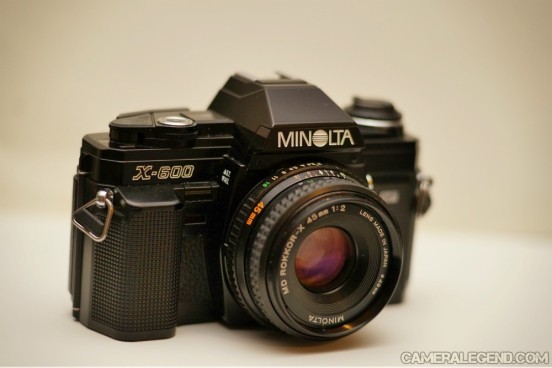
Monday Mystery Camera: The Minolta X-600

MinX600CC

Just when I thought that, as Bob Seger might say, I had nothing left to burn and nothing left to prove, I have another camera to profile for you 🙂

THE MYSTERIOUS MINOLTA X-600

In 1994 there was an article in Popular Photography magazine regarding the “mysterious” Minolta X-600. In fact the title of the article was “The Mysterious Minolta X-600.”

In that article, I remember the late, great Herbert Keppler wrote of how in 1983 he received an express package from Minolta Research and Development headquarters in Osaka, Japan. He went on to say that in the box contained a camera he had never seen or heard of before: the Minolta X-600.

Now before I continue, let me just say that I really loved Mr. Keppler’s articles and his candid and sometimes brash way of writing. I’m can’t remember if he was Pop Photo’s editor or associate editor, but if you read the magazine long enough, you can tell that he was “The Boss” or “The Man” at that publication.

He was a legend in the photography business and to me, his articles were the main reason I was reading Popular Photography. I was somewhat awestruck actually when he sent me a hand written response to a question I sent in, back in the 90s.

I also have to say, I’ve read over the years, so many people bashing that magazine. To me though, it was better than a lot of other photography magazines out there, but that’s a topic for another day.

Now back to the X-600. After reading the Pop Photo article on it, I got the impression that this was not a production camera and I never thought about it again until I came across one, quite unexpectedly, from a local seller’s collection.

WHAT MAKES THE X-600 SO MYSTERIOUS?

Ok, there’s not a lot of information about this camera on the web, but there is some. So I will try to break down what I have read and what I know of the camera, now that I have one.

The camera was produced as far back as 1983. Contrary to what I deciphered from the Pop Photo article, which gave me the impression that the camera was never released to the public, the X-600 was actually sold/given/leaked to the public, perhaps up to 10,000 units (according the the great Rokkor Files website), and sold in Japan only. Obviously, some have made it around the world 🙂

Now what makes the X-600 special? Now you might have a little chuckle when you read this because we’re so used to it by now…

The X-600 was a manual focus camera that had focus confirmation via a green led dot in the viewfinder that appeared once you have achieved focus. That’s it!

So what’s the big deal you say, all my Nikons have done that for years. In fact, nearly all serious cameras, and even non serious cameras have some kind of focus confirmation. It’s a prerequisite. But back in 1983, this was a BIG deal. In fact, if I recall correctly, they made a big deal about focus confirmation in the Contax RX, a manual focus SLR, and that was in 1994, more than ten years later.

No one knows for sure why Minolta abandoned the X-600 project. If you search around the web you may come across something about patent infringement, but I could not confirm this in any way so I can’t state that as truth.

Anyway, the X-600 was apparently a “pre-autofocus” experiment by Minolta, an experiment that may have led to the creation of the very successful Minolta Maxxum 7000 of 1985, the runaway first hit of the autofocus era of SLR cameras.

The success of the Maxxum 7000 ushered in the era of autofocus to the masses, with Canon and Nikon following shortly thereafter.

HANDS ON

12744392_10207750558474305_6305584978195444372_n

“The X-Man” aka the “Ghetto-Blaster” hands on with the X-600. Not a narcissistic selfie, only trying to show that the X-600 is out there in the hands of the public 🙂

I’ve only had this one for a short time, a few months, still have film in it. Based on my limited experience, and allow me to say that this may change with time, here are my impressions:

The initial impression upon seeing and handling one is that the camera looks and feels like the X-700. But after you hold it for a short time, you realize that this is NOT the X-700.

The X-700 was my first “real” camera which Mom bought for me in 1985 as a geeky teen with a thirst for photography. I used it for almost ten years straight before I got into all this G.A.S. stuff, and I still have it 31 years later so the X-700 is a camera I know a little about 🙂

The good news for most folks? The X-700 is a much better camera. Not only in looks, but in ergonomics and operations. The X-700 is cheaper and easy to find. The bad news about the X-700? It’s not an X-600 🙂

The X-600 is a much more basic camera, which can be a good thing, but it doesn’t have some of the things that made the X-700 so nice. For example, it doesn’t have a shutter speed dial on top as in the X-700. Instead, the shutter speeds appear in a counter on the top right plate of the camera and appears much like a film counter, which under certain conditions can be hard to see and hard to read.

There is no exposure compensation dial. No ASA/ISO indicator. Shutter speeds range from 1s to 1/1000 plus B. There is an Aperture Priority mode which can be engaged via the AUTO settting in the shutter speed selection dial.

The camera uses two AAA batteries, which I actually like better than the usually hearing aid type batteries seen in the X-700 and other cameras.

One great thing I noticed is that the X-600 does not drain the batteries the way my X-700 did. I have accidentally left the X-600 in the “On” position for days and it still doesn’t show battery drain.

The viewfinder shows shutter speeds with red line indicators. The focus “window” is a long slit right in the center of the viewfinder. There are right and left red arrow focus indicators and a green spot in the middle which will light up once you have achieved focus. Anyone who has used the focus confirmation feature on Nikon cameras will be familiar with this method of manual focusing.

The “special” focus confirmation feature works, but it needs good light to work well. According to info I have read on the web, the camera needs later MD lenses with an extra pin or post on the rear lens mount which was apparently needed by the X-600, which has two focus aid sensors in the body.

But wait…I am using the X-600 with three lenses, one which has the pin and two which do not have that extra pin, yet the camera is giving me a focus confirmation signal on all three lenses when I achieve sharp focus! Whether this is reality or not, I will have to report back when I am finished with the film. Only then will I know if the focus confirmation system actually worked with these lenses.

BOTTOM LINE

In today’s world, I must say that there is nothing outstanding about the X-600 as a camera, other than its rarity and its history which I have tried to relay to you here.

I’m not trying to take anything away from the X-600. It’s a very basic camera that uses batteries. Usually a no-no in my book. And focus confirmation is something so basic now that we just take it for granted.

But we must, in respect to Minolta, remember that this was new stuff back in 1983 and they should be given credit for doing something that moved the camera (as a species, not just the X-600) further up the ladder of evolution.

The X-600 is the missing link, the “Lost Testament” of Minolta’s development and refinement of autofocus. The Maxxum 7000 autofocus SLR of 1985 changed the world forever, but to get to the 7000, Minolta had to create the X-600.

Just as the Apollo astronauts who did the test runs never got the glory of the astronauts who landed on the moon, the X-600 is a rare and largely unknown camera, but just like those forgotten astronauts, without the X-600, it’s safe to say there would be no Maxxum 7000.

The Minolta X-600 is most certainly a Camera Legend. It is a camera pioneer. To appreciate that, you must take into account its history. Once you do that, you can then realize that this is indeed a very special camera.

WHERE TO BUY?

The X-600 is a rare camera, based on the low production numbers and the limited information that there is on this camera.

The good news is that they show up every now and then on eBay and I have seen it once at KEH camera. And even better news is that when they do show up, they do not cost a lot. The bad news? You never know when they show up. It could be tomorrow, it could be six months from now. That’s the nature of rare collectibles.

I’m not sure how to say this. You may think I’m just a guy with no life who does nothing, but seek out these odd cameras, and you might have well been justified in your thinking, but honestly, and I’ve said this before…I don’t seek out these cameras, they come to me! 🙂

Seriously! As with so many other cameras and lenses I’ve come across, I found the X-600 when I wasn’t even looking for it. This is a camera that no one hears or talks about simply because not many know about it. When you don’t know about it, you’re not looking for it.

Based on the fact that this is a rare camera, if and when you do find one, you’ll probably come across it the same way I did…when you’re not looking for it.

But assuming you do find one, based on my research, prices are trending at $90-135 on eBay, but you might do a little better if you find one locally. I got mine for $60 with a little haggling 🙂

If you have one of these Camera Legends, I’d sure love to hear about it!

Note: As this is already a late posting, you can safely assume that there won’t be a “Tuesday Titans” tonight 🙂

All content are © 2014-2016 CameraLegend.com


Tuesday Titans: The Leica R8 (R9)

SLRCam

I might as well call this “Tuesday Night Titans” as a tribute to the old WWF (now WWE) rasslin’ show 🙂

The Leica R8 is a 35mm film SLR introduced by Leica in 1996. The R9 was introduced in 2002 and was the last film SLR made by Leica for their R series which was discontinued in 2009.

Although the R9 was marketed at the time as a new model, it is pretty much an upgraded R8. The bulk of this review is based on my extended use of the R8. R9 differences will be pointed out later on in this article.

While the R8 appears much like an autofocus camera, it is not. It’s an electronic camera that relies on batteries for everything, and it is pure manual focus.

THE LEICA R8 BODY

The Leica R8 (and R9) look radically different from any Leica single lens reflex before it. It is huge, it is massive, it is a TITAN!!

I remember reading about the R8 in one of those cool British photography magazines in the late 90s. I remember thinking it was huge and cool and even a little crazy. I never thought about getting one until I started picking up R lenses to use on my 5D in the mid 2000s.

After seeing how great these lenses were, I found a great deal on an R8 in 2008 and although I’ve sold off a whole load of stuff since then, I still hang on to the R8.

99388588-wrfjkuxc1

“Lots Of Love” 2008. Leica R8, 90mm f/2 Summicron-R, Ilford XP2.

The camera feels great in the hand. Heavy, robust, and well put together. The controls are definitely in the Leica bloodline, spartan and uncluttered.

The Mode dial is on the top left. It has all your usual modes, manual, aperture priority, shutter priority, and a very unusual “F” flash metering mode. I could write about this, but it would take a whole half page and I’ve never used it. In a nutshell, the mode is used in conjunction with the camera’s pc socket and your flash which can be a dedicated flash unit or a number of studio strobes. You trigger the flash (or strobes) in “F” mode and it will help you determine flash exposure values which you can see on the back LCD without actually taking a shot, saving you from wasting film. At least that’s how I understand it.

On the top right of the camera is the shutter speed dial which runs from 16s to 1/8000th of a second. A good rule to remember when buying cameras is that any camera with 1/8000 means serious business even if 99 percent of the time we never use that shutter speed!

The 93 percent coverage viewfinder is bright and clear, but appears smaller and not as easy to focus as that on the older Leicaflex SL series. You probably would’ve expected 100 percent viewfinder coverage on a camera like this, and so did I.

RLMC

“Man In Black” 2015. Leica R8, 80mm f/1.4 Summilux-R, Tri-X 400 developed in Ilford ID-11 developer. My man Mr. Louis Mendes, NYC fixture, icon, and friend. I don’t know how many times I’ve photographed Lou over the years, but I never tire of it. Awesome guy, awesome photographer!

Funny thing, when I first got the R8 I felt as if I could never be sure if I had things in critical focus or not, having been spoiled by the SL viewfinder. I was a little obsessed about it to the point that I had even contacted several highly regarded Leica “people” including repair expert Don Goldberg (DAG) and famed Leica nature shooter Doug Herr. Both gentlemen were extremely helpful. However, in the end, I never did anything to the viewfinder.

My fears dissipated when roll after roll, 80-90 percent of the images were always in sharp focus, which is actually better than a lot of other manual focus bodies I have used.

“Baby Love” 2008. Leica R8, 90mm f/2 Summicron-R, Ilford XP2. Despite my fears, I was able to manually focus well enough on the R8 to get roll after roll of mostly sharp shots. The color cast is the result of a drug store scan, which I have not bothered to correct.

Don’t let me scare you though. What happened to me was that the images looked “in focus” in the R8 viewfinder, but it didn’t have a reassuring “snap” to it the way the SL did and that concerned me. I don’t know if the screen in my R8 is original stock, but it doesn’t have a split-image focusing screen in it, which always helps if you’re unsure.

But again, my fears were unwarranted so I no longer have issues focusing on the R8. Most of the time, if it looks in focus, it probably is.

treec

“Lonely Still” 2008. Leica R8, 90mm f/2 Summicron-R, Ilford XP2.

The shutter is well damped and smooth in its sound. Always a sign of a high quality camera.

ISSUES

In the first few years that the R8 was out on the market, there were numerous reports on reliability issues. Leica reportedly, at that time, fixed these issues free of charge.

All I can say is in the eight years I’ve had the camera, knock on wood, I never had a problem with it.

It is likely, but not certain, that if you buy one today and it’s in working condition, it’s probably fine.

If you’re worried about this, that’s one good reason to buy an R9 which apparently fixed everything. However, the R9 on the used market is a good $500 more than a used R8.

Here’s a good page on R8 ISSUES including suspected serial number ranges.

IS THE LEICA R8/R9 THE ULTIMATE LEICA CAMERA?

If Leica had not discontinued their R system bodies, lenses, and accessories, it is my opinion that the Leica R could stand out as the ultimate Leica film body, even when compared to their beloved rangefinders.

Whether you love it or hate it, it’s a standout body. There’s nothing in their film range of cameras that looks like it. I’ve compared a lot of these monstrous cameras to the Canon EOS-1, but I can’t even compare the R8 to that behemoth in its looks. It stands alone.

LeicaR8FlowerLFICrop

“Past Imperfect” 2010. Leica R8, 80mm f/1.4 Summilux, Tri-X.

I know people who think this camera is butt ugly, and I can’t remember if I was one of them, but what I can tell you is that most people who love the R8 end up loving it after they have held and used one.

To me now, it feels and looks awesome and it produces great results, roll after roll.

THE UNIQUE LEICA DIGITAL MODULE R (DMR)

The Leica R8 and R9 have the distinction of being the only 35mm film camera that could be converted to a digital body by replacing the film back with a digital back that Leica made called the “Digital Module R” otherwise known as the “DMR.”

The DMR used a 10mp Kodak CCD sensor and was highly praised by those lucky enough to use it. I was not one of them. They were and are always pricey and scarce on the used market.

At the dawn of the digital era, around 1996 or so, there were dreams of turning film cameras into digital. You may have remembered reading about this. If you forgot the main company pushing this idea at the time, they were called “Silicon Film.” Do a Google search if you’re interested.

Anyway, although it held great promise, the “digital film” concept never materialized in production.

To this date, only the only 35mm cameras that could be turned into digital are the R8 and R9 bodies, again, assuming you can find, or really want to buy a 10mp digital back for over $2000 used.

LENS COMPATABILITY

To further complicate things, the Leica R8/R9 are recommended to be used only with Leica 3-Cam or ROM lenses. The 1-CAM or 2-CAM lenses can damage the ROM contacts on the R8/R9 bodies. You can get these lenses converted to 3-CAM or ROM by a specialist. As a disclaimer, me being foolhardy and cheap, I’ve used 2-CAM lenses on the R8 with no issues, but I don’t recommend it and don’t blame me if you try this and it ruins your camera 🙂

LEICA R9 DIFFERENCES

The R9 is 100g lighter than the R8. The R9 has a special edition “Anthracite” model, in addition to the black model. The R9 has an LCD frame counter on the top plate, the R8 has the frame counter on the back LCD.

There were also some changes in the electronics, mainly to better support Metz’s flash units. Reliability is supposedly better with the R9. Do a little research on this if this interests or concerns you.

Overall though, they are pretty much the same camera.

BOTTOM LINE

The Leica R8/R9 were the climatic highlight of the Leica R System, a system which was never as popular as Leica’s own M System and a system which is now dead.

The R lenses were, in most cases, every bit as good as their M counterparts, but the R bodies were not. The R8 and R9 were said to be the only electronic R bodies which had nothing to do with Leica’s partnership with Minolta. But sadly, it’s too little, too late for the R system.

Ironically, digital photography and the popularity of adapted lenses have resurrected the R system lenses from the dead, at least on the used market and prices are dramatically higher than they were only a few years ago. I’m so glad I got my R lenses when the tide was low.

The R8 and R9 are eye-catchers in terms of looks, but more importantly, they are superb shooters which can produce fantastic results. Although they now belong to a technically dead system, the Leica R8 and R9 represented the pinnacle of Leica’s foray into the 35mm single lens reflex arena and they are true Camera Legends which serves to remind us of Leica’s past and gave us a glimpse into Leica’s future.

NOTE FOR POTENTIAL BUYERS

While I love the R8 and the R System lenses, I would not recommend you start with an R8 or R9 if its your first foray into this system. I certainly would not recommend the DMR unless you have money to burn.

The reasons are many…

It’s a dead system. I’m not sure if Leica will still repair the R8/R9. I’m pretty sure they don’t repair the DMR any longer.

The ability to adapt the R lenses to many, many systems including many full-frame systems negate the purpose of the DMR, which remains pricey on the used market.

If wanting to get your feet wet in the Leica R System, spending as little as you can, the all manual Leicaflex SL is a much better choice. No batteries necessary, better viewfinder, and cheaper. Body should be $100 or less. A good lens to start with is the 50mm f/2 Summicron-R and for the SL, you could probably find a 1-CAM version for around $300 or under. That’s the cheapest way to get into the Leica R System.

WHERE TO BUY?

If you really have your heart set on an R8 or R9, I can’t blame you after all the stuff I just wrote about it 🙂

Prices are trending at $350-500 for the R8 and $650-1000 or more for the R9. And for delicate electronic cameras you really should buy from a place with a good return warranty.

For a safe purchase try HERE and HERE in the USED section.

Happy hunting and if you do get one, please be sure to drop me a note, would sure love to hear about it!

***DEAL ALERT***

For those of you into more modern stuff, there are some great savings on Panasonic Gear.

Also if you’re an Olympus user, take advantage of the current Olympus Lens Rebates. There’s no better time to buy lenses for your OM-D or Pen series cameras.

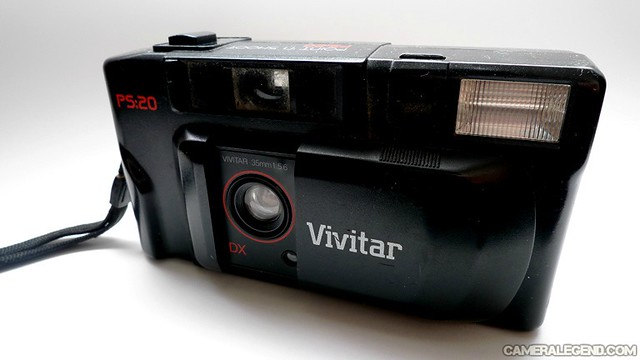
The Lowly Vivitar PS-20 Point & Shoot Camera

Vivitar PS-20

We live in a different age, different time. Everything is better. Cars, television sets, cameras. Heck, even the camera on your phone is likely better than many of the high end cameras you once had. Here’s a camera I wrote about in 2009:

This is my Vivitar PS-20 from 1987. Bought it for $20 bucks at a now defunct chain store called “Caldor”. This camera took me through the late 80’s and half of the 90’s, providing some of the most memorable (if techincally poor) images of my life.

It was part of my two camera kit in my simpler (and poorer) days of the 80s when I had only the Minolta X-700 and one lens, the MD 50mm f/1.7 plus this camera, the Vivitar PS-20. Somehow, I feel like I was much more focused than I am now with the countless cameras I have used. I long for those two camera days, and who knows, maybe that’s going to be a project for me…get rid of everything, use two cameras, and be a happy photographer again 🙂

Ladies and gentlemen, this camera is the quintessential point ‘n shoot. It is what I would call a “SLC” or a “Super Low Class” camera. It is the ULTIMATE “Poor Man’s Camera!” It is poor, it is cheap, it is what people used to think of when they think of a point ‘n shoot camera. In fact, it says “Point ‘N Shoot” on the top of the camera! 🙂

IT’S NOT ABOUT THE CAMERA

Today, lucky us, we have point and shoot cameras that can do so much more than this old Vivitar. Yet in some way, these new point and shoot cameras seem to have lost track of what it means to be a point and shoot!

That’s why I love this old Vivitar PS-20. It can’t do 30 megapixels. It doesn’t have a Zeiss or “GR” lens. It can’t do HDR. It can’t do HD Video. It’s not a “luxury” point and shoot. It makes no pretenses about being anything other than a point and shoot camera 🙂

140343323.fVR6yepL.DSC_1288Zoe

“Joy Of Point ‘N Shootin” 2009. Baby Z gets a kick out of Papa’s old camera 🙂

While this article is about the Vivitar PS-20, it is really not about the camera itself. It’s a tribute to the lowly point and shoot cameras of yore. To the thousands of lousy, but charming old point and shoots out there. The ones that are worth next to nothing, but have more heart and soul than a $3000 point and shoot.

The Vivitar PS-20 “Point ‘N Shoot” may never be a Camera Legend, but taken as a collective with its thousands of peers, they all could be considered Camera Legends.

SPECIAL NOTE ABOUT THIS CAMERA

This is the funniest thing, except it’s really not funny. A few years ago, some seller on Amazon apparently decided to swipe (steal) this pic from my Flickr stream and use it. You can see the Amazon ad in this link HERE.

I never made a big deal out of it because it’s not an award winning picture or anything and this camera is worth next to nothing. In fact, before I wrote about this camera back in 2009, I don’t believe there was any information on it anywhere on the web because I always do a little research before writing about anything.

As I said, I’m not mad or anything, but I do find it humorous. But if I, by some chance, had an award winning shot and someone used it without my permission, sure I would be pissed.

But this, nah, it’s something I’ve accepted as part of the deal when you post pics on the internet. When you post something to the internet, remember this is part of your “contract.” I’m sure the person who used the photo didn’t know any better.

The main thing people should remember here is, just as Napster once opened the MP3 Pandora’s box, so too do you when you post pictures to the internet.

I’ve always accepted that once you post something, it’s subject to theft or anything by anyone. So please, if you feel you have an award winning picture, DO NOT post full sized images. Put some kind of watermark or something.

If it’s just an average, everyday picture no need to do anything, no one will care. I hate watermarks or copyright logos actually. The only reason I put them here is so that people can remember the website, which is always a wise thing when you’re running a relatively new site.

More cameras to come, have a great week! 🙂


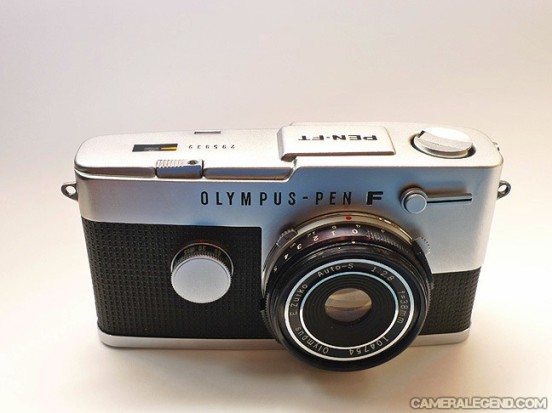
Celebrating The Olympus Pen

PenFC

The Olympus Pen FT and Zuiko 38mm f/2.8 pancake lens.

With the release of the new Olympus Pen-F digital, I thought this would be a good time to celebrate the old Olympus Pen film series and the original “Digital Pen” the Olympus E-P1 🙂

Before we do that, just a few notes on the new Pen-F digital. It is a 20mp mirrorless camera in the Micro 4/3’s format. It has a built-in 5-axis image stabilizer in the body, much like the OM-D (which I love) series or the EP-5. 1080P HD Video. Nice touches include the electronic viewfinder (EVF), the 80/50mp (raw/jpeg) high-res mode, and customizable modes. There’s a lot more to it of course.

The funny thing is that when Olympus released the E-P1 in 2009, they marketed it as the new “Digital Pen” yet with this new Pen F, we are being told (as seen on the Dpreview video) that this is a whole new class of Pen cameras, and priced accordingly at $1199. Yeah, ok 🙂

OlympusC

“Decade Of Digital” From left, my first digital camera bought in 1999, the Olympus C-3000 Zoom and the Olympus E-P1 from 2009.

Anyone who knows me knows I’m a huge Olympus fan going way back. I’m sure the new Pen F digital will be awesome and just on the specs alone, it looks to be 1000 times better than the original E-P1, but I probably won’t be getting one any time soon. Not now anyway. Price is an issue, yes. Don’t have, and don’t want to shell out that much for a Micro 4/3’s camera.

And nothing against Olympus, but coming from the old film school, while I love the new Pen’s retro looks, I just see it as a digital camera dressed up in a film camera’s suit. Much like the Fuji X series, Nikon DF, or any number of cameras riding on the retro wave. This has been an enormously successful formula for many companies and more power to them. While I love the way they look, I’m just not as easily pulled in by it.

In addition, it’s really hard for me to get excited about the latest and greatest these days. The truth of the matter is that most of the cameras from the last five years (and going back even further actually) have been extremely capable.

I may sound a little less than enthusiastic, but I’m still young enough to realize that whether it looks like a film camera or not, whether I like the retro looks or not, learn to love it because (and my fellow film fanatics might not like this) let’s face it…This IS the “Digital Era.” Film may be around for a long time, who knows. But the “Film Era” has passed and it will never be the film era again.

But if you got the dough for the new Pen F, I’m sure it’s going to be an awesome new toy for you!

If you want to see all the new Olympus cameras, you can do so right HERE which is an easy link to everything. You can also pre-order there or here Olympus PEN-F if you want to be among the first to get one. My favorite might be that “Faux Leather” OM-D EM10 II!! 🙂

Below are some images from the Olympus Pen F and FT half-frame film cameras and the Olympus E-P1. I’ll dig up more if I can find them. I’ll keep shooting with these oldies until I can save enough for the new digital Pen F 🙂

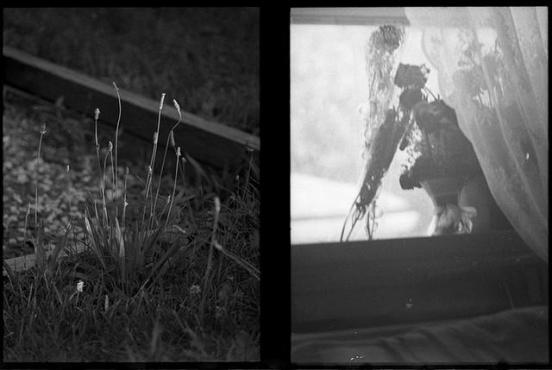
12522944_10207474007440702_2584785228760462622_n

“Order & Chaos” 2009. Olympus Pen FT, Zuiko 38mm /2.8 pancake lens, Tri-X. These two sequential frames from the half-frame Pen FT shows how order can turn into chaos in a minute if Grandma is babysitting you 🙂

540628_3716236796857_375587103_n

“On Life & Love” 2010. Olympus Pen F, Zuiko 100mm f/3.5, Tri-X. As in life, love grows like the weeds, is full of hope and promise, but eventually grows old like last week’s bouquet of roses 🙂

531200_3410784400738_2009729031_n

“Beauty & The Beast” 2009. Olympus Pen FT, Zuiko 38mm f/1.8, Tri-X. Both a little scared, neither one prepared, beauty and the beast 🙂

OLYMPUS DIGITAL CAMERA

“Aging In a Digital World” 2010. Olympus E-P1, Lumix 20mm f/1.7

OLYMPUS DIGITAL CAMERA

“RGB” 2010. Olympus E-P1, Lumix 20mm f/1.7, Brooklyn, NYC.

OLYMPUS DIGITAL CAMERA

“Sex & Religion” 2010. Olympus E-P1, Lumix 20mm f/1.7, Atlantic City, NJ. You might not be able to see it, but there’s a gentlemen’s club on the left and a church on the right. I’m still trying to figure out why WordPress is not letting me post larger pics.

120946458-1.c6ZnWIqs.EP1ZoeSamBuddies1.jpg

“Digital Buddies” 2009. Olympus E-P1, Lumix 20mm f/1.7 ASPH. Had a little fun with this one 🙂

Photo Of The Day: “Magic of Ramen Noodles”


“Magic Of Ramen Noodles” 2011. Minolta CLE with Canon 50mm f/1.5 Serenar ltm lens on Kodak Tri-X 400 developed in T-Max developer in 2011.

It might not be the best thing for you, but it sure feels good in the tummy 😀

Yes, it’s instant ramen, the ultimate poor man’s comfort food. Perfect for those times when you’re absolutely starving or when you have very little time to concoct a fine meal. Once the craving is satisfied, hunger is gone 🙂

Celebrating Ten Years Of JuJu

DSC_9567JJ

JuJu @ Six Months. 2006. Nikon D1X. Cannot remember the lens, it just shows as 300mm on the exif viewer. A straight jpeg from the D1X, no treatment done. Although it was only 5mps, I really loved the D1X!

No “Tuesday Titans” today. Instead, we are celebrating a “titan” of our personal world. He is the first kid of the new generation of our family. Today, we celebrate my nephew JuJu who just turned ten recently. He was, in a way, my first beta tester for so many of the cameras that came into my possession in the years following his birth. Thanks for joining me in the celebration and for my fellow gear heads, take comfort in the captions which will reveal some the cool cameras used during this ten year period. Happy Birthday JuJu!! 🙂

80313978.Y6P5wTjM.JoeJU1CPba

“Boy From NYC” 2006. Bessa R3a, CV 40mm f/1.4 Nokton Classic, Kodak BW400CN. I had just fixed the rangefinder on this camera, it was the first rangefinder adjustment I’d ever done. Shortly thereafter, I sold this camera, but now looking at the results from this combo, I kinda regret it!

124288972.KEsjHcuK.PenZoeJuJu1_SerenityCalamity

“Order & Chaos” 2009. Olympus Pen FT, Zuiko 35mm f/2.8 Pancake lens, Kodak Tri-X 400 developed in T-Max developer. Two frames from the half frame Pen FT camera showing how order can turn into chaos in a minute 🙂

1614239_10202970154807201_8424783835683906259_o

“My Brother’s Keepers” 2014. Nikon D1X, 35mm f/2.4 MIR Russian lens.

10917057_10205025856438457_737518350959434799_o

“Rockabilly Ju” 2013. Fuji X-Pro 1, Canon FD 55mm f/1.2 Aspherical lens. JuJu rocks around the clock! 🙂

10295047_10202961627314019_3801333893296660026_o

“Happy” 2014. Panasonic DMC-GF1, Lumix 20mm f/1.7 ASPH lens. Go ahead people, clap along if you feel like a room without a roof! 🙂


Tuesday Titans: The Mighty Minolta XK Motor

DSC00181XKMotorCCC

The Legendary Minolta XK Motor of 1976. Sorry for this funky Instagram pic, I’ll probably replace it 🙂

Hi everybody. Let’s start 2016 off with a bang with this ultra-rare Camera Legend, where info is scarce even on the best Minolta/Rokkor sites…

Somewhere in the deep, dark corridors of my camera memory lurks a giant. A giant that frightened and fascinated me at the same time. That giant is the Minolta XK Motor.

The XK Motor is a 35mm SLR introduced by Minolta in 1976. It was marketed as a professional camera and was Minolta’s answer to the Canon F-1 and Nikon F/F2.

The XK Motor is ultra-rare and hard to find in today’s market.

MY MEMORIES AND DREAMS OF THE MINOLTA XK MOTOR

As a kid, I still remember seeing this gigantic brute of a camera in magazine articles and ads. It was a camera that seemed frighteningly large, muscular, and complicated to a young boy. Yet at the same time, for a skinny young kid, this camera’s muscular build signaled “power” in my mind.

I wanted it bad, but I knew I’d never get one. Or so I thought…


HOW I CAME ACROSS THE MINOLTA XK MOTOR CAMERA

Fast forward some thirty plus years. About four years ago in 2012, I saw two XK Motors listed on KEH Camera in BGN (bargain) condition, priced at about $500 each. Right away, knowing the rarity of these cameras, I had to get one!

Fortunately, it was one of those rare times when I actually had enough in the bank. Sure it still hurt to part with $500, but hey man, this was the Minolta XK Motor! Gotta have it! 🙂

So I got one, and if I had the funds, I’d probably have gotten the other too, but I didn’t have any funds left and it quickly went to someone else.

Though I can’t check 24/7, I do check KEH’s site fairly often. I’ve never seen the XK Motor before or since on KEH’s site. My theory is someone sold these two from their collection to KEH and it quickly went up for sale.

THE XK MOTOR BODY

When I first got the camera, I was in awe. This thing was solid, heavy, and just as in my dreams, seemingly powerful.

The body feels blocky, much like other cameras of its time such as its slated competitors, the Nikon F/F2 and the Canon F-1.

Unlike those two cameras, the motor drive is permanently attached on the XK Motor. The motor drive was capable of a (then) “high” of 3.5 frames per second at its top speed.

The camera required two EPX-76 or S-76 alkaline or silver batteries for the body and ten, count ’em, TEN AA batteries for that motor drive. With batteries installed, this camera got heavy fast!

The camera had electronic shutter speeds of 16 seconds to 1/2000th of a second and mechanical shutter speeds of 1/100 and B.

ISSUES

Shortly after I got the XK Motor, I realized it is not without issues. While my first roll of film went off without a hitch, I quickly realized there was one glaring achilles heel (or heels in this case) with this giant.

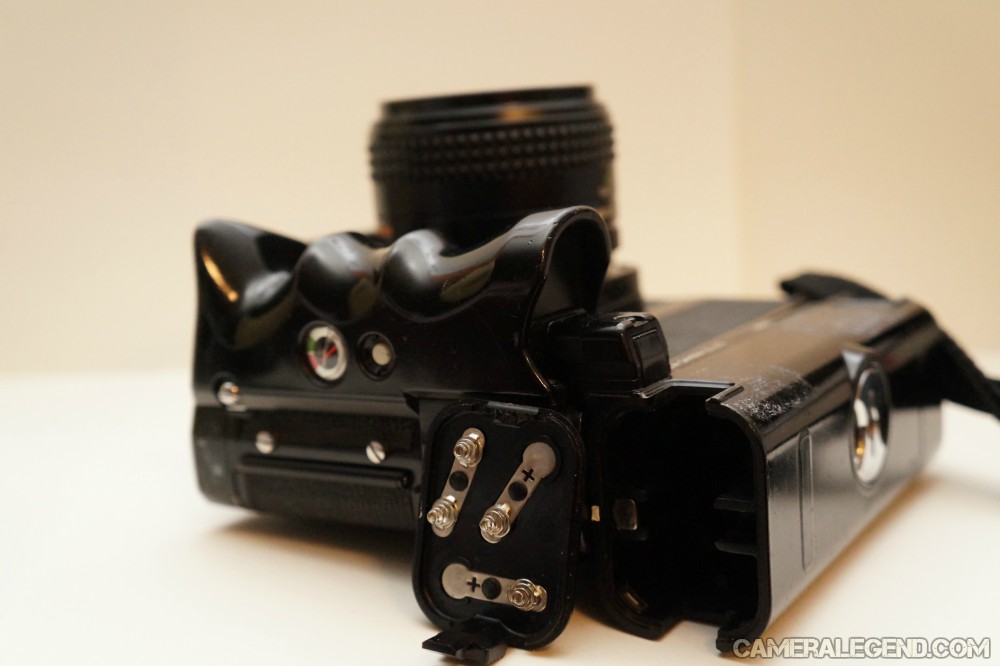
That fault is…the battery clips that hold the epic ten batteries are brittle and worse, they eventually break rendering the great “motor” portion of the camera virtually useless. They broke off on both sides of my XK Motor and believe me I did not do anything rough to cause it.

DSC00184MC

“Chipped Clips” The battery clip issue is the main thing that ruined my XK Motor experience. If seeking one of these cameras, be aware that this is an unfortunately common thing with these cameras.

And if that wasn’t enough, trying to find a replacement for these clips is harder than finding a needle in a haystack!

Sure, I have tried the old fashioned method of taping the broken clips. As you can see from the pics, that is exactly what I did but it didn’t work well. The tape would eventually come off and one time the battery compartment on one side got incredibly hot and I had to quickly remove the batteries for fear of fire.

If you think the broken battery clips were just my error, take a look at this link from KEH BLOG from 2011.

They had an XM Motor for sale in EX+ condition for $1950 with one catch…”battery door broken” 🙂

WHY I SOLD THE XK MOTOR

I recently sold this camera to a private buyer who was willing to buy it as is for the same price I bought it for. The great thing about these old legendary cameras is that you could almost always sell them without much of a loss.

It may seem unscrupulous to sell the camera in worse condition for the same price I bought it, but these babies are rare and the last one I saw was on eBay where it was sold as a parts camera. Bidding went over $500, so I definitely think I gave a fair price.

It became an unusable paperweight for me and the climax of a dream that became a nightmare.

This camera could have easily become one of my “Best Cameras I Never Knew” but it’s such a rare camera that I was honored to have had a chance to hold and use one in the flesh, fulfilling one of my childhood fantasies.

X-1 XK XM DIFFERENCES

There is actually a non motor driven version of this camera. The ones sold is the USA are known as the XK and known elsewhere around the world as the XM or X-1.

While the XK Motor is ultra-rare, the standard XK/XM/X-1 are not as rare. Many people mistakenly buy these thinking they are the XK Motor, but they are not, and they do not command the same high prices.

Cool you say, couldn’t I just buy an old motor drive and turn my XK/XM/X-1 into an XK Motor? In theory, you could’ve, but sorry there was no motor drive option for these cameras which is one of the reasons the XK Motor still holds its place among the Camera Legends of Minolta.

BOTTOM LINE

The Minolta XK Motor was a dream camera for a young boy that turned into hard reality for a grown man.

It was Minolta’s answer to the Canon F-1 and Nikon F/F2. Unlike the Canons and Nikons, the Minolta XK Motor had one glaring and seemingly incomprehensible fault…weak battery clips!

Despite their ability to make some of the world’s finest cameras and lenses, there IS a reason why Minolta never made it to the top in the world of Canon and Nikon pro bodies. A flaw such as weak battery clips is totally unacceptable for a professional grade body such as this.

If you search the internet for the XK Motor, you will find precious little information from actual users. You will not see much on the battery clip issue either. Why? Because there is not much info on this camera in general, it’s that rare.

In usable form, the Minolta XK Motor is a dream camera to hold and use. It was a culmination of Minolta’s dream to rule the professional camera world. It was a dream ruined by flawed execution, but that doesn’t matter in the end. The Minolta XK Motor represented the power of Minolta and what could have been. It is, without a doubt, a Camera Legend.

WHERE TO BUY?

If looking for an XK Motor, and I’m not sure that’s a good idea, prices are very hard to calculate due to its rarity on the market.

I got mine for $500 at KEH Camera in Bargain condition. But they also had one five years back in EX+ condition for $1950. The last one I saw on eBay was an “as is” parts camera which went for over $500 in 2013.

So I would say in pristine working condition, these cameras could easily fetch anywhere from $1500-2000 and maybe more.

If you want a taste of the XK Motor without using a fine toothed comb, you could easily get the ‘regular’ XK/XM/X-1. Prices for these can go anywhere from $50-300. I would not pay more than $100 for one. In fact, I got one of these for $56 bucks! 🙂

Note: I do have pics from my test roll with this camera and the 50mm f/1.2 Rokkor. But it’s not on a hard drive, it’s on a photo CD and I can’t find it. I do not think these test pics are worthy of your time, but I am still looking for them and may or may not post them. But it is proof that at one time, the Mighty XK Motor worked and gave me some nice pics!


Tuesday Titans: The Pentax MZ-S

PMZSCPSII

The Pentax MZ-S of 2001. Perhaps the best 35mm SLR Pentax ever made.

The Pentax MZ-S was a high end 35mm autofocus SLR introduced in 2001 by Pentax Corporation.

The MZ-S was the last 35mm flagship film SLR from Pentax and was marketed as a professional camera.

THE MZ-S CAMERA 

The first thing about the MZ-S that you’ll notice right away is the somewhat odd and futuristic look to this camera. The MZ-S was apparently supposed to be the Pentax “MZ-D” which was to be the first Pentax full-frame digital SLR and at that time, it would’ve been the first Pentax DSLR full-frame or not. The prototype was shown in 2001, but never materialized in production.

In many ways, the MZ-S looks and feels like a modern digital SLR. Strong, sturdy, but feels somewhat lighter than a comparable film camera such as a Nikon F-100. If the MZ-S was indeed a digital camera, it’s my opinion that this would be the coolest looking Pentax DSLR ever!

With Ricoh/Pentax’s recent (actually a couple of years now) teasers on a full-frame 35mm digital and thinking back to the MZ-D, it does make you wonder nearly fifteen years later on now, will we ever see a full-frame Pentax DSLR?

Of course, we know they have the technology, but one has to wonder what’s taken them so long. Fifteen years and counting guys 🙂

Anyway, back to the MZ-S. The body is strong with a magnesium alloy chassis and to me it looks great, especially with the BG-10 battery grip attached. But I have heard differing opinions.

This is a story within itself, but aside from their classic M42 and K mount cameras, Pentax has not been known for making the prettiest looking cameras in the modern era. I’ve heard people say that Pentax AF cameras look “atrocious” and “horrific” to, on the other side of the coin, “fantastic” and “magnificent.”

There’s not much of a grey area when it comes to Pentax AF bodies. You either love them or you hate them.

The Pentax MZ-S with the BG-10 battery grip attached has a very aggressive look, not unlike the Canon EOS-1 I profiled earlier. In an odd way, it does look like a Pentax version of a Canon 1 Series camera.

Unlike the EOS-1, the MZ-S feels noticeably lighter. And with the grip off, it is a very nice and more portable body. While marketed as a pro body, the MZ-S actually feels closer to a semi-pro or advanced enthusiast class body such as the Nikon F-100 or Canon EOS-3, although I must say these two cameras do feel more rugged to me than the MZ-S. The MZ-S however looks more interesting than the other two 🙂

The MZ-S featured a 6 point AF system and has a shutter speed range of 30-1/6000s and a flash synch of 1/180s. The camera has mirror lock-up and can do auto-bracketing and multiple exposures.

The MZ-S without the battery grip runs on two lithium CR2 batteries. With the BG-10 attached, the camera will run on four AA batteries.

HANDLING AND OPERATIONS

The MZ-S feels excellent in the hand. Solid, tight, but not too heavy. Controls are well laid out for the most part, but it’s an odd mix of good and confusing.

There are dedicated buttons and switches for AF, Drive, Metering, etc, etc. There is also a dedicated MF/AF switch near the lens mount. When you have clearly marked dedicated dials and buttons, it’s always a good thing.

The cool circular LCD actually has a dial around it that serves as your controller for changing shutter speeds, modes, etc. The funky looking dial on top left of the camera is actually two dials, for ISO, exposure compensation, auto-bracketing, and multiple exposures. This left dial is probably the most confusing part of the camera, but it all makes sense once you get to know it. The camera also has 19 custom functions. This is truly a pro spec’d camera!

PMZSIII

The top deck of the MZ-S. A strange mix of good yet confusing controls, highlighted by that top LCD in a cool circular dial. That’s Pentax for you! Sorry for the dust. I could, if I tried, maybe take a nice studio type shot of this, but I live in the real world and in the real world, there’s dust 🙂

This camera offers quite a comprehensive feature set and I don’t feel like writing a manual on it. But if you want to figure out all the MZ-S can do, you will probably need a manual for this camera.

While you can figure out many things without an instruction manual, again I will say that I think you do need a manual to completely figure this camera out so it’s not the most intuitive camera I’ve ever used, but to be fair, most complex electronic cameras of the modern era fall in the came category.

PERFORMANCE

imgMZSZoeSmile1051 copy (1)

“Sunday” 2010. A smile to transform an ordinary Sunday into something extraordinary 🙂 Pentax MZ-S, Pentax FA 35mm f/2 AL lens, Arista Premium 400 film.

The Pentax MZ-S performed very well in the several rolls I’ve shot with it. The camera was quick to focus, albeit a little noisy when focusing. It will sometimes hunt in low light and the noise can be a little disturbing. AF was for the most part accurate.

MJ

“Joe Young” 2010. Pentax MZ-S, Pentax SMCP-FA 77mm f/1.8, Arista Premium 400.

I’ve only used two AF lenses with this camera. The SMC Pentax-FA 35mm f/2 AL, which is an excellent lens, and the SMCP-FA 77mm f/1.8 Limited, which is a superb performer by any standards.

The MZ-S offers six segment, multi-pattern, center-weighted, and spot metering. I usually leave it at the six segment setting where exposures are usually spot on.

MZSZC

“Barbizon” 2010. A star in the making? 🙂 Pentax MZ-S, Pentax SMCP-FA 77mm f/1.8 Limited, Arista Premium 400.

BOTTOM LINE

Pentax has always been a bit of an eccentric in camera world. They have always been the under-dog company that offered a much needed alternative to a world ruled by two or three big dogs.

They created a legacy that includes not only great 35mm cameras and lenses, but they have also been a force in the medium format world with iconic cameras such as the Pentax 6×7 and now in the digital era with the Pentax 645z, beloved by today’s pros. That’s something neither Canon nor Nikon has done. A true Camera Legend company, no doubt.

As far as camera collecting, the Pentax M42 mount cameras and lenses are hugely popular as well as K mount manual focus bodies and lenses. The Pentax AF 35mm film bodies, not so much.

But the MZ-S is different. It is a highly capable body and in my opinion, perhaps the only Pentax 35mm AF body worth collecting. I hope I’m not offending any Pentaxians out there, but cameras such as the ZX-5n and *ist film bodies, while very capable, are hardly what one would consider collectible.

In recent years, Pentax has had a resurgence of popularity, thanks in part to its merger with Ricoh and great cameras such as the Pentax K-5 of 2010.

The MZ-S may have been the most full-featured and capable film SLR that Pentax ever created. It is a well designed camera that can perform to a very high level and has almost everything you might need. And of course, it is capable of using the fantastic Pentax AF and manual focus lenses, one of the largest and most abundant collection of lenses available for any system.

The Pentax MZ-S may have started its life as the would-be Pentax full-frame digital that never materialized, but ended its life as the last great Pentax camera of the film era. It is without a doubt, a Camera Legend and one of the best cameras ever made by Pentax.

WHERE TO BUY?

If looking for the MZ-S, prices are trending at $150-350, with average prices of around $250 or less. There was a time when these cameras commanded close to $400, but it seems the prices have fallen on these babies in recent years.

You can find them quite easily on eBay, where most of them are being sold from Japan.

KEH Camera has them from time to time, prices are usually a bit higher there, but you would probably get the best one for your money, plus a great warranty and return policy.

I got my first one there, sold it and missed it. Found my second one at Adorama in their used section for around $200 in EX+ when they were going for over $300 at the time. And you can sometimes find a good deal from sellers on Amazon.

Note: Sorry a little late with this post, but I got it in before Tuesday was done 🙂

Doing this blog is a labor of love, but these late nights were killing me and I really needed to get myself together. Thanks for your continued support my friends, appreciate it!


Black & White Portraits

JuJu1Pba-2

“The Tsingtao Boy” 2009. Canon F-1N, 50mm f/1.4 FD lens, Tri-X. Chinatown, NYC.

While I do love color photography, there’s just something different about black and white photography that really endears me to it. And when you combine b&w with people (or animals!), that really takes it to another level for me.

These are just some b&w images taken over the years. Like I’ve said before, sometimes I do want to remind myself that I love shooting almost as much as I love cameras…I think! These are also images from cameras I am planning to review for you, cameras like the Leica M8 and the Canon F-1N, which is one of my favorite Canon bodies ever, past or present.

It seems almost unbelievable to me that it has taken this long, but after two weeks I’m finally getting my main working computer back today! As I mentioned before, this really set me back as far as content for this website is concerned and I’m just beginning to catch up. Thanks to those who continue to visit and I do appreciate your time and comments.

This is admittedly going to be a busy week and writing a blog with any kind of content takes a lot of time. Even my shortest article takes me almost half a day. I admire those who can do this consistently on a daily basis, I know I can’t!

Hope you all have a good short week in preparation for the Thanksgiving holiday here in the USA.

301330_2123110929706_5679977_n

“Man In The Middle” 2011. Canon Powershot G10, Paranaque, Philippines.

a0020_22M1PSIBW

“Imported From The Past” 2011. Nikon F4s, Nikkor 28mm f/2.8 AIS. The great Louis Mendes stands out like an icon from the past with his old school Speed Graphic and sharp, retro outfits.

399395_3807078227836_955166717_n

“Vimeo” 2006. Canon Rebel XT, Sigma 30mm f/1.4 EX DC. I was buying a lens from this man and I took this shot while testing it. I found out a couple of years later that he is apparently one of the founders of the video sharing site Vimeo!

TheCompetitionC.jpg

“The Competition” 2006. Canon Rebel XT, Sigma 30mm f/1.4 EX DC. Sometimes facial expression tells you everything!

L1002321BoBui1

“Time Will Not Wait” 2011. Leica M8, 35mm f/2 Zeiss Biogon. Koh Samui, Thailand.

M8BluesMan1Crop

“Brother Blues” 2010. Leica M8, 50mm f/2 Summicron-M. Washington Square Park, NYC.

PAudMCC

“My Door Is Open” 2011. Leica M8, 50mm f/2 Summicron-M. Nonthaburi, Thailand.

12193438_179280389080157_404639994576245317_n.jpg

“The Godfather Of Bangkok” 2011. Minolta CLE, 40mm f/2 Summicron-M, Tri-X. A scene from a restaurant on the side streets of Bangkok, Thailand. With one hand on his meal, the other hand reaches for the plate before anyone else could get to it first. Don’t mess with the Godfather of Bangkok! 🙂

A couple of my favorite portraits from the selection above were done with Sigma lenses. Our affiliate and friends at Adorama is offering some incredible savings on SIGMA lenses which only runs through 11/30/15 so if you wanted to pick up some of those super sharp “ART” lenses, this is a good time to do it! And if you order within a certain time, they make every effort to ship same day, which is a great benefit to buying from Adorama versus the competition.


Flashback Friday: The Olympus M-1 Film Camera

DSC_0669M1CamFAC

The Olympus M-1 35mm slr. Basically an OM-1 with a few external and internal differences. The most obvious give away is the “M-1” logo on the top plate of the camera. Otherwise, the M-1 and OM-1 are cosmetically and functionally the same.

The Olympus M-1 is a 35mm SLR introduced by Olympus in 1972. It is the original OM-1.

The M-1 was originally a part of the Olympus “M System” as they called it. They were all set to go, even having a full set of lenses made to support the M-1. Only one thing they forgot…Leica already had an “M System” out!

From all accounts, Olympus changed the designation of the M-1 to the “OM-1” because Leica protested the use of the “M” and “M System” as it conflicted with their M series rangefinders and their lenses.

The M-1 is basically an OM-1, which is among the finest and most iconic systems camera ever made. A modern masterpiece from the brilliant mind of the late great Yoshihisa Maitani, the genius camera designer of Olympus.

There are some differences between the M-1 and OM-1. Main thing you need to know is that the M-1 says “M-1” on the top plate and it cannot accept a motor drive.

There is a wonderful page that tells you everything you need to know about the M-1 if you google “Olympus M-1 film camera.”

As a camera, it has an all manual 1s-1/1000s plus bulb shutter and originally took a PX-13 mercury battery, which has long been outdated/outlawed. The battery is only needed for the meter and yes, the camera can operate without a battery. You can use a replacement battery and my recommendation would be the Wein MRB625 Zinc battery which at 1.35v is closest to the original mercury cells.

RARITY, PRICE AND COLLECTABILTY

This one is not as easy as it looks. While the M-1 is certainly not as common as the OM-1, I don’t think I would call it rare either. “Rarer” would be a better word I guess.

They don’t seem to come up for sale often, but you do see them at fairly regular intervals on eBay, usually by sellers who stress that it’s “RARE.” I know that sounds like an oxymoron, but you know what I mean 🙂

I got mine for $40. It is not in perfect condition, eyepiece and focus screen looks to need replacing, viewfinder needs cleaning, but the shutter works though I haven’t tested it for accuracy. It’s going to be a fixer-upper for me which should be fun.

I have seen people asking up to $500 for this camera, usually on eBay, but they ain’t getting $500! 🙂

Most camera lovers will know or search and find out that the M-1 is basically an OM-1, a camera you can get anywhere from $10-150 dollars depending on condition and how much you want to spend.

A more consistent and fair price for this camera I think is around $150-250 in excellent condition and preferably with a lens thrown in.

SamOM

“Zuikoholic” 2009. With the black Olympus OM-1 and 40mm f/2 Zuiko lens. As far as I know, the M-1’s were only made in chrome.

Of course, for a collector with money, and if you are a true Zuikoholic you probably wouldn’t mind paying extra just to have that “M-1” in the house 🙂

BOTTOM LINE

The Olympus OM-1 is one of my favorite manual SLR’s of all time. The beautiful styling, mechanical shutter and all manual exposure makes it a pleasure to use just for the pure joy of photography.

When I gave up on my Minolta X-700 from 1985 and after trying Canon and Nikon in the 90s, I settled on a couple of OM-1’s and it carried me through the rest of the decade giving me thousands of precious memories on film. And as the 90s came to an end and digital was dawning, my first digital camera was an Olympus C-3000.

The M-1 being the “rarer” version of the OM-1 makes it just a little more special.

These cameras live on in their OM-D incarnations although I think all the OM-D’s lack the true heft and feel of the classic film OM cameras. As imagers, I think the OM-D’s are great!

DSC_0671M1OMDFAC

“Generations” 2015. The Olympus M-1 film camera on the left and the OM-D EM-5 on the right. Yes, I know that OM-D needs a little dusting off 🙂

In closing, there is no doubt that the Olympus M-1 (and OM-1) is a true Camera Legend that inspired a whole generation of photographers and continues to influence photographers and camera designers, even today.