Flashback Friday: The Nikon Coolpix 100, The First Nikon Coolpix Camera

UPDATE 11/01/15: Just want to pass along some info for our Nikon fans out there that I have been informed of HUGE instant rebates going on for a limited time. You can check out all the Nikon deals HERE. From what I can see some of the instant savings are up to as high as $1100!! on certain Nikon camera/lens combos. If you’re looking to buy new Nikon stuff, this is the time to do it!

You may also find the Nikon deals HERE. While browsing/dreaming, I was amazed at the deals and wish I had the funds! For example, you can now get a new Nikon D7100 for close to the price of a USED D7000. This is a screamin’ deal for some of Nikon’s hottest cameras and lenses.

DSC01100SamCoolpix100S

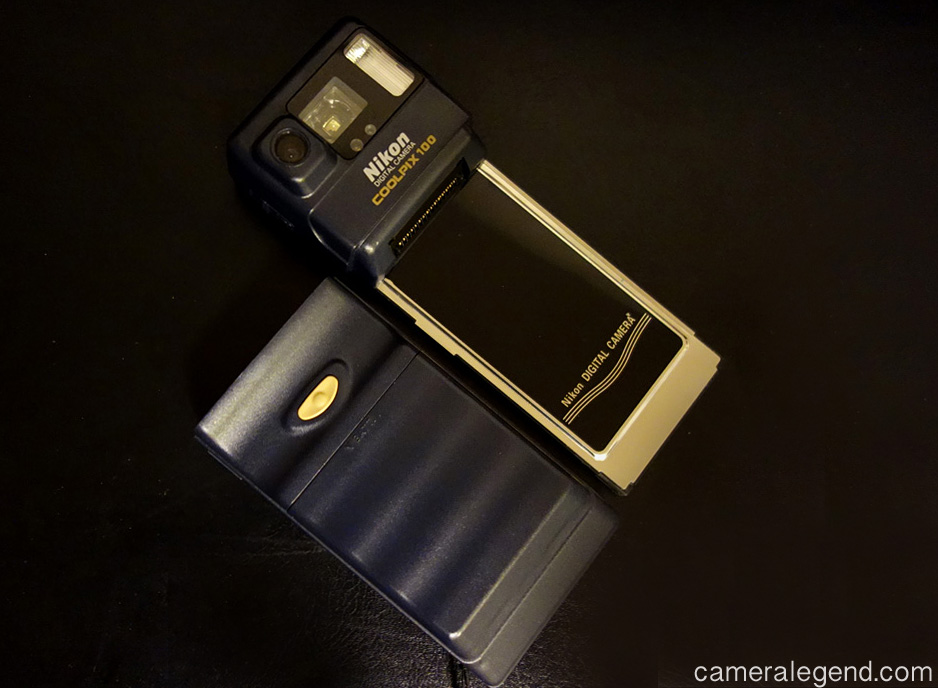
“Retro Thang.” The Nikon Coolpix 100, released in 1997, is Nikon’s first camera under the “Coolpix” banner.

The Nikon Coolpix 100 is a .03mp digital camera introduced by Nikon Corporation in 1997. It is the first Nikon Coolpix camera and the first Nikon digital aimed at the general public.

The Coolpix 100 featured 52mm f/4 fixed lens and a whopping .03mp resolution, proving a maximum of 512×480 in Fine mode on a 1/3″ sensor.

The camera takes no media card as it is built around an old school PCMCIA serial connection and has a built-in memory which holds a maximum of 19 images in Fine mode and 37 images in Normal mode.

DSC01103NikCPC

The Coolpix 100 is a long and funky camera. The camera is built around a PCMCIA device and takes no flash media. Instead it has built0in memory for very limited storage of images.

I found this camera for…59 cents!! The camera was in “As Is/Parts” condition. At first it didn’t seem to work, but after fiddling with the battery compartment, it came back to life.

However, I can’t show you any pictures from it because I have been unable to locate my oldest computer which might have a PCMCIA slot.

DSC01102NikCP2C

The Coolpix 100 with its “jeans” off revealing its PCMCIA computer connection.

Information is scarce on this camera. In fact, if you search “Nikon Coolpix 100” what comes up is a more recent “Coolpix P100” camera.

That said, this camera, as with many from the dawn of digital are not worth much if anything. It is only valuable to me as a collector, but financially it’s worth almost nothing.

Despite its low value and (now) low tech, the Nikon Coolpix 100 is indeed Nikon’s first ever consumer digicam under the “Coolpix” label and therefore has its place as a Camera Legend.


PhotoPlus Expo Show Report Part II: Canon, Nikon, Sony, Etc

The Leica SL (Typ 601) was the Big Daddy for me at this year’s PhotoPlus Expo, no doubt. I mean, after that, where do you go? 🙂

DSC01029CLeicaC

The Leica S and SL gallery of images.

Anyway, I know there’s a lot of other “fish in the ocean” so I’ll try to give you guys a rundown of other things I saw. This is Part II and my final show report for this year’s expo, but it is by no means a “complete” report of the show, it would take way too much time to do that and I’m sorry if I left out anything someone might have been interested in. I leave the complete reporting for sites like dpreview, etc, etc.

CANON

Canon had all their big guns out as well as their hot new lenses. Obviously, the cameras getting the most attention were the Canon 5DS and 5DS R, their 50 megapixel super DSLRs.

I tried the 5DSr and low and behold…it looks and feels like a 5D! I don’t know what else to tell ya! It feels good, it’s dependable, it’s a 5D series camera. Nothing super exciting, but you know it’s going to get the job done.

DSC01051SamCamC

Trying out the new Canon 5DS R, 50.6 megapixel champion with the 24-70mm f/2.8 II. Nice combo!

The Canon rep did ask, to my surprise, if I wanted to put a card in there and try it out. Of course, I didn’t have a card on me! All these years I’ve gotten used to the idea that manufacturers won’t let you put a card in their demo cameras so I didn’t bring one.

But I don’t regret it. What will I get? Some boring pics of the crowd at the expo? All the samples I need, I can find on the web anyway.

Canon did have some really nice large prints showcasing the capabilities of these cameras.

DSC01054Canon5DSRPic

Prints from the Canon 5DS and 5DS R. I walked right up to the print and saw hairs on the model’s nose. That’s resolution for you! 🙂

They looked gorgeous, superb, but not mind-blowing. I’m not taking anything away from these incredible 50mp cameras, but I didn’t think the prints were anything that you couldn’t do with today’s crop of 20+ megapixel cameras. It’s really a new day in photography when one has a hard time being impressed with 50mp prints!

I did ask the Canon representative if there was a 1DX replacement coming any time soon. The 1DX is nearly five years old now and seems due for an upgrade. The answer was that they do not know. Are you surprised? 🙂

Canon also had all their new lenses out, and I had a good time looking at them, although it’s not like I’m going to be getting any new lenses any time soon.

NIKON

Nikon had their usual DSLR lineup at the show. Of course, the D4s was there, the Df, and surprisingly the very old D3X was also on hand.

DSC01062NikonGenC

“I AM GENERATION IMAGE.” Nikon’s new cool slogan 🙂

All their big daddy lenses out for all to drool and fool around with. Nothing new as far as I can see.

Actually the coolest thing I saw at the Nikon booth was the retro looking black and silver J5 mirrorless camera 🙂

DSC01059NikonJ5C

Coolest Nikon at the show! The retro looking Nikon J5 mirrorless.

UPDATE 11/01/15: Just want to pass along some info for our Nikon fans out there that I have been informed of HUGE instant rebates going on for a limited time. You can check out all the Nikon deals HERE. From what I can see some of the instant savings are up to as high as $1100!! on certain Nikon camera/lens combos. If you’re looking to buy new Nikon stuff, this is the time to do it!

You may also find the Nikon deals HERE. While browsing/dreaming, I was amazed at the deals and wish I had the funds! For example, you can now get a new Nikon D7100 for close to the price of a USED D7000. This is a screamin’ deal for some of Nikon’s hottest cameras and lenses.

SONY

I had a good time checking out the new Sony A7RII and A7SII, I couldn’t get my hands on the RX1R II due to lack of time.

The new cameras felt great, but to tell you the truth, since getting my A7R last year I have very little interest in spending any more to ‘upgrade’ a camera that works well for my needs.

I’m finally at a point, thank God, where I really am not interested in the latest and greatest!

Note: Still editing pics, I have some from the Sony booth that I may post. Maybe, maybe not 🙂

FUJIFILM

Fuji had a hot booth showcasing their latest cameras and lenses. I was impressed with the prints from the X-T1. If my old X-Pro 1 had focused anywhere as good as the new Fujis, I would’ve never given up on the X system.

DSC01016FujiC

The ever popular Fujifilm spot.

Fuji also had a very cool “retro” area showcasing their popular line of Instax cameras. I give Fuji a lot of credit for being one of the very few manufacturers still dedicated to making instant cameras and instant film.

DSC01024FujiPrintsC

Fuji posted some wonderful pics, mostly from their X-T1 cameras.


ETC, ETC

Aside from the Leica SL (Typ 601), the only other camera I really wanted to see at the show as the fabled Ricoh/Pentax full-frame. Apparently, they had a near complete mock-up that was shown early on in the show, but it was no longer there when I went on Saturday.

My thoughts on this? Ricoh/Pentax…guys, enough of this hide and seek! If it’s that hard and if it’s going to take you that long to bring out a full-frame DSLR, don’t worry about it! It may be a showcase product, but it’s not like you’ll be selling a boatload of these vs Canon, Nikon, or Sony.

DSC01022RicohC

“Imagine. Change.” Ricoh/Pentax’s lineup. Always a very capable system and a great alternative to the Big Boys.

I’m a huge Ricoh/Pentax fan, but they’ve taken way too long with this thing. I’m all for “getting it right” and maybe that’s what they’re doing, but the longer they take, the more likely the tech inside the camera will be outdated.

They did have the awesome 645Z there and the images I’ve seen from this camera at its best eclipses almost anything else out there. At $6995, you can get this 51mp digital Medium Format camera for less than the new Leica SL! Wow!! 🙂

DSC01023PenPeepC

“You Know You Want It.” Ricoh/Pentax rep and customer debating on the hot Pentax 645Z camera system 🙂

Zeiss was on hand with all their HOT lenses! However, I don’t see myself being able to afford one of these any time soon 🙂

DSC01041CZeissC

Hot lenses!! Who doesn’t love Zeiss? I don’t even know one photographer who doesn’t 🙂

FINAL THOUGHTS ON THE EXPO

The PhotoPlus Expo is always a lot of fun, especially if you’ve never been there. But every year, the cameras and lenses have gotten better to the point where I feel it’s no longer all that exciting…for me, anyway.

I go there to check out the latest gear, yes, but I also go to hook up with good friends who I haven’t seen in a while. Sadly this year I wasn’t able to go on the day when the “Dream Team” was attending and they know who I’m talking about! Sorry about that, and hope to hook up in the near future 🙂

Let me say this; if you have a modern Canon, Nikon, Sony, Pentax, etc, you probably have a camera that’s “good enough” for your needs. We are very lucky to live in an age where cameras can do what they can do, I love it! That said, the better these cameras get, the more film I shoot 🙂

DSC01070SamLMendesC

“Film Buddies.” With my analog brother, Mr. Louis Mendes, NYC street photography icon. The Master Blaster has always been good to me and I consider him a friend and an inspiration.

I apologize to anyone who found this report lacking. I know there are a lot of Canon, Nikon, and Sony fans who probably wanted a little more.

I’m not a reporter. I’m a fan. I went to the show as a fan of these manufacturers and their products, and I am relaying what I saw, what I experienced.

Best,
Sam


The Best Camera I Never Knew Part II: The Rollei A110

DSC01007A110CA

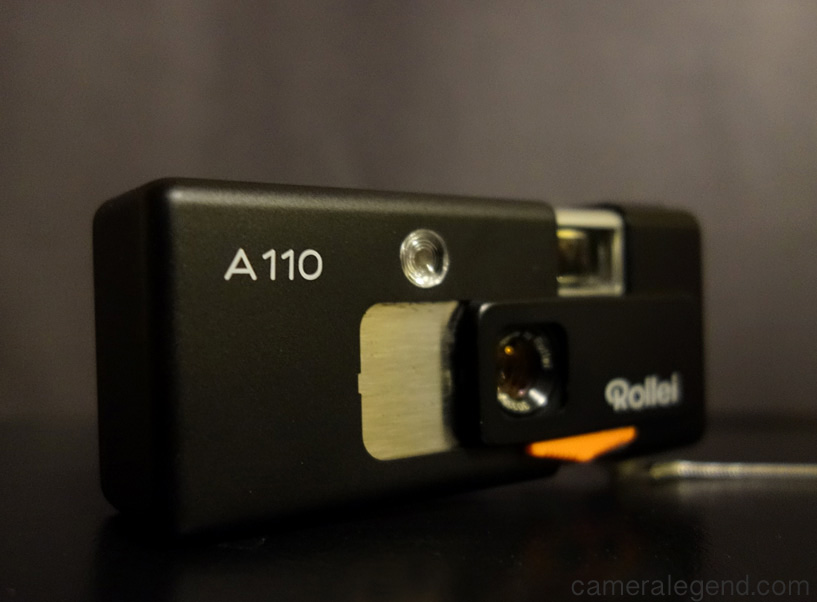
The Rollei A110. One of the Best Cameras I Never Knew 🙂

I will have more from this year’s PhotoPlus Expo I promise you, but today I’m going back to the core of this site, which is classic, collectible, and interesting cameras.

The first in this series was a camera from Rollei called the Rolleimatic. It was a camera designed by Rollei camera design legend, Heinz Waaske.

Today’s “best camera I never knew” is also…a Rollei! And also designed by Mr. Waaske and his design team 🙂

It is called the A110 and it is a super cool looking miniature, pocket camera that takes 110 film. I know a lot of people who think 110 film is extinct, but you can still readily get it through Lomography or Amazon.

Lomography will also do the developing if you send the film to them or drop it off in one of their stores.

THE CAMERA

The Rollei A110 was introduced by Rollei in 1975.

The camera is a funky little thing. The camera relies on scale focusing and has a focus range of about 3.2 ft to infinity. There is an orange focusing slide below the 23mm f/2.8 Tessar lens. In the viewfinder are symbols to give you an idea of what you should choose to focus on depending on how far away your subject is. The symbols include one person, a group of people, and a mountain (infinity).

Pulling the camera “apart” and closing it advances the film and cocks the shutter. This is definitely a Waaske design trademark!

The camera is auto exposure only and originally took a 5.6v PX27 battery. The modern day replacement for the battery is a S27PX silver battery that is 6 volts. This small difference could effect the exposure, but with the wide dynamic range of most films you should still, in theory, get a usable shot.

WHY IT DIDN’T JIVE WITH ME?

Why? Why you ask? I got two of them from eBay. Both didn’t work! 🙂

The sellers swear they were working, but I suspect both sellers did not know much about the camera. Many are probably found in their parents or grandparents camera collection and being auctioned off by people who have no idea what they are selling.

Fortunately, I got both of them cheap. First one for ten dollars, second one fifteen. If seeking an A110, they usually run from $10-50, with an average of around $30. They usually come with a presentation case and a cool chain. If you’re lucky, you can get the whole shebang with presentation case, leather case, chain, and flash.


WHY BOTHER?

With the exception of hardcore film lovers, and I do count myself as one, this camera doesn’t make a lot of sense.

It takes 110 film which is not widely available and of which development is only available in select speciality stores.

The image quality will not exceed what you can get with 35mm film or even today’s higher end cell phones.

So why did I want one? First, I am a camera hunter and I love old, classic cameras, and even more so if I can find them cheap. The A110 fits that bill. The very first camera I ever used was my Mom’s Kodak 110 camera from the 70s, so there’s a bit of nostalgia in it too.

Secondly, I’m a fan of Tessar lenses, so again, the A110 fits that bill. And lastly, even if the image quality would be less than 35mm, the A110 could possibly give me a unique film look, which is something I’m always after.

So guess what? I’m on my third A110, which I got for $30 and this one IS working! Got film in it now, but it is unfinished. Then when the film is done, I still have to send it out for developing and that might take a while.

So until that day when I can see the results from the quirky, eccentric, classic camera, the Rollei A110 will remain…The Best Camera I Never Knew 🙂

Note: If you want to see a great review of a WORKING sample of this camera, please check out this review at DOWN THE ROAD a great blog by Jim Grey who also reviews classic cameras with excellent photo samples, as well as elegantly and honestly sharing his personal life experiences. It’s a great blog worth checking out!

PhotoPlus Expo Show Report I: Hands On With The Leica SL (Typ 601)

Ho! There she is…

photo-36 copy 3

Hands on with the Leica SL (Typ 601) and Vario-Elmarit 24-90mm f/2.8-3.5 ASPH at PhotoPlus Expo in NYC. As I handed the combo back to the Leica representatives, I thought of Biggie’s immortal words…”It was all a dream” 🙂

I’ve been going to PDN’s PhotoPlus Expo show in NYC every year since 2007 to check out the latest and greatest gear. High on my list of priorities this year was to get a glimpse and hopefully try out Leica’s new SL (Typ 601), their new 24mp, full-frame mirrorless system camera.

As I approached Leica’s booth, a little anticipation came over me. I don’t know why, maybe it’s the Leica name, mystique, “German Heritage” or what have you. I was a little worried that I, a mere peon, would be “snubbed” by the people representing this Camera Legend.

I need not have worried. The Leica reps were among the nicest people at the show! Certainly a lot nicer than the Nikon rep I ran into, but I’ll leave it at that for Nikon.

Anyway, I asked the Leica representative if I could try the SL and he handed the camera to me right away.

I actually picked up one with a smaller Leica T lens on it, and he said, “Take this one better” as he handed me the SL and 24-90mm f/2.8-4 Elmarit, which is their full-frame setup.

LOOK, DESIGN, FEEL AND USE

The camera, together with the zoom lens, felt very solid. It did look like a Sony A7 series, but was larger and felt much beefier.

The materials used to cover the camera body felt very nice to the touch, grippy and comfortable.

DSC01035Cams

“The Last & The First.” From left, Leica’s S (Typ 007) digital Medium Format system, the Leica R8 (mine!) and the Leica SL (Typ 601). I asked the Leica representative if I could put my R8 next to the SL and take a photo of them together. He said yes and liked the idea so much, he asked if he could take the same photo! Of course, I said yes 🙂

The design and controls are very minimalist, very Leica. There were some buttons which I’m not sure were labeled, which could be a problem in usage, and I’m not sure this was a pre-production model or not. If it is, I would hope they will have better labeling and indicators on their final production model cameras.

The view in the EVF looked great. Just like the Sony A7 series, it was very sharp and easy to see. The AF was very fast and accurate on first impressions and easy test targets. If I had more time with it, I probably could’ve selected harder to focus subjects, but time was of the essence so I didn’t have that luxury.

THE LENS

The Vario-Elmarit 24-90mm f/2.8-4 ASPH was huge. If was big and beefy. You have to wonder why in today’s world, a zoom lens of this range has to be so large and heavy.

The zooming action was smooth and the lens focused very fast and accurately on the SL under the bright shows lights of the expo.

As I understand it, this lens has built-in optical stabilization which is always a great thing to have. The Leica representative stated that this lens could do macro mode on both ends of the zoom range, which is quite unique and something you don’t see in many lenses.

As a prime lens lover though, I did ask the Leica representative if they had any primes in the works for this camera.

He mentioned a 90-280mm tele-zoom, and then stated they were going to have a 50mm f/1.4 Summilux lens for this camera that will “set new standards.”

I said, ‘So you’re going after the Zeiss Otus?’ and the answer was “Yes.” Now this I have to see! 🙂

MY THOUGHTS

The camera is a beautiful monstrosity! Ugly, but beautiful at the same time. It feels great in the hand and the operations were smooth.

I think the SL is going to be a great camera, I don’t doubt that. However, at $7450 for the body and $4950 for the zoom lens, this is strictly for the hardcore Leicaphilles. I wouldn’t be able to even put a down payment for these 🙂

I suspect most people will opt for the Sony option, which offers similar and even better spec’d cameras at much lower prices.

Even though I didn’t ask the representatives outright, I do suspect that the SL and especially that 24-90mm Vario-Elmarit to be made by Panasonic.

The lens is very reminiscent of the Vario-Elmarit 14-50mm f/2.8-3.5 ASPH which they released in 2006 as a kit lens for the 7.5mp Panasonic DMC-L1 and Leica Digilux 3 cameras which were 4/3’s system cameras.

That was also a beefy lens. The look, the lettering, everything screams Panasonic. Nothing against Panasonic, they make awesome cameras. In fact, if Panasonic released a twin of the SL under their own name, I’d be inclined to try it!

Leica has made their name as a premium brand, and they earned it. I totally understand that. But in today’s world, with SO many digital camera choices out there, I think they are doing themselves and their fans (myself included) a disservice by pricing themselves right out of the market.

Despite all I’ve said about pricing, there will be one thing I can predict with confidence…the SL (Typ 601) will sell out on its first run! 🙂

WHERE TO BUY?

If you’ve got serious cash to spend, you can pre-order the Leica SL HERE and the matching Leica Vario-Elmarit-SL 24-90mm f/2.8-4 ASPH HERE. It’s slated to be released for sale November 20, 2015.

If you get this camera, you’re a CAMERA LEGEND in my book and I want to hear from you! 🙂

Autumn Surprise 2015

DSC00634ZaydaZoeCATI

“Autumn Surprise” 2015. Sony A7R, CV 35mm f/1.2 Nokton Aspherical. I used to love using 90-105mm lenses for shots like this. Now I like using wide and getting in close. For a larger and better view, please click on the photo.

Every year since 2008, I’ve been photographing my elder daughter in a personal series of fall portraits that I like to call “Autumn Surprise.”

I’ve used the photos to document her growth with the yearly change of seasons. It’s quite heart-warming to see how quickly she has grown. Time flies too fast for me 🙂

Today, that seven year record was broken with the introduction of her baby sister into this series.

Just as fun for me is to see the gear I was using then and what I am using now. I plan to post the whole series in another post.

If you live in an area of the world that has fall foliage and you have children, this is a good weekend to pull out your Camera Legend cameras and catch those kids in the Autumn Leaves!


Leica R Images

As a follow up to last night’s article on the Leica SL (Typ 601) mirrorless full frame system from Leica, tonight I am posting some Leica R images, both film and digital that I have taken over the years.

The Leica R system was Leica’s 35mm SLR system. Though it had its own large and cultish following, it never set the world on fire the way Leica’s M system did.

That said, Leica R lenses were every bit as good as their M system equivalents and at one time commanded much lower prices. But through online forums, the internet, and the popularity of alternative lens adapters, the prices for the R lenses have gone way up.

I had an almost complete collection of the “essential” R lenses, including the 28mm f/2.8 Elmarit-R, 50mm f/2 Summicron-R, the 80mm f/1.4 Summilux-R, the 90mm f/2 Summicron-R, the 90mm f/2.8 Elmarit-R and the hard to find 35mm f/1.4 Summilux-R.

While I had to sell most of them when I hit rock bottom, the one I regret selling the most was the 35mm f/1.4 Summilux-R. I had a persistent overseas buyer who offered me twice what I paid for it. I needed the money. That was five years ago. I have yet to find another one as their prices have skyrocketed to the point where I don’t even consider it.

Still, you may find bargains in the R lens lineup that you won’t with the M lenses. So for your Throwback Thursday, I present you a small set of Leica R images that I hope will show some of the characteristics of these fantastic lenses. Please click on the images for a better view. Thanks for lookin’

Best Regards,
Sam

SLZoePepsiCAFA

“Blue Bayou” 2008. Leicaflex SL, 90mm f/2 Summicron-R, Kodak Portra film.

99388588.WRfjkUXc

“Lots Of Love” 2008. Leica R8, 90mm f/2 Summicron-R, Ilford XP2.

BirdJunC

“Bonnie & Clyde” 2008. Leica R8, 90mm f/2 Summicron-R, Ilford XP2.

CLeicaZ80C

“UFO” 2012. Leica R4, 80mm f/1.4 Summilux-R, Tri-X film.

TreeC

“Lonely Still” 2008. Leica R8, 90mm f/2 Summicron-R, Ilford XP2.


CZoeC

“Those Eyes” 2008. Canon EOS 5D, 90mm f/2.8 Elmarit-R

SL90Plants

“The Entrance” 2008. Leicaflex SL, 90mm f/2 Summicron-R, Fuji Superia X-Tra 800.

17600_10200941212084901_1335241629_n

“Ordinary Day” 2013. Canon EOS 1Ds, Leica 28mm f/2.8 Elmarit-R. The focus was off, but I kinda liked it.


The New Leica SL (Typ 601) System

lcsl

The newly announced Leica SL (Typ 601). A 24mp, full-frame, mirrorless monster from Leica!

There’s a new Big Daddy in town! Leica has announced its 24mp, mirrorless, full-frame camera system and from the pics I have seen, it’s a MONSTER!! It’s called the SL (Typ 601). Leave it to Leica to give it one of these funky “Typ” names, sounds so serious 🙂

It looks like a Sony A7 series on steroids. Seriously, it looks like a beautiful monstrosity, just in time for Halloween 🙂

I’m hoping to see this thing in the flesh this weekend at the Photo Plus show in NYC. I will report back if I do see it in the flesh so stay tuned.

_MG_5075SLSamCAM

The original 35mm Leica SL. Perhaps the best film SLR made by Leica. Image from 2008, CPG Productions.

The Leicaflex SL was introduced in 1968. While Leica 35mm SLR’s didn’t exactly set the world on fire the way their M series did, I do consider the SL one of the finest 35mm cameras of its time. Dials, knobs, a glorious viewfinder and pure manual focus goodness and unlike many of the R series cameras, the SL was actually designed and made by Leica.

I can’t foretell whether the new digital SL (Typ 601) will have the timeless appeal of the original SL, but I have no doubt it’s going to be an imaging giant!

Meanwhile, if you’ve got serious cash to spend, you can pre-order the Leica SL HERE and the matching Leica Vario-Elmarit-SL 24-90mm f/2.8-4 ASPH HERE. It’s slated to be released for sale November 20, 2015.

Despite its price tag, I’m sure this camera will SELL OUT almost right away, so if you got the cash, I don’t have to tell you…Don’t hesitate because that SL won’t wait! 🙂

This is going to be an awesome combo, no doubt, but it’s going to be WAY beyond my reach and wallet. I like cheap and this ain’t cheap…but I like it!

But I’ll tell you one thing…If you get this, YOU my friend will definitely be a CAMERA LEGEND!! 🙂

Here are the official specs and a pdf brochure on the SL (Typ 601) from Leica.

Technical Data – Leica SL (Typ 601) & SL 24-90

Memo 2016-33 Leica SL (Typ 601)

It’s Fall Foliage Time!

It’s that time of the year again. Especially for those of us in the Northeastern part of the country, the autumn leaves are at or approaching their peak. In some parts, they may even be past their peak.

While I haven’t gotten my foliage pics yet this year, I hope to soon. Maybe this weekend or next.

Anyway, I thought this would be a good time to post some fall foliage from years past. Many with gear I no longer have, but how I miss them!

This is a great time to photograph and use some of those Camera Legends in your closet. Don’t miss it!

Update 10/17/15: I did get some shots today, but only have one to post so far. It is the top photo using the EOS-M I reviewed HERE.

IMG_0230AutumnEOSMCA copy

“AutM Leaves” 2015. Canon EOS-M, 22mm f/2 STM.

Autumn5DC

“Change” 2007. Canon EOS 5D, 70-200mm f/2.8L IS.

ZoeLeavesFA

“Fall Fashion” 2014. Nokia Lumia 1020.


AutumnD700NC

“Red, Green, and Gold” 2008. Nikon D700, Hasselblad 110mm f/2 Planar via adapter.

AutumnRollei

“Fall Back” 2007. Rolleiflex 2.8F, 80mm f/2.8 Planar, Kodak Portra 400 UC.

SONY DSC

“Crown Of Thorns” 2012. Sony NEX-C3, 25mm f/1.4 CCTV lens.

10685428_10204953304024692_577397599141384464_n

“It’s Raining Leaves” 2008. Contax 645, 80mm f/2.8 Planar, Kodak Portra 400 film.

The First Sony Cybershot Camera…Plus A Look At The Sony RX1R II

SonySamIIC

“Cyber Cam” The Sony DSC-F1 from 1996 is an 0.3mp digital stills camera and is considered to be Sony’s first digital Cybershot camera.

Sony has just announced their latest Cybershot camera, the Sony RX1R II.

It’s a premium quality fixed lens camera with 42.4 megapixels and a superb 35mm f/2 Zeiss Sonnar T* lens. Wow. To appreciate how far we’ve come in camera technology, let’s take a quick look at the very first Sony Cybershot camera.

THE VERY FIRST SONY CYBERSHOT CAMERA

Now here’s a camera not many of you today remember, heard about or even knew existed. Web searches are scarce, this is a forgotten camera and probably justifiably so. But it was a first for Sony.

The very first Sony Cybershot camera is the Sony DSC-F1 from 1996. This camera featured a 0.3 (!) mp sensor, a fixed 35mm equivalent f/2 lens, and a 1/3″ sensor that produced VGA quality 640×480 pixels. The camera has a unique swiveling lens. This could’ve been one of the first “selfie” cameras 🙂

DSC00989SonyDSCam

From 1996, the DSC-F1, Sony’s first Cybershot camera.

It does not say “Cybershot” anywhere on this camera, but it has the distinction of being the first “DSC” stills camera from Sony which is why it is considered a Cybershot. Before entering the still camera market, Sony had been known for producing quality video camera for years. It is interesting to note that at the time of its introduction, Sony was so new to this that the lens on the DSC-F1 says “Sony Video Lens.”

I got this camera for ten bucks. I have no samples to show you because it requires a hard to find, old school serial PCI type cable to download the images. The camera also has an IRDA port to transfer images wirelessly. Ahead of its time!

If you wonder what that 0.3mp quality would be like, just imagine an old school web-cam. It’s dreadful. That’s what this camera basically is.

You don’t see them for sale often, but they are not worth much if anything. And I don’t know if it ever will be. But being the first Sony Cybershot camera, the DSC-F1 is indeed a Camera Legend. I love the design and the way it looks, that’s the only reason I got it.

Now let’s go into details about Sony’s latest Cybershot camera…

THE LATEST CYBERSHOT: The Sony RX1R II

Sony has just announced the Sony RX1R II. Major specs from reading the Sony press release are: 42.4 Megapixel full-frame sensor, apparently the same BSI-CMOS sensor as the A7RII, 35mm f/2 Zeiss Sonnar T* lens, retractable XGA OLED viewfinder, faster AF (same system as A7RII) and the world’s first optical variable low-pass filter. You can actually choose whether or not you want the AA filter in front of the sensor and if so, the levels, i.e., off, standard or high. There is of course a lot more to this camera, but you can find all you need to know by checking Sony’s site or searching the internet.

The original Sony RX1 was a high-end point and shoot camera introduced by Sony in 2012. It is a fixed lens camera with a 35mm f/2 Zeiss Sonnar lens and a 24.3 megapixel full-frame sensor.

I must admit, the Sony RX1 was one of those cameras I coveted, but could never get myself to buy. I loved the way it looked, I loved the way it felt, and I loved the files I saw from the camera. However, I couldn’t plunk down $3000 for a fixed lens digital. I didn’t have the cash and even if I did, I just couldn’t do it.

I buy and sell cameras. I’m not rich and I have a family to feed so I have a budget. For me to afford the next camera I get, I have to sell the last camera I got. And with today’s flooded market, that’s not always easy to do. All the cameras I’ve reviewed here, I bought with my own money. I don’t get cameras sent to me for review and I don’t get invited to press events.

My blog is relatively new and I thank each and every one of you who have stopped by, left a comment, or help support it. It’s just the grassroots blog of a guy who, just like you, loves cameras and wants to share what he’s found along the way. There IS a reason for those horrible low-budget selfies 🙂

As mentioned elsewhere on my blog, I would pay for quality but I like cheap. For me to get an RX1, I would have had to sell off a lot of stuff for a digital camera that would depreciate over time. I would rather get a Konica Hexar or Ricoh GR1 and deal with the hassles of developing film, but that’s just me.

That said, I would have to say the files I saw and downloaded from the RX1 were among the most impressive I have seen from a digital camera or any camera for that matter. The camera felt great and the files had a look, depth, and ‘pop’ that you only see when you have a near perfect camera/lens/sensor combo. The RX1 had it. I’m sure the RX1R II will take this to the next level.

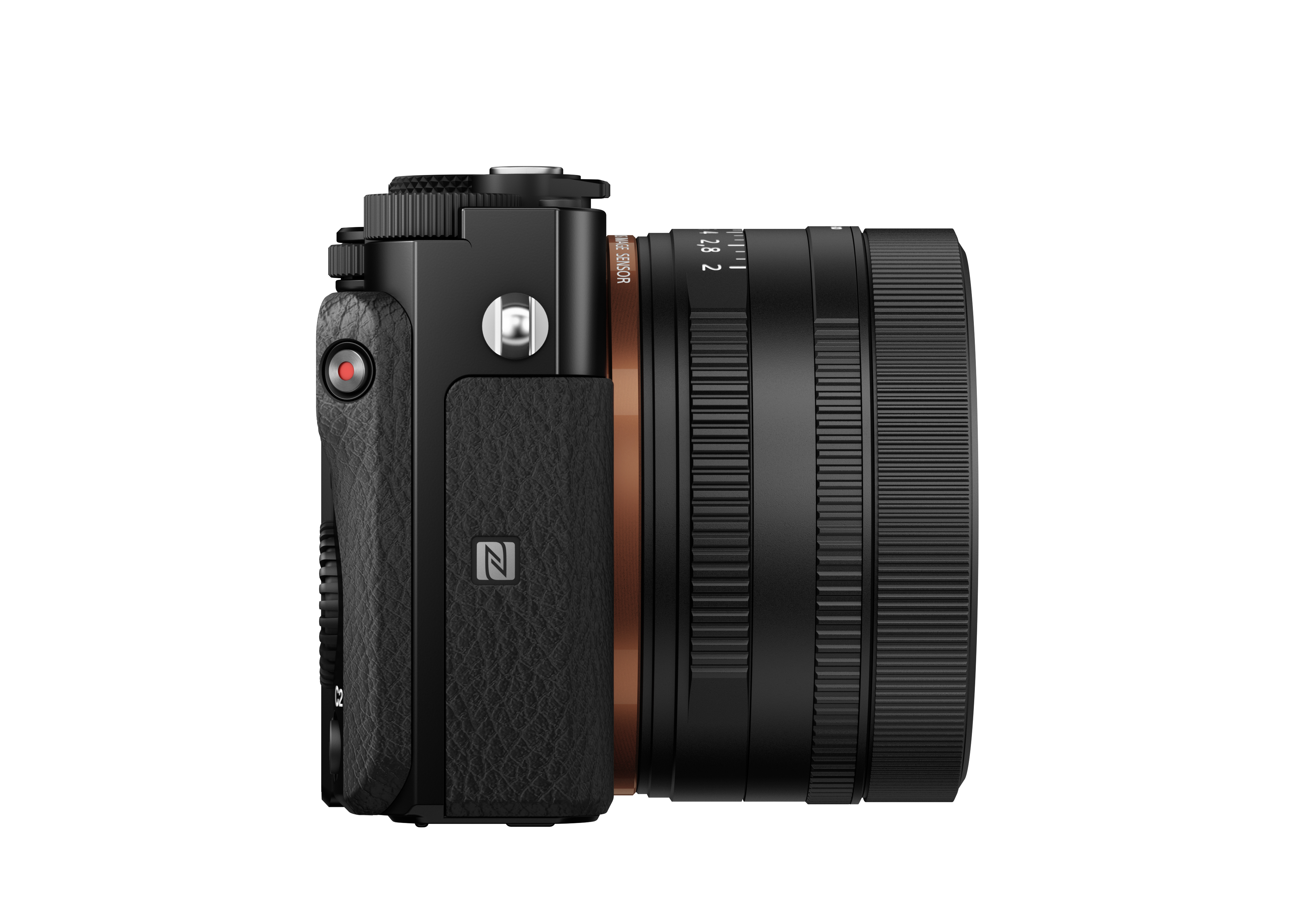
Below are images of the RX1R II distributed by Sony, so you may have seen the images on other blogs as well. While the RX1R II is not available in stores yet, I’m sure it’s going to be a HOT seller. People love this stuff man, we all do! 🙂

Anyway, if you want to sign up for notification when the camera is in stock, you can do so HERE.

But if you’re like me, you’d probably go for a used RX1 or RX1R first version which is a deal at $1200-1500 used. For that I would check Amazon and their vast network of dealers. Even if what you find is showing $2700 etc, etc, etc, when you click on it and scroll down, you will find the USED or REFURBiSHED units. That’s where the deals are.

DSC-RX1RM2_(RX1R II)_front_evf_wLogo

DSC-RX1RM2_(RX1R II)_front_sensor

DSC-RX1RM2_(RX1R II)_rear_evf_eyecup_wScreenFill

DSC-RX1RM2_(RX1R II)_right

DSC-RX1RM2_(RX1R II)_terminal

DSC-RX1RM2_(RX1R II)_top_wLogo

DSC-RX1RM2_(RX1R II)_tilt_hight_wScreenFill

The First Canon Mirrorless: The EOS-M

SamC

The original Canon EOS-M. Trying to look serious, but this camera is fun. Serious Fun! 🙂

With today’s introduction of the EOS-M10 I thought it would be a good time to take a look at Canon’s first mirrorless camera, the EOS-M.

The EOS-M is an 18 megapixel mirrorless, interchangeable lens camera introduced by Canon in 2012.

I got the “M” sometime in 2013 when they were having a closeout on these cameras with a huge price reduction.

IN THE HAND

The EOS-M is physically the size of any average digital point and shoot. It is remarkable that inside lies an 18mp APS-C sized sensor, possibly the same or a variation of the venerable 18mp sensor Canon has used in a number of cameras including the 7D and SL1.

The camera feels light, but the body is surprisingly solid thanks to a magnesium alloy body.

The camera controls are spartan. On the top right by the shutter release you have a mode dial for play, camera, and video. There is no dedicated “P/S/A/M” dial they must be accessed through the menu. The menu thankfully will be a familiar one for EOS users. There is a hotshoe for dedicated flash units, but no built in flash.

The camera does feel a little slippery to the touch and could benefit from a hand grip. I don’t believe Canon makes one for the EOS-M, but you can get a hand grip for the camera from third party manufacturers.

PERFORMANCE

The main complaint people had about the original M is the slow autofocus, which they did not expect from a modern Canon digital.

Canon attempted to rectify this with a firmware update, which was version 2.02 which was to improve AF in one shot mode and also supported the new 11-22mm f/4-5.6 STM.

Yes, the people were right, the camera was slow. And yes, the AF did improve after installing firmware 2.02, but it is still slow by today’s standards. I would put its AF on par with the original Fuji X-100.

I originally thought this camera would work for my street shooting, but it’s a tad too slow for on the fly street work. I now use it as a fine stills and family camera 🙂

12052465_10206889611671173_219641290945445510_o

“M Love” 2015. Canon EOS-M, EF-M 22mm f/2 STM. I originally intended to use the EOS-M as a street cam, and it’s fine for stills, but a tad slow for on the fly street shooting. I do love it for family pics if and when the kids are not on the move 🙂

One of the best features of the EOS-M is the touch shutter. This is a feature we’re used to on our phones, but still not quite the norm on “real” cameras.

IMG_0216CokeCAM

“Legend” 2015. Canon EOS-M, EF-M 22mm f/2 STM. Just a test of the EOS-M’s AF system. In auto, the lens would rack back and forth looking for a target due to the white background. But when switched to the touch shutter, it found its mark easily and accurately. Not super fast, but fast enough.

I became a big fan of touch shutter after using it on the Olympus OM-D EM-5. On that camera, it was incredibly fast and effective, especially for street shots. Sad to say, it’s not that fast nor as effective on the M, but hey it works.

I’m not knocking down the M, the AF is very accurate, but it takes its time and I’ve gotten used to that.

High ISO images are good to about ISO 3200 which is a bit grainy depending on the light, but still usable. Higher than ISO 3200 I would say is good for “artistic” purposes 🙂

Another feature I loved on the M are the built in creative filters. I’m not a big fan of novelty filters, but the filters on the M are quite effective and fun to use. The effects include Toy Camera, Fish-Eye, Miniature, Art Bold, Water Paint, Soft Focus and Grainy Black and White.

I got the M as a fun to use camera, and these filters are a big part of what makes the camera fun. It helps to negate the slow AF and other issues I might have with it. However, these filters are for photos I like to look at myself and not necessarily post because the novelty of these filters wear out quickly.

151859933.nCpjeYH5.IMG_0045JJZoe

“Hey You Mini Me” 2013. Canon EOS-M, EF 22mm f/2 STM. A shot using the “Miniature” effect, one of seven Creative Filters found on the EOS-M.

IMAGE QUALITY

The saving grace for the Canon EOS-M is this…

When paired with the EF 22mm f/2 STM, the image quality is excellent to superb, especially at lower ISO settings and favorable conditions. The lens which is equivalent to 35mm on full-frame is quite an amazing performer on the time tested Canon 18mp sensor.

At low ISO’s you can count on clean, colorful, and detailed images with this combo. The image quality is several notches better than the Nikon V1 (with its much smaller sensor) which I also reviewed some time ago. However, the V1 makes up for its sensor disadvantage by having much faster autofocus, which could make the difference between getting the shot or not.

IMG_0230AutumnEOSMCA copy

“AutM Leaves” 2015. Canon EOS-M, 22mm f/2 STM @ around f/5.

I have not tried any other lens with EOS-M. Actually, I believe I did try some manual lenses with it using adapters, but as the M lacks focus peaking it was neither fun nor productive which brings us to another complaint about the M, the lack of native lenses for it. As of this writing, the lenses available are the EF-M 22mm f/2 STM, the 18-55mm f/3.5-5.6 IS STM, the 11-24mm f/4-5.6 IS STM, and the 55-200mm f/4.5-6.3 IS STM.

To their credit, Canon makes an EOS to EOS-M adapter for using your EOS lenses. I have not used it so I cannot comment. I should have mentioned it earlier, but to be clear you CANNOT use standard EOS lenses on the EOS-M without this adapter.

BOTTOM LINE

The original EOS-M was discontinued and replaced by the EOS-M2 which was basically the same 18mp camera with faster AF and then the EOS-M3 which was much beefier and featured Canon’s new 24mp sensor.

Both these cameras and the new M10, I imagine would offer better AF performance than the original M. However, I like cheap, and the original M is probably your best chance to get a Canon mirrorless cheap 🙂

Used prices for the original M or M2 are trending at $200-300 and they are usually bundled with the 18-55mm zoom or 22mm f/2 STM. If you’re lucky, you might find the body alone for around $150-175.

Although the M and M2 are older models, you can still find them abundantly either used, refurbished, or if you’re lucky, new old stock.

Canon (and Nikon as well) have not shown, until recently, a great dedication to expand or promote their mirrorless division which is why you don’t really think of Canon or Nikon when you think of mirrorless.

The original Canon EOS-M is an enigma from Canon, one of the Camera Legends of photography. On one hand it offers slow and sometimes frustrating AF and ergonomics. On the other hand it offers superb imaging possibilities.

Mirrorless was a relatively new market to Canon and the original M shows that even a giant like Canon will make some mistakes when entering a market pioneered and dominated by Olympus, Panasonic, and Sony.

However, based on the image quality I have seen with the EOS-M, I believe they have just scratched the surface of what they could achieve in this market with a little more love and dedication. If Canon got into this market full throttle, I believe they could have a best selling mirrorless Camera Legend on hand and that would be a great addition for all of us camera lovers.

WHERE TO BUY

You can pre-order the new EOS-M10 with the 15-45mm IS STM lens in BLACK or SILVER. Or go all out with the EOS-M10 plus 15-45mm IS STM and the 55-200mm IS STM from our friends at ADORAMA. Actually, if you’re looking for the original EOS-M, profiled in this post, you might want to check out their “USED” section. There’s a good likelihood that the camera would show up there.

You can also preorder from everyone’s super-store AMAZON with their wide selection.

Anyway you do it, I believe any variation of the EOS-M will bring lots of FUN to your life and a good reason to leave that bulky DSLR home 🙂

Note: I will be updating this post later with more pics from the EOS-M. Just so much to do and so little time tonight. Thanks for stopping by!