The Vivitar Ultra Wide & Slim Film Camera

UWSPic

The Vivitar Ultra Wide & Slim and its virtual clone, the Superheadz Yellow Peace. Cult camera favorites of toy camera fanatics.

The Vivitar Ultra Wide & Slim is 35mm point and shoot film camera made by Sunpet Industries of China and distributed by Vivitar under their own name. The camera has an almost exact clone from Superheadz in different colors and different nicknames.

The actual year of manufacture is unknown or undocumented. At least, I cannot find it in my research. I suspect it was made in the 1990s or late 1980s.

The Ultra Wide & Slim is an all plastic camera with a plastic lens and low quality build. However, the camera has achieved cult camera popularity primarily due to its 22mm f/11 “Ultra Wide” lens which is unusual for a fixed focus point and shoot, even today.

As a camera, the Vivitar “UWS” has only one aperture, f/11 and only one shutter speed, 1/125. This makes it primarily usable as a daylight camera using higher speed film.

This was and is intended to be a cheap camera. However, the camera has become very popular with the toy camera, Holga, Lomography, etc, crowd for whom lens distortion, light leaks, and imperfect photos are much desired.

If you love cameras as much as I do, you’re bound to collect some cameras that you have yet to use. This is one (or two) of them!

Actually, I did get a roll of film through the Superheadz but when I developed the film the whole roll came out black. I’m not ashamed to admit that it was probably my mistake in development. I added too much water to Ilford ID-11 which is not a developer I use often, though some say D76 (which I have used often) is the same. However, I’m can’t be 100 percent sure if it was me or the camera so I will try again.

Any camera with a 22mm lens is bound to give you some very dynamic looking photos and I don’t mind the flaws, especially for the price. If you know what to expect, you won’t be disappointed.

If seeking one of these, prices used to be very cheap, but now is trending at $25-50 for the Vivitar in used condition, and from $24-60 for the Superheadz version, price dependent on the model and seller. For example, the black version called the “Slim Devil” runs near $40 from most sellers. You may find a good selection of the Superheadz version HERE.

I got my Vivitar on eBay for under $10 and paid $25 new for my “Yellow Peace” Superheadz clone. These cameras probably cost a few bucks to make, so even buying it for $25 is probably too much in principle. But since we don’t make these cameras (and no one else does) we have no choice 🙂

Don’t go too crazy with these cameras. As I said, they were intended to be cheap and fun cameras, but now some may argue that they are Camera Legends in the toy camera department. Take that out of your head, they ARE cheap cameras. Try to find one cheap! 🙂

***DEAL ALERT***

One great thing about Spring, other than the weather, are all the photographic deals going on. Some great deals and savings on Nikon Lenses are going on right now. If you’re going to buy, please buy through the link and help support this site. I greatly appreciate it, thanks!

Fujifilm Instax Mini Instant Film, 10 Sheets x 5 packs

Olympus has a very cool Trade Up program where you can trade in virtually any used camera and get monetary value towards the purchase of new Olympus gear including the OM-D series and the awesome new Pen cameras.

Photo Of The Day: “Near Miss”

10403425_10205187086492924_6368048658433125075_n

“Angry Bunnies” 2015. Canon EOS-1Ds Classic, Zuiko 35-80mm f/2.8

Easter weekend to me is about reflecting and celebrating the victory of Jesus. It’s also about spending time with the family.

Number one, Jesus, I need to work on. I need to go to church more often. I believe, I respect, and I love Jesus, but maybe that’s not enough.

Number two, I have no problem with. I’m always spending as much time as I can with my family, specifically my girls, although they may sometimes find Papa annoying, as you can see in this photo 🙂

Anyway, here’s a good example of missing the moment because you’re fiddling with equipment. I was playing around with my 11mp EOS-1Ds Classic (2001) and one of my favorite zoom lenses, the Zuiko 35-80mm f/2.8 OM lens when all of a sudden my eight year old (with a piece of gum dangling out of her mouth) and my (then) six month old went into “angry” mode!

The 1Ds is old school. It doesn’t have focus peaking or any fancy way to help with manual focus, other than your eyes. The shot wasn’t in critical focus, but I got it just enough where I could use it on Facebook or send to family. I would’ve preferred it if it were in critical focus and if I had my trusty EF 50mm f/1.8 on the 1Ds, I probably would have gotten that.

But since I was fiddling around with a manual focus lens, I barely got the moment which as you can imagine with kids, was gone right after I took the shot.

Anyway, I’m just glad I got this funny moment enough where I can have a good memory of it.

Have you ever missed a shot because you were fiddling around with a new (or old) lens? Fiddling around with a new camera or its settings?

Hey, have a blessed Easter weekend good people! 🙂

Tuesday Titans: The Contax 645

C645C

The almighty Contax 645 and 80mm f/2 Carl Zeiss lens. I took this shot when I had to sell this dream combo. Perhaps one of the greatest camera systems ever made?

Wow, what can I say about this one?

The Contax 645 is a Medium Format autofocus film camera introduced by Kyocera in 1999. It was part of their 645 system, an ambitious foray in the (then) professional portrait and wedding world where medium format was king.

I got the Contax 645 in 2008 and had the pleasure of using it for a few years, but eventually had to sell it. I’d always say that I would only sell this camera if I had to pay the rent. Guess what? I had to pay the rent 🙂

I had actually gotten the camera initially because I had done a couple of weddings, was thinking of going down the weekend weddings path, and was thinking of adding something different and unique to my wedding portraits. Looking back now, it was just another excuse for G.A.S. but man, if you have to have an excuse for another camera, the Contax 645 is IT!!

I apologize for not having more photos of the camera. When I sold it years back, I never thought I’d be writing about it one day on a blog 🙂

This is by no means a complete review of the Contax 645, just my memory and experience with it. I do have photos made with this camera and will be updating this article, once I can rescan and put them together. I couldn’t write enough to do the camera justice.

THE CONTAX 645 BODY

The Contax 645 is a modular system with removable backs, prisms, and lenses. You can even add a nice (but expensive) accessory battery holder/vertical grip (the MP-1).

The body when fitted with AE prism and film back feels very solid and is as beautiful to look at, as it is to shoot. The viewfinder is beautifully bright and contrasty. I believe there was actually a waist-level finder for this camera.

From the shooter’s perspective, the top right of the camera contains the shutter speed (32-1/4000 in AV mode) and exposure compensation dials. The mode (B/X/M/TV/AV) dial and AE lock is also located on the top right.

The left side does not have a top “plate” so to speak, but it contains the dial for drive (single or continuous at 1.6 fps). The camera runs on one 2CR5 battery, but can run on four AA batteries with the optional MP-1 grip.

The Contax 645 is still popular with wedding and portrait photographers today due to its ability to use compatible digital backs and if you’ve got this setup, this would be the ultimate digital portrait system in my view.

PERFORMANCE

Ergonomically, I had no complaints. It’s a Contax and all the controls are well laid out. It’s one of those cameras I could use without a manual and that to me is always a sign of a good camera.

The Contax 645 is an autofocus camera and unlike the Contax AX 35mm camera I wrote about, the AF on the 645 is quite good and definitely usable.

While there were quite a few lenses for the 645 system, I only used the 80mm f/2 Zeiss Planar so I speak only to my experience with the camera and this lens. I do not know how it performed with any other Contax lenses.

It was not an EOS or Nikon speed demon, but I did not remember having issues with it, except in very low light conditions. I think you’d be fine with this for those wonderful outdoor wedding portraits.

The 80mm f/2 Zeiss Planar is one of the fastest lenses available in the 645 format. I believe only the manual focus Mamiya 80mm f/1.9 was faster.

C1

The lens, as expected, made for wonderful portraits. The lens was beautiful wide open for portraits with bokeh that seemed much smoother than other Zeiss lenses I have used. Perhaps it was the extra shallow DOF that you can get with medium format, but the bokeh on this lens was not quite as “nervous” as the Zeiss lenses I have used in the 35mm format.


BOTTOM LINE

If you’ve ever read any of my articles on Contax, you will know that while I love Contax cameras, I’ve always blasted their electronics as brittle and unreliable.

I’m happy to report that in the three or four years that I had the Contax 645, I never had that problem. Oh, there was one time when the camera started focusing erratically, but it turned out that it just needed a new battery.

It seemed to me that Kyocera put everything they could into making the Contax 645 the best camera that they could make.

The Contax 645 is a highly desirable camera. With its usable AF system, and an arsenal of superlative Carl Zeiss lenses, it is an incredibly capable image maker. To this day, it is considered one of the premier systems in all of medium format photography. It is a camera that can take film or modern digital backs making it versatile enough for the old school film die-hard or the modern digital artist.

The Contax 645 is without a doubt a Camera Legend and perhaps one of the greatest cameras ever made.

WHERE TO BUY?

If you’re thinking about a Contax 645, I have to burst your bubble a little bit and say that with Kyocera out of the camera business, buying a Contax 645 is a bit of a risky gamble.

The reason for this is that if something goes wrong with the camera, Kyocera’s contact in the USA, Tocad, will no longer repair them. I’m not sure who does.

The good (or somewhat good) news is that there are not many reports of these cameras needing repair, just do a search. However, as these cameras approach twenty years on the market, they are getting older and as with any camera, there’s bound to be many ready for retirement or in need of repair.

I would imagine that since the camera is incredibly popular with pros, there should be someone or some place out there repairing these cameras. But in my research, I haven’t found any. I believe they still repair them in Japan, but I will have to do more research.

When I got the Contax 645 in 2008, I paid $1200 for the whole outfit with 80mm f/2 lens, film back, and AE prism. A complete outfit in the same excellent condition today runs for $3000 or more. I’m glad I sold it when I did and made a little profit from the sale 🙂

A Mamiya 645 AF or AFD system is probably a better alternative if you are looking for a similar medium format system that will still be supported.

Now, if you still have your heart set on the Contax 645 Kit (body, 80mm lens, AE prism, back) is trending at $3000-3500. I have seen the kit on eBay with the 45mm f/2.8 Zeiss lens going for around $2300.

For this camera, with its delicate electronics, I would definitely recommend buying from a place with a good returns policy. For that you may try HERE and HERE.

INSTAX cameras on Sale

GoPro HERO on Sale


Recent Items

SonZCFAC

“Z Fashion” 2016. Sony A7R, Leica 50mm f/2 Summicron-R. sporting a purple polka-dot jacket for her late winter/early spring fashion as well as a super serious look, trying to emulate her favorite models 🙂

Howdy good people. For some reason this old Barbara Streisand song/lyrics is in my head: “Coming in and out of your life, isn’t easy” 🙂

No my friends, I would never give up on the Camera Legend project, even if at times I want to. I just love cameras too much to stay away from them for too long. And if I’m going to be around cameras, I might as well write about them.

But as I’ve said before, the late nights spent writing the contents of this blog sucked the life out of me and I do need to retreat now and then. I do apologize for not getting back to quite a few of you, but I’m going to get to everyone, and I do thank you.

The good thing for me is that, while on a break, I was able to concentrate on taking photos and remind myself that I love photography as much as cameras (maybe) 🙂

The shot above was taken last week. I usually much prefer black and white for my own portrait work, but I think this shot works better in color. I used a Sony A7R and a beat up Leica 50mm f/2 Summicron-R.


Although it may not be to everyone’s liking, it works for me and for any photographer, I guess that’s what counts. I personally like the cold, bluish hue of this shot. Reminded me of some Eastern European portraits or portraits I used to see in magazines from the 70s.

The lens, while not the sharpest that I’ve ever seen wide open, is giving me that soft/sharp look that I’m always looking for. Based on my experience with the Mandler designed Leica lenses, these lenses are perfect for portraits. The quality of the bokeh, given the right amount of distance, is quite fantastic to my eyes.

Below is what’s sitting on my desk right now. Haven’t run out of cameras, but perhaps ran out of gas (or film, I suppose) 🙂

SONY DSC

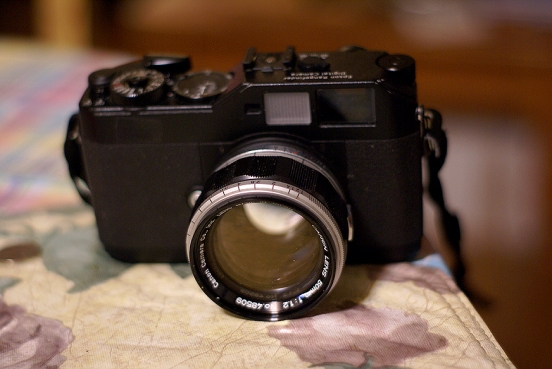
Epson R-D1, Canon 50mm f/1.2 ltm.

file_0124

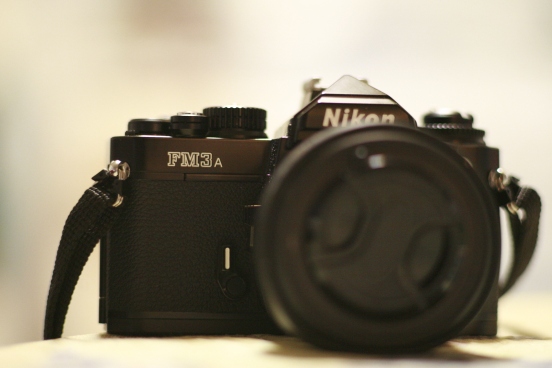
Nikon FM3A. The ultimate manual focus camera?

Have a blessed Palm Sunday and see you soon!


The Fuji FP-100C Discontinued: The End Of Pack Film

imgPolaroid110BZoeC016

“Peace” 2012. Polaroid 110B converted for pack film, 127mm f/4.7 Ysarex, Fuji FP-100C.

Periodically, I go through periods where I need a mental break from it all. I’m sure there’s more than a few of you who feel the same if you’ve been blogging or posting photos on the internet for some time. “C-B-R” I call it. Crash. Burn. Rise (or try to rise) again 🙂

As mentioned before, putting up a blog with any kind of quality content takes effort and I would rather not post unless I could put up something interesting for you.

Anyway, almost two weeks ago it was announced that Fujifilm would be discontinuing the FP-100C, the last commercially produced 3.25×4.25″ peel-apart pack film. The announcement caused a bit of an uproar in the film community.

The discontinuation of this film has more implications than it first seems. It goes without saying that those who truly enjoy pack film and use it regularly will be most affected. But they are not the only ones affected. With no more pack film, here are just some of the after effects:

  1. People who ever wanted to try a “Polaroid Back” with their film camera will be affected when there is no more pack film because virtually all Polaroid backs, especially for medium format systems, take the 3.25×4.25″ peel apart films. And for the Polaroid backs that do not take this film, such as the 545 backs, film is virtually non-existent, except for really old batches sold on eBay or the cool, but expensive New55 films.
  2. The announcement rendered all Polaroid Land cameras and any other camera that takes this film useless. Well, not really useless right now, but living on borrowed time.
  3. People who make a living selling pack film photos on the streets or at fairs, events, etc, will be affected. Admittedly, there are more people these days shooting with a digital camera and a portable digital printer than there are those using pack film, but I do know a couple of really cool photographers whose unique work was directly a result of shooting with vintage cameras and instant pack film, and some who even make a living from this.
  4. Folks who, over the years, have resurrected vintage Polaroid cameras and have made a living restoring and modifying old Polaroid cameras to take pack film. There was a good market for this, just check eBay. They will definitely be affected by this. Some of these people have started converting cameras to use Instax film, but they’re just beginning. I hope they will continue and wish them success with this.

The surprising thing about Fuji’s discontinuation? Well, from all accounts Fuji’s own line of Instax instant cameras and film are booming! These instant cameras are incredibly popular and according to some accounts, making a better profit over Fuji’s own line of renowned digital cameras.

I’ve read people saying maybe Fuji did not want the pack film market to compete or hinder the sales of Instax cameras so they discontinued the FP-100C. This however doesn’t make sense because Fuji had no competition. There was no other company left that was making pack film.

So why not just shoot Instax? Because at this time, there are no Instax cameras that offer decent manual/advanced user capabilities. Actually, there is the Lomo Instant Wide which takes Instax Wide film and offers more manual controls than what Fuji is offering, but reports on this camera are mixed. I hope to get one for review in the near future. However, so far none of these Instax cameras have anything like the great Tominon lenses on the Polaroid 180/195 Land cameras or the Ysarex lens on the Polaroid 110A and 110B.

MY EXPERIENCES WITH PACK FILM

Personally, as an available light and night shooter, I much preferred the Fuji FP-3000B, the amazing ISO 3000 black and white version. It was amazingly sharp with beautiful tones. Sadly, this film was discontinued in 2013, but can still be found albeit at ridiculous prices.

For the FP-100C, I find my best results outdoors with plenty of sunlight. The FP-100C needs lots of light. If you have a studio setup, it’s cool, but I’m an available light shooter. I could and have done portraits with flash, but for those Polaroid “party” shots with flash, I’d just prefer to shoot with a One Step.

The great thing with Fuji’s peel apart instant film is that you get two images for the price: an instant print and a negative which you can reclaim through scanning or a bleaching process.

12507240_10207518823561077_5350476564941216045_n

“Friend” 2009. Polaroid 600SE, 127mm f/4.7 lens, FP-3000B scanned negative side.

Not all is rosy with pack film though. I’ve had issues with broken tabs, film jamming and losing the first couple of shots and sometimes, the whole pack which makes you feel really lousy because these films have become really expensive.

At its best, it’s an awesome feeling because there’s nothing like seeing an instant print develop before your eyes. And with the right camera/lens combo, you can get really excellent pics that can’t quite be duplicated digitally, even with the best “film” filters. At its worst, the film jamming, the underexposed shots, the expense, the gunk, it sometimes makes me say, why bother?

PRICE AND AVAILABILITY

As soon as Fuji announced FP-100C’s discontinuation, the price gouging began. The film was selling for around $10 earlier, all of a sudden it went up to $14.99, then $18.99, now $24 and even over $30 in some places.

This is nuts and capitalism at its best, or worst. Strange thing is that the film was never out of stock whenever I looked, before the announcement. Now, it’s out of stock in most places. I know what you’re saying, supply and demand.

People are panicking. But I look at it this way. The Fuji FP-3000C was discontinued in 2013, but you can still find it even today on B&H, albeit at about three times the price before it was discontinued. Surely, once the entire stock is gone, it’s gone. But apparently Fuji had enough stock that, three years later, is still being sold.

Hopefully, Fuji made enough stock of FP-100C to last us a few more years.

THE BITTER END

In Fuji’s press release, they cited declining sales as the reason for discontinuing the film. This is the only thing that makes sense. Fujifilm is a business after all and just like all businesses they’re here to make money, not to appease a niche market of enthusiasts. Perhaps it cost more to produce the film and maintain the equipment that makes the film than they saw worthy.

Ironically, it is this niche market of old film cameras that Fuji borrowed the analog styling for its very successful line of retro styled digital cameras.

There are online petitions to save the Fuji FP-100C with thousands signed. The same was done when the FP-3000B was discontinued in 2013, it yielded no results. I expect the same here.

12764683_10207745492307654_8311477229874032163_o

“Mini Me” 2016. Pentax 6×7, 105mm f/2.4 Takumar, Fuji FP-3000B.

Some have wondered in the Impossible Project may take up this opportunity and buy out Fuji’s equipment to continue making pack film. I certainly hope they could. They really did do the impossible with Polaroid 600 and SX-70 film and I applaud their efforts. However, I personally feel that they won’t because they are probably already stretched thin as it is, although if any company can do the “impossible” they can!

Fujifilm has always been a different breed and have always made cameras, films, and decisions that were different and often unique. This time, sadly, they did what any corporate business would do and I think all analog photographers have lost something special because of it.


Tuesday Titans: The Contax AX Film Camera

ConAXCC

The Contax AX. A camera that could “autofocus” manual focus lenses. Totally unique, but it didn’t always work well. Note the tripod attachment on the very bottom is not an original part of the camera.

Today, I present to you good readers a double whammy:

“Tuesday Titans” and “The Best Camera I Never Knew” and the recipient of this honor is the legendary Contax AX 🙂

THE CONTAX AX

The Contax AX is a 35mm single lens reflex film camera introduced by Kyocera in 1996. At the time of its introduction, the AX made camera headlines due to its unique ability to autofocus manual focus lenses.

Although probably more technical than this, in a nutshell, AF was achieved by moving the film plane, the distance from lens to film. The official company description of this was “Automatic Back Focusing.” This was a remarkable achievement and still something unmatched in the camera world today.

THE CONTAX AX BODY

The Contax AX is a big, bulky, OX of a camera! The extra bulk was needed to accommodate the mechanism that would drive the film plane to focus.

The camera feels well built, sturdy, and again, bulky. Like most Kyocera made Contax SLR cameras, it gives the feel and impression of quality.

Ergonomically, the AX is pure Contax. That is, controls are well placed with knobs and dials, things I really like on a camera.

On the left top plate you have a mode shifter for AV/TV/P/M/X/B and the shutter speed dial which runs from 4s to 1/4000. Also on the left is where you can change ISO values as well as play around with the cameras Custom Functions. I can’t remember these off hand, but I think the only one I used was the function to leave the film leader out.

On the top right plate of the camera you have the on/off switch, the film counter lcd, the exposure compensation dial, the focus switch which includes macro, manual focus, continuous, single af. Also on the right is a dial for drive, i.e., single shot, continuous, even double exposure.

Again, all these are on switches, knobs and dials that are well labeled which I really love on a camera.

WHY IT DIDN’T JIVE WITH ME?

I tried two of these. The problem? Well, the first one I got couldn’t autofocus to save my life! It would just rack back and forth. Then it would get close, but seemingly give up. I sent that one back. I eventually got another one and it did autofocus…when it felt like it 🙂

Actually, I’m being unfair. Maybe not. Anyway, it did autofocus, and when it did, I got some nice shots. However, the AF was very fidgety. On certain targets, it would be great, but in general, the AF was inconsistent. It would rack back and forth, sometimes never getting the focus, even on easy targets. Sometimes it would be so out of focus and give up. Pre-focusing the lens seemed to help, but again, it wasn’t consistent.

The autofocus was also somewhat slow, but that’s to be expected and I’m not blaming the camera for that. You have to remember this was a camera that was attempting to autofocus manual focus lenses.

ConAXJPBabyI305

“Olympians” 2011. Contax AX, 50mm f/1.4 Zeiss Planar lens, Kodak Tri-X 400 developed in HC-110. When the AX managed to focus, it focused well, but it was inconsistent. Shooting in daylight seemed to help.

And speaking of manual focus, you can do that with the AX and if you use the camera that way, it’s a pleasure to use, but maybe not to carry around due to its bulk.

ConAXZoe304

“Fix My Hair” 2012. Contax AX, 50mm f/1.4 Zeiss Planar, Kodak T-Max 400 in HC-110. Aside from trying to capture the moment, I was actually testing the autofocus system on the AX. The problem is that, with the AX, I always seemed to have to be “testing” it 🙂


BOTTOM LINE

So why does this “Titan” of a camera get a “Best Camera I Never Knew” badge? Because autofocus was its selling point. It was an admirable attempt by Kyocera, and like I said, if and when it worked, it’s great. But most of the time, for me, it didn’t hit its mark.

Ultimately though, I just could not rely on the AF to get the shots I wanted and decided that the AX was better as a manual focus camera. And if I wanted a manual focus Contax, I much prefer the (also big, but more portable) RX or the smaller ST (my favorite Contax body).

The Contax AX was a titanic attempt by Kyocera to bring autofocus to their fine line of manual focus Carl Zeiss lenses by doing something no one else had ever done before. It was made at a time when AF had already become the standard for 35mm SLR cameras.

However, company was not ready to join the AF race and wanted to keep their loyal customers happy. They eventually came out with a true autofocus SLR cameras, in 2001 with the introduction of the Contax N1 and the NX in 2002. Unfortunately, the company folded in 2005.

Kyocera and their Contax/Yashica line were something unique in the camera world. They were innovative and sought to bring the philosophy of high quality cameras and lenses to the masses and market themselves as an alternative to a “luxury” camera market that was ruled by the German giant Leica.

Kyocera and their Contax brand were the Lexus/Acura/Infiniti of the camera world. Unfortunately, many of their cameras, such as the AX, while beautiful, did not deliver the expected performance nor were they as reliable as a Lexus or Acura, or in this case, Leica.

They do, however, hold a special place in my heart and in the hearts of millions of camera fanatics around the world. The Contax brand still has a huge and loyal following. The AX may not have lived up to my expectations, but as I said it was an admirable attempt by a Camera Legend. In some ways, it was ahead of its time with technology that wasn’t quite ready for prime time. If only it worked better than it looks 🙂

WHERE TO BUY?

Due to its unique technology, the Contax AX is still quite popular among camera collectors.  I think most people will seek one out based on curiosity, as I did, only to find its headlining autofocus abilities clunky in real world use.

If seeking one of these, and I’m not sure that’s a good idea, prices have been trending steady at $200-300 dollars. Mid to low two hundreds are a good price on the AX. I got my first malfunctioning one about five or six years ago at around $300. As mentioned, I sent it back for a refund. I got my second one, which was sold as a parts camera because the battery chamber lock was broken, for $80. I replaced the battery chamber lock with a lock from a tripod and was more than happy with my $80 AX 🙂

If seeking one make sure your seller has a good return policy because I’ve said many times that the electronics in Contax cameras DO NOT age well. For a safe purchase try HERE and HERE.

Monday Mystery Camera: The Minolta X-600

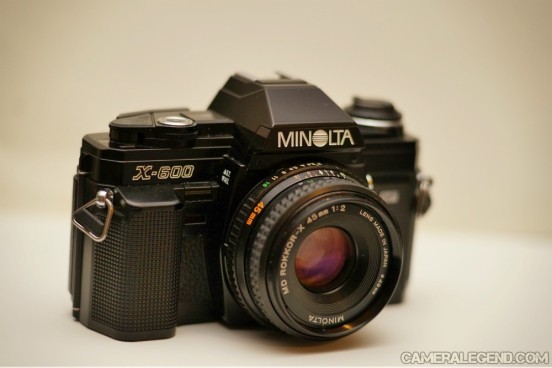
MinX600CC

Just when I thought that, as Bob Seger might say, I had nothing left to burn and nothing left to prove, I have another camera to profile for you 🙂

THE MYSTERIOUS MINOLTA X-600

In 1994 there was an article in Popular Photography magazine regarding the “mysterious” Minolta X-600. In fact the title of the article was “The Mysterious Minolta X-600.”

In that article, I remember the late, great Herbert Keppler wrote of how in 1983 he received an express package from Minolta Research and Development headquarters in Osaka, Japan. He went on to say that in the box contained a camera he had never seen or heard of before: the Minolta X-600.

Now before I continue, let me just say that I really loved Mr. Keppler’s articles and his candid and sometimes brash way of writing. I’m can’t remember if he was Pop Photo’s editor or associate editor, but if you read the magazine long enough, you can tell that he was “The Boss” or “The Man” at that publication.

He was a legend in the photography business and to me, his articles were the main reason I was reading Popular Photography. I was somewhat awestruck actually when he sent me a hand written response to a question I sent in, back in the 90s.

I also have to say, I’ve read over the years, so many people bashing that magazine. To me though, it was better than a lot of other photography magazines out there, but that’s a topic for another day.

Now back to the X-600. After reading the Pop Photo article on it, I got the impression that this was not a production camera and I never thought about it again until I came across one, quite unexpectedly, from a local seller’s collection.

WHAT MAKES THE X-600 SO MYSTERIOUS?

Ok, there’s not a lot of information about this camera on the web, but there is some. So I will try to break down what I have read and what I know of the camera, now that I have one.

The camera was produced as far back as 1983. Contrary to what I deciphered from the Pop Photo article, which gave me the impression that the camera was never released to the public, the X-600 was actually sold/given/leaked to the public, perhaps up to 10,000 units (according the the great Rokkor Files website), and sold in Japan only. Obviously, some have made it around the world 🙂

Now what makes the X-600 special? Now you might have a little chuckle when you read this because we’re so used to it by now…

The X-600 was a manual focus camera that had focus confirmation via a green led dot in the viewfinder that appeared once you have achieved focus. That’s it!

So what’s the big deal you say, all my Nikons have done that for years. In fact, nearly all serious cameras, and even non serious cameras have some kind of focus confirmation. It’s a prerequisite. But back in 1983, this was a BIG deal. In fact, if I recall correctly, they made a big deal about focus confirmation in the Contax RX, a manual focus SLR, and that was in 1994, more than ten years later.

No one knows for sure why Minolta abandoned the X-600 project. If you search around the web you may come across something about patent infringement, but I could not confirm this in any way so I can’t state that as truth.

Anyway, the X-600 was apparently a “pre-autofocus” experiment by Minolta, an experiment that may have led to the creation of the very successful Minolta Maxxum 7000 of 1985, the runaway first hit of the autofocus era of SLR cameras.

The success of the Maxxum 7000 ushered in the era of autofocus to the masses, with Canon and Nikon following shortly thereafter.

HANDS ON
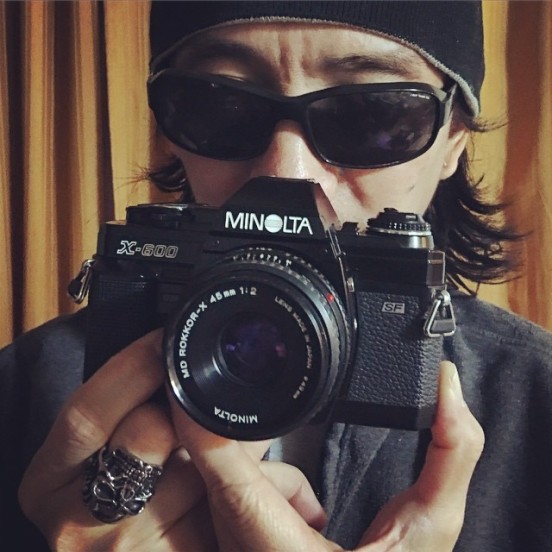
12744392_10207750558474305_6305584978195444372_n

“The X-Man” aka the “Ghetto-Blaster” hands on with the X-600. Not a narcissistic selfie, only trying to show that the X-600 is out there in the hands of the public 🙂

I’ve only had this one for a short time, a few months, still have film in it. Based on my limited experience, and allow me to say that this may change with time, here are my impressions:

The initial impression upon seeing and handling one is that the camera looks and feels like the X-700. But after you hold it for a short time, you realize that this is NOT the X-700.

The X-700 was my first “real” camera which Mom bought for me in 1985 as a geeky teen with a thirst for photography. I used it for almost ten years straight before I got into all this G.A.S. stuff, and I still have it 31 years later so the X-700 is a camera I know a little about 🙂

The good news for most folks? The X-700 is a much better camera. Not only in looks, but in ergonomics and operations. The X-700 is cheaper and easy to find. The bad news about the X-700? It’s not an X-600 🙂

The X-600 is a much more basic camera, which can be a good thing, but it doesn’t have some of the things that made the X-700 so nice. For example, it doesn’t have a shutter speed dial on top as in the X-700. Instead, the shutter speeds appear in a counter on the top right plate of the camera and appears much like a film counter, which under certain conditions can be hard to see and hard to read.

There is no exposure compensation dial. No ASA/ISO indicator. Shutter speeds range from 1s to 1/1000 plus B. There is an Aperture Priority mode which can be engaged via the AUTO settting in the shutter speed selection dial.

The camera uses two AAA batteries, which I actually like better than the usually hearing aid type batteries seen in the X-700 and other cameras.

One great thing I noticed is that the X-600 does not drain the batteries the way my X-700 did. I have accidentally left the X-600 in the “On” position for days and it still doesn’t show battery drain.

The viewfinder shows shutter speeds with red line indicators. The focus “window” is a long slit right in the center of the viewfinder. There are right and left red arrow focus indicators and a green spot in the middle which will light up once you have achieved focus. Anyone who has used the focus confirmation feature on Nikon cameras will be familiar with this method of manual focusing.

The “special” focus confirmation feature works, but it needs good light to work well. According to info I have read on the web, the camera needs later MD lenses with an extra pin or post on the rear lens mount which was apparently needed by the X-600, which has two focus aid sensors in the body.

But wait…I am using the X-600 with three lenses, one which has the pin and two which do not have that extra pin, yet the camera is giving me a focus confirmation signal on all three lenses when I achieve sharp focus! Whether this is reality or not, I will have to report back when I am finished with the film. Only then will I know if the focus confirmation system actually worked with these lenses.

BOTTOM LINE

In today’s world, I must say that there is nothing outstanding about the X-600 as a camera, other than its rarity and its history which I have tried to relay to you here.

I’m not trying to take anything away from the X-600. It’s a very basic camera that uses batteries. Usually a no-no in my book. And focus confirmation is something so basic now that we just take it for granted.

But we must, in respect to Minolta, remember that this was new stuff back in 1983 and they should be given credit for doing something that moved the camera (as a species, not just the X-600) further up the ladder of evolution.

The X-600 is the missing link, the “Lost Testament” of Minolta’s development and refinement of autofocus. The Maxxum 7000 autofocus SLR of 1985 changed the world forever, but to get to the 7000, Minolta had to create the X-600.

Just as the Apollo astronauts who did the test runs never got the glory of the astronauts who landed on the moon, the X-600 is a rare and largely unknown camera, but just like those forgotten astronauts, without the X-600, it’s safe to say there would be no Maxxum 7000.

The Minolta X-600 is most certainly a Camera Legend. It is a camera pioneer. To appreciate that, you must take into account its history. Once you do that, you can then realize that this is indeed a very special camera.

WHERE TO BUY?

The X-600 is a rare camera, based on the low production numbers and the limited information that there is on this camera.

The good news is that they show up every now and then on eBay and I have seen it once at KEH camera. And even better news is that when they do show up, they do not cost a lot. The bad news? You never know when they show up. It could be tomorrow, it could be six months from now. That’s the nature of rare collectibles.

I’m not sure how to say this. You may think I’m just a guy with no life who does nothing, but seek out these odd cameras, and you might have well been justified in your thinking, but honestly, and I’ve said this before…I don’t seek out these cameras, they come to me! 🙂

Seriously! As with so many other cameras and lenses I’ve come across, I found the X-600 when I wasn’t even looking for it. This is a camera that no one hears or talks about simply because not many know about it. When you don’t know about it, you’re not looking for it.

Based on the fact that this is a rare camera, if and when you do find one, you’ll probably come across it the same way I did…when you’re not looking for it.

But assuming you do find one, based on my research, prices are trending at $90-135 on eBay, but you might do a little better if you find one locally. I got mine for $60 with a little haggling 🙂

If you have one of these Camera Legends, I’d sure love to hear about it!

Note: As this is already a late posting, you can safely assume that there won’t be a “Tuesday Titans” tonight 🙂

All content are © 2014-2016 CameraLegend.com


Photo Of The Day: “That Smile”

SummarZC

My little “Country Bumpkin” in 2008.

This could be considered a “Flashback Friday” post. This is my elder daughter in 2008, just a little more than a year old.

Shot with an Epson R-D1 and a seventy plus year old 50mm f/2 Leica Summar lens. I had just gotten this lens in rough condition on eBay for under $100. I was so enamored that it was giving me these (to me) beautiful soft/sharp images, just what I’d been looking for!

The Epson R-D1 was a 6.1mp camera, the world’s first digital rangefinder, and one of my favorite old school digital cameras ever. I’ve been meaning to do a flashback review of this camera, but this is one of those cameras that I love so much, I would need a lot to time to do it justice. Time I simply don’t have tonight. But I’ll get to it, eventually 🙂

Have a good Friday and a good weekend everybody!

Best, Sam

Breaking News: The Pentax K-1 Full-Frame Digital

K-1_004_2470_hood-3a-wm_WM

The K-1 full frame digital camera, the new “King Of Pentax.” Pictured with the HD Pentax-D 24-70mm f/2.8 SDM WR lens. Pure Pentax heaven! Picture courtesy of Ricoh/Pentax Corporation.

Ho! I thought I was on a week long sabbatical but this one is a must! Ricoh/Pentax has finally introduced their full-frame digital called, appropriately the K-1.

Just from looking at the specs, key features: 36.4mp CMOS sensor, no AA filter (better sharpness), built in 5-axis stabilization, ISO 204,800, 1080p 24/30fps HD video, rugged build and tilting screen. Of course, there’s a lot more to it.

All the cameras we have today are like super computers in many ways. They have like gazillion features and you know I’m not the kind of guy who wants to repeat all the technical specs. If you’re interest in the technicalities you can read them HERE.

I’m sure there will be a lot of Pentax fanatics who will be picking this thing up. In fact, I KNOW some fanatics who will be looking hard at this one 🙂

THOUGHTS ON THE PENTAX K-1

Everything seems right with this camera. Specs are great, however things seem familiar. 36.4 megapixels? Hmm, probably that Sony sensor we saw in the Nikon D800/D800E and Sony A7R. No AA filter? Cool, seems like everyone is doing away with that “wicked” AA filter that used to be so important for the first fifteen years of digital. ISO 204,800? Cool, but I never go anywhere near that ISO so I wouldn’t know.

I guess what I’m saying is…the specs are great, awesome even, but many of these things we have seen since 2012 so it’s not mind-blowing anymore (to me anyway). Nothing against Pentax, as I’ve said a few times before, it’s really hard for me to get excited about the latest and greatest these days. But I love the build and handling of the top Pentax cameras and this one looks to be the best of the best.

PentaxK01C

“Pentax Camera Art.” Before the K-1, we had a funky little thang called the K-01! Wow, what a close call with the names 🙂

Despite what I said about the specs, the main thing that we should remember is that while the rest of the world have seen these high specs before elsewhere, Pentax users have not had these specs till now so this is enough reason for Pentaxians to rejoice.

And heck, based the fact that all your Pentax lenses in the 35mm format can now be used as they were intended and even based on the specs as they are, this could probably be the only Pentax digital anyone could ever want or need! Here’s a cool and interesting video on the new K-1:

As I said in an article not too long ago, many have waited for this day since we heard about the Pentax MZ-D in 2000. The first full-frame Pentax digital that never was. Today, nearly sixteen years later they have officially announced the K-1. Whether it succeeds or fails this camera is bound to be a Camera Legend. All I can say is…Pentax, thank you.

Note: The Pentax K-1 was introduced with three new lenses. You can check out all the specs to the K-1 and see the new lenses HERE.

WHOA, WAIT A MINUTE, THERE’S ALSO THE CANON EOS 80D 

I didn’t put this in the headlines because I didn’t want to take anything away from the Pentax K-1, which many have waited so long for and is in a different league of cameras, but I’m sure many Canon fans will be happy to hear that there’s a new “enthusiast-class” body out, the EOS 80D.

Just quickly off the specs: new 24mp sensor, 45 point AF, updated dual-pixel AF, mirror vibration control.

I don’t really want to get too much into it, but I’m sure it’s going to be a killer little camera.

You can check out the specs HERE.