Celebrating Ten Years Of JuJu

DSC_9567JJ

JuJu @ Six Months. 2006. Nikon D1X. Cannot remember the lens, it just shows as 300mm on the exif viewer. A straight jpeg from the D1X, no treatment done. Although it was only 5mps, I really loved the D1X!

No “Tuesday Titans” today. Instead, we are celebrating a “titan” of our personal world. He is the first kid of the new generation of our family. Today, we celebrate my nephew JuJu who just turned ten recently. He was, in a way, my first beta tester for so many of the cameras that came into my possession in the years following his birth. Thanks for joining me in the celebration and for my fellow gear heads, take comfort in the captions which will reveal some the cool cameras used during this ten year period. Happy Birthday JuJu!! 🙂

80313978.Y6P5wTjM.JoeJU1CPba

“Boy From NYC” 2006. Bessa R3a, CV 40mm f/1.4 Nokton Classic, Kodak BW400CN. I had just fixed the rangefinder on this camera, it was the first rangefinder adjustment I’d ever done. Shortly thereafter, I sold this camera, but now looking at the results from this combo, I kinda regret it!

124288972.KEsjHcuK.PenZoeJuJu1_SerenityCalamity

“Order & Chaos” 2009. Olympus Pen FT, Zuiko 35mm f/2.8 Pancake lens, Kodak Tri-X 400 developed in T-Max developer. Two frames from the half frame Pen FT camera showing how order can turn into chaos in a minute 🙂

1614239_10202970154807201_8424783835683906259_o

“My Brother’s Keepers” 2014. Nikon D1X, 35mm f/2.4 MIR Russian lens.

10917057_10205025856438457_737518350959434799_o

“Rockabilly Ju” 2013. Fuji X-Pro 1, Canon FD 55mm f/1.2 Aspherical lens. JuJu rocks around the clock! 🙂

10295047_10202961627314019_3801333893296660026_o

“Happy” 2014. Panasonic DMC-GF1, Lumix 20mm f/1.7 ASPH lens. Go ahead people, clap along if you feel like a room without a roof! 🙂


Breaking News: The Nikon D5 and D500

12243354_185366478471548_5876698353812685713_n

The Nikon D3 of 2007. Nothing quite like shooting with a pro Nikon body.

Sure we love classic cameras here on Camera Legend, but we also love the latest and greatest. After all, some of these will become the Camera Legends of tomorrow.

And wow, they’re here…

The Nikon D5 is the newest flagship camera from Nikon. It features a 20.8mp FX (full-frame) sensor, a redesigned 153 point AF system, and features such niceties as 4K UHD (Ultra High Definition) video and (what?!) ISO 3,280,000!!

It’s nice to see Nikon keeping the megapixels at a comfortable 20.8mp, much like Canon did with their 18.1mp 1DX flagship camera. That’s more than enough megapixels for most purposes and is a good balance for all aspects of photography, especially for the press and sports pros to whom this camera will most likely cater to most.

You can see all the specs and pre-order the Nikon D5 HERE.

Also be sure to check out the Official Nikon D5 Video.

Perhaps even more exciting than the D5 is the surprising release of the new Nikon D500! This is the successor to the Nikon D300s that Nikon DX (APS-C) fans have been asking for, waiting for, begging for…for years!!

The Nikon D500 features an all new 20.9mp DX sensor, inherits the same 153 point AF system from the D5, as well as 4K UHD video, and other goodies.

It may seem strange, but even with such capable cameras as the D7000, D7100, and D7200, many hardcore Nikonians never considered these cameras the true successor to the Nikon D300/D300s.

For years, their pleas to Nikon seemed to have fallen on deaf ears, but apparently Nikon has been listening all along. They just took their sweet time with it 🙂

I think it all boils down to build quality and in a historical context it all dates back to the Nikon D100 of 2002. Then you had the D200 of 2005 which improved even further with superb build quaility.

I used the D300 when it came out in 2007 and I know why the D300/D300s “cult” feel this way. In fact, now that the D500 is out, I may start looking around for the old D300s 🙂

The fact that there was no successor to the D300s, till now, is probably what has kept the prices on these cameras high.

If you want to be one of the first to get your hands on the D500, you can pre-order it HERE.

Nikon flash lovers, the new Nikon SB500 Speedlight is also coming and you can pre-order it HERE.

This is very much like that day nearly nine years ago when Nikon released the D3 and D300. Exciting times for Nikon fans!!

Tuesday Titans: The Canon EOS-1 Pro Film Camera


CEOS1

The Canon EOS-1 professional 35mm SLR of 1989. The EOS-1 is a titan with a tank like body, super speedy AF, and a futuristic design.  A true Camera Legend among 20th century cameras.

The Canon EOS-1 is 35mm SLR introduced by Canon in 1989 as the flagship camera of their (then) two year old EOS system.

Canon is no doubt one of the legendary names in the camera world. Despite non Canon fans (usually Nikon fans!) attempting to take jabs at Canon by saying things such as “Canon’s main business are its copiers and not cameras” or “Canon’s bodies are made of plastic and feels cheap” everyone that I know equates Canon to cameras first and foremost.

And the camera division is apparently a source of pride for the company. Even though, yes, they make way more selling copiers and other stuff to corporations, they do put a lot of that money back into creating awesome cameras that are often on the cutting edge of technology.

One of the greatest things about loving all cameras is that I’ve never been accused of being a fanboy, not that I know of anyway 🙂

Anyway, I’m rambling a little bit here, but the main point is that since the 1930’s Canon has had its share of legendary cameras. The Kwanon of 1934, the Canon II of the late 40s and early 50s, the Canon 7 and 7s rangefinders of the 60s, the A-1 and F-1 of the 70s, the T90 of 1986 just to name a few.

Canon is no stranger to making all kinds of cameras. However in 1987 Canon set out to do what many of their loyal customers thought to be the unthinkable; create a whole new series of lenses and cameras and letting go of their FD system which enjoyed a tremendous following and passion from professionals and enthusiasts alike. And with the introduction of the EOS-1 in 1989, Canon set out to create a new legend. Would their plan work?

dscf0648canont90mkiic

The Canon T90 of 1984 and the EOS-1D Mark II of 2004. The predecessor and successor of the EOS-1 respectively.

This was a very risky move. To take (in 1987) the nearly twenty year old, proven FD system and not only replace it with a whole new system, but also to convince their huge and loyal customer base that they should buy into the new system.

And the new EOS lens mount was NOT compatible with the FD system and vice versa. So in essence, Canon had to say…’Guess what guys? You can’t use all those lenses and accessories you’ve acquired for your A-1, AE-1, F-1, etc, etc if you buy the new EOS system’

As to be expected, it was a hard sell at first. From all I have read on this, many loyal FD fan were totally bummed, even angry at this move. They felt betrayed that their gear would now be “obsolete” and unusable on the new EOS system.

And you have to remember back then was not like today where you could use your legacy lenses on many different cameras with the right adapters. Adapters that allowed the use of one mount to a different mount were precious and few back then. I know of people who switched to Nikon because they were so outraged!

WISDOM OF FORESIGHT AND THE POWER OF TIME

Despite the initial outlash, now nearly thirty years later, I believe that time has proven Canon right in their decision to change from the FD mount to the all electric EOS mount.

With the EOS mount came cameras with super speedy autofocus, and such innovations as quiet USM “ultrasonic” motor lenses, cameras with electronically controlled wheels and dials, offering sophisticated levels of control customization. Many of these features we see on almost all serious DSLRs today. The EOS lens mount was also large enough to make way for some very unique L lenses such as the EF 50mm f/1L, the 85mm f/1.2L, and 200mm f/1.8L.

I believe Canon, as well as Nikon and other manufacturers saw the promise of the future with the runaway success of 1985’s Minolta Maxxam 7000, the first truly successful autofocus 35mm SLR.

Looking back, you have to give Canon, its camera designers and engineers credit for having the courage and foresight to create a whole new system that not only embraced the technology that was available then and but would also be able to take advantage of technology yet unseen in 1987.

THE EOS-1 FILM CAMERA

Two years after the introduction of the EOS system and the enthusiasts’ friendly EOS 650 camera, Canon decided the new system was successful enough to introduce their new pro flagship, the EOS-1 professional system camera.

The EOS-1 is a big brute of a camera and was very much reminiscent of the T90 of 1986 in its design.

However, being designed with professional photographers in mind, the EOS-1 was built to a much higher standard with an extra tough aluminum frame wrapped inside a polycarbonate plastic shell, and weather proofed with o rings, seals, and gaskets.

I remember in the mid 1990s reading an article on the Canon EOS-1 vs the Nikon F4s. I can’t recall if it was Modern Photography or Popular Photography magazine, but it was a great article on the pros and cons of both cameras, and included opinions from two professional photographers who used these cameras for their livelihood.

I also remember at that time, opinions and doubts about Canon’s use of polycarbonate materials on their pro bodies, especially from “heavy metal” camera lovers and pros.

Today, with the power of time, polycarbonate and other hard plastics have been proven to be as durable, if not more so, than the all metal bodied cameras of yore.

The EOS-1 is an all electronic camera and it operates on one 2CR5 battery. It will not operate without a battery. The electronics in the EOS-1 series of cameras have stood the test to time. The shutter speeds range from 30 secs to 1/8000th of a second and the camera can do a maximum of 5.5 frames per second with the optional Power Booster E-1. The viewfinder has 100 percent coverage. The camera had only one autofocus point which was cross-type and in the center of the frame.

USER EXPERIENCE

I got my first EOS-1 in the mid 90s. I still remember vividly the first time I held the camera. It was one of those magic moments on my camera journey!

I remember the sense of pride and amazement that I had in my possession this huge and powerful pro Canon in my home. Holding my first pro grade body ever was a feeling that, many many cameras later, comes very rarely today. It would take a lot to excite me these days 🙂

After I got over the initial excitement, I was quickly disappointed to find that the EOS-1’s AF, which was very fast and speedy outdoors and in good light, struggled and hunted in low or even moderately bright indoor lighting.

On top of that, the single central point AF did not have the red light indicator. That feature came with the EOS-1’s 1994 successor, the EOS-1n.

After a few months of use, I quickly sold the camera and moved up to the EOS-1n which was a much better camera in all aspects.

imgCan1Zoe293

“The One” 2012. Canon EOS-1, EF 50mm f/1.8 lens.

THE LEGACY AND LEGEND OF THE EOS-1

Despite my disappointment with the EOS-1, I eventually got another one when the prices became real cheap.

As with many other cameras, I can now appreciate its strengths while avoiding or trying to avoid its weaknesses.

Armed with a very strong selection of Canon EF lenses, the EOS-1 helped Canon to finally take over their rival Nikon in the 1990s as the professionals choice. It would take Nikon many years later to catch up and regain equal footing.

With the EOS-1 came many innovations such as dual input dials, wheels, and the use of polycarbonate and hard plastics on a professional grade body. All these features have made its way to many mid and high end cameras that came after the EOS-1.

The Canon EOS-1 is a true Camera Legend of the modern camera world. The EOS-1 is not only legendary, but has historical significance as the first pro body of the EOS line.

All the pro film EOS bodies that came after the EOS-1, including the 1n/1V/3 are all much better performers having taken all the best features of the EOS-1 and refining it to much higher levels, but if you want to experience that early EOS experience, warts and all, and want to pay the lowest price you can for a pro EOS film body, then the EOS-1 is a great choice, even if only to appreciate its design and/or to appreciate the technology of its day.

Note: The Tuesday Titans series was created to profile the huge “Big Guns” or monster sized cameras.

WHERE TO BUY

If shopping for an original EOS-1 film camera, prices are trending from $50-150 with an average under $100.

For a safe purchase with a good return policy, both Adorama in their USED section or Amazon periodically have the camera in stock.

IF YOU’RE JUST READING THIS AND PREFER MODERN CANON CAMERAS

Our friends at Adorama have some great deals for you, just in time for the holidays! Please check the links below to see the savings.

Canon EOS Rebel T5i DSLR Camera with EF-S 18-55mm f/3.5-5.6 IS STM Lens – Special Promotional Bundle – $399 after IR/MIR

BUY HERE

Canon EOS Rebel T5i DSLR Camera with EF-S 18-135mm f/3.5-5.6 IS STM Lens – Special Printer Promotional Bundle – $499 after IR/MIR

BUY HERE

Canon EOS 70D Digital SLR Camera Body – Special Promotional Bundle – $679 after IR/MIR

BUY HERE.

Canon EOS 6D DSLR Camera Body with Special Promotional Bundle – $1449 after IR/MIR

BUY HERE

Tuesday Titans: The Nikon D2H and D2Hs

46820_4866905122846_2053977932_n

In 2006 with the Nikon D2Hs. At that time I proclaimed it “Number One” 🙂

The Nikon D2H is a 4.1 megapixel camera introduced by Nikon in 2003. The D2Hs is an “updated” version of the D2H introduced in 2005. For all practical purposes, they are pretty much the same camera with some minor differences, hence the bulk of this review applies to both models, but I will note the differences where and when it is necessary.

Many of you reading this blog have probably followed cameras as long as I have, and some even longer.

So do you remember when Nikon announced the D2H in 2003? And wow, can you believe it is now near the end of 2015? Time marches on, but this is sick! It felt like yesterday to me and now it’s twelve years later. Man, I feel sick to my stomach at how fast time is flying by. Seriously! 🙂

Anyway, I still remember when they released this camera. The hardcore Nikon fans loved it, of course. But there were also people who complained that 4 megapixels was too small, too little resolution.

THE CAMERA

The Nikon D2H/D2Hs is a professional grade camera, replacing the D1H (2.7mp) of 2001.

Somehow those two years from 2001 to 2003 felt a lot longer to me and I think two years meant more back in the early days of digital than it does today. It looks much more modern than the D1H (and D1X) which sprang from the era of the 1999 D1 pro camera.

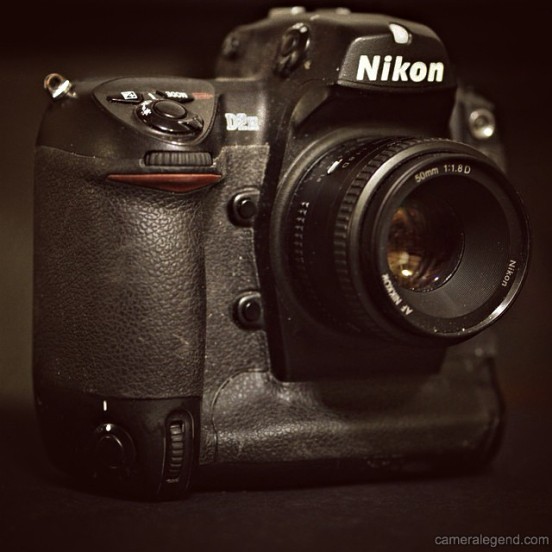
The build quality is superb as expected from a pro Nikon body. If you’re a fan of today’s smaller, sleeker bodies such as the Olympus OM-D, Sony A7 series, Fuji X-T1, etc, then the D2H might freak you out because baby this thing is a brute! It is a big, bold, and beautiful monster of a camera 🙂
NikonD2H

A well used, well loved Nikon D2H 🙂

Actually, not a lot has changed with regards to Nikon or Canon pro cameras as far as build. The current D4s flagship camera is still a huge monster DSLR. I think this all dates back to the F4/F5 and EOS-1 series film cameras of the late 80s and early 90s.

Some people like this because they feel that “power” while holding a big DSLR. I’m not joking, I actually have a few friends who feel this way. Some will even get grips on their non pro cameras just to feel that “power”…crazy stuff! 🙂

THE SENSOR

The D2H sensor deserves a special mention. It was a 4.1 megapixel sensor that Nikon called the JFET-LBCAST sensor and it is a sensor unique to the D2H and D2Hs. According to the Nikon it was “a completely new type of image sensor, different from CCD and CMOS sensors…”

I won’t go into all the technical details on this, but the sensor was said to be designed for faster image signal read, better color, less image noise, and more efficient power consumption. Nikon apparently took over ten years to develop this sensor.

And the initial response to their creation? The LBCAST (for short) was blasted by critics and folks on the forums who were disappointed with the image noise levels above ISO 400, especially compared to the Canon competition at that time. I very well remember reading posts on Dpreview and Fred Miranda forums on this.

In fact, the D2Hs was created to curtail these criticisms because one of its main selling points was the promise of better jpegs and better high iso images than the D2H.

Without getting into all the details, the camera has excellent ergonomics with well laid out dials and buttons, two control wheels, and horizontal and vertical shutter releases. Everything feels like it’s in the right places. The menus are well organized and easy to navigate. Some of the custom functions might be a little confusing though so check the instruction manual if necessary.

PERFORMANCE

The D2H is a speedy performer. The camera uses the Multi-Cam 2000 autofocus unit, has an AF system with 11 areas, 9 of them cross type, and its AF is fast and accurate. The camera was designed with press and sports photographers in mind and it can do a blazing 8 frames per second in continuous shooting mode.

I come from the film era of shooting and even then I never really liked using motor drives for “spray and pray” shooting, but it’s good to know that the D2H has the capability if needed.

ND2HBoon

“Babs” 2012. Nikon D2H, 85mm f/1.8 AF Nikkor.

I almost always use single shot AF and use the center spot for focusing and the D2H rarely misses a shot for me.

IMAGE QUALITY

Despite having only 4.1 megapixels, the D2H produces very sharp images with generally great color reproduction especially when paired with a good lens and good lighting.

ND2HSZC

“Strike A Pose” 2013. Nikon D2H, Nikkor 105mm f/2 DC lens.

The sensor is quite contrasty and perhaps because of this, images appear more detailed and sharper than you might expect from 4.1 megapixels.

Skin tones can be excellent with flash, studio, or controlled lighting, but can be “off” and take on a yellow-orange tone in low or available light.

Image quality at the ISO 200 base is the best, but ISO 400 and up to ISO 1600 images do take on more noise and loses color saturation, but I like “grit” so I do not find it particularly objectionable. Files like these can be coaxed into that elusive “film-like” digital file with the right kind of treatment in your post processing.

ND2HSTigerC

“Tony Tiger” 2012. Nikon D2H, Tokina 80-400mm f/4.5-5.6 ATX lens.

D2HSMonkeyC

“The Wise Old Man” 2012. Wise beyond his years was this one-eyed monkey master 🙂

You can get ISO 6400 on both cameras via ISO boost, but it looks horrific to me, not film-like, but something you’d expect from a really old digital camera.

The D2H, as with most cameras of that era, can clip highlights quite easily so be careful with exposure.

I have made 13×19 prints from the D2H and D2Hs and they look excellent, even by today’s standards.


DIFFERENCES BETWEEN THE D2H AND D2HS

As mentioned at the start, these two cameras are pretty much the same camera. According to Nikon, the D2HS offers better in camera jpegs, ISO 6400 versus ISO 1600 on the original D2H firmware, faster AF, larger image buffer up to 50 jpegs vs 40 on the D2H, a slightly higher resolution rear LCD (232, 000 dot vs 211, 200 dot), though the size remains the same at 2.5 inches

There may be other differences I didn’t mention so do some research if there is something I missed.

The jpegs are better on the D2Hs, but I can’t say it was a major difference based on my experience with both cameras. If shooting RAW (NEF), the D2H image quality is exactly the same as the D2Hs.

_DCS0026JettFA

“Boy Po” 2014. Nikon D2Hs, Sigma 50mm f/1.4 EX DG HSM.

HOW TO TURN YOUR D2H INTO A D2HS

Well, almost! If your D2H has the last 2.02 firmware or you update any older firmware to the last version, you will have most of the D2Hs improvements on your D2H such as supposedly faster AF, ISO 6400, etc, etc, except the larger image buffer and slightly higher rear LCD resolution.

ISSUES

The Nikon D2H is notorious for its well known, but not deadly “ERR” blank shot issue.

What happens is you turn the camera on, take the first shot and it is blank while the camera gives you an “ERR” error code. This freaks a lot of people out, especially if this is their first experience with the camera.

But take another shot, and the camera is fine for the rest of the day. If you buy a D2H and get this error, it is very common, generally not serious, and you can continue to use the camera as is.

I’ve heard of people sending the D2H for repair for this issue, and after it is “fixed” the issue reappears after some time.

This is generally not something to worry about as it usually affects only the first or second shot. I’ve had it happen to me on two different D2H cameras.

The problem was apparently fixed with the D2Hs and I’ve not encountered this problem when using the D2Hs.

BOTTOM LINE

I got my first D2H in 2006. I sold that first one and got a D2Hs that same year, which I eventually sold and flipped a profit on.

When they became cheap, I missed the camera and went back to the standard D2H which I used as a “fun” camera for several years. But it’s more than a fun camera, the Nikon D2H is a pro powerhouse capable of image quality that was good enough for print and speed fast enough to capture the moment and not let that moment slip by you.
ND2HSEyeTigerC

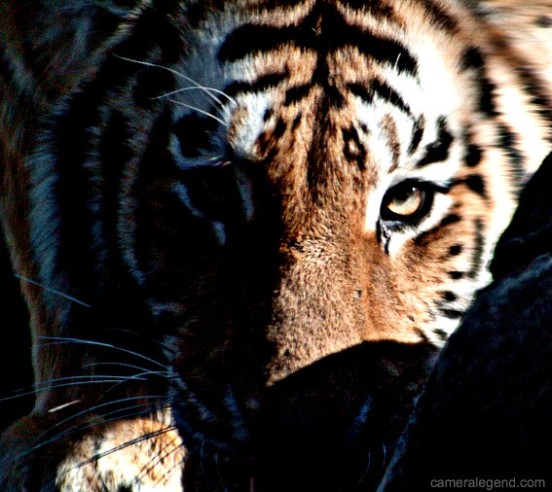
“Eye Of The Tiger” 2012. Nikon D2H, Tokina 80-400mm f/4.5-5.6 ATX.

If looking for one of these monster Nikons, prices are trending at $100-300 for the original D2H and $300-$500 or more for the D2Hs. The Nikon D2H is quite abundant on the used market, the D2Hs not as abundant.

You can actually find the D2H for under $100 on auction sites, but these tend to be well used, but hey if it works, it’s a great deal. I got my last D2Hs sample a couple of years ago for $150. It had some minor cosmetic issues, but I fixed it up by replacing the camera skin. As mentioned before, I am a camera hunter and I like cheap 🙂

Remember that many of these cameras have been pro workhorses that have been used and abused for years. I would just buy the cheapest one in working condition and not worry whether it’s a D2H or D2Hs. Take my word for it, they are pretty much the same camera and you can certainly get the exact same image quality if you shoot RAW.

The Nikon D2H (and D2Hs) is an amazingly fun camera to shoot with. Working within its comfort zone, images can be crisp, colorful, and look better than anything you’d ever expect from a 4.1 megapixel camera. The small files are a joy to work with in a 40+ megapixel world.

With its unique sensor and all that Nikon pro bodied goodness, the Nikon D2H (and D2Hs) is an unforgettable Camera Legend that took the digital slr out of its infancy to give photographers a more mature product at the time of its introduction. The D2H can still provide amazingly good files even today.

WHERE TO BUY

The cheapest place to find the D2H/D2Hs would be eBay obviously, but there are some seriously beat-up and ugly samples out there on that auction site with no guarantee. If you’re willing to take a risk, go for it.

If you want a safer purchase with a good return policy, then I would check KEH Camera, Amazon or Adorama in their USED section.

Black & White Portraits

JuJu1Pba-2

“The Tsingtao Boy” 2009. Canon F-1N, 50mm f/1.4 FD lens, Tri-X. Chinatown, NYC.

While I do love color photography, there’s just something different about black and white photography that really endears me to it. And when you combine b&w with people (or animals!), that really takes it to another level for me.

These are just some b&w images taken over the years. Like I’ve said before, sometimes I do want to remind myself that I love shooting almost as much as I love cameras…I think! These are also images from cameras I am planning to review for you, cameras like the Leica M8 and the Canon F-1N, which is one of my favorite Canon bodies ever, past or present.

It seems almost unbelievable to me that it has taken this long, but after two weeks I’m finally getting my main working computer back today! As I mentioned before, this really set me back as far as content for this website is concerned and I’m just beginning to catch up. Thanks to those who continue to visit and I do appreciate your time and comments.

This is admittedly going to be a busy week and writing a blog with any kind of content takes a lot of time. Even my shortest article takes me almost half a day. I admire those who can do this consistently on a daily basis, I know I can’t!

Hope you all have a good short week in preparation for the Thanksgiving holiday here in the USA.

301330_2123110929706_5679977_n

“Man In The Middle” 2011. Canon Powershot G10, Paranaque, Philippines.

a0020_22M1PSIBW

“Imported From The Past” 2011. Nikon F4s, Nikkor 28mm f/2.8 AIS. The great Louis Mendes stands out like an icon from the past with his old school Speed Graphic and sharp, retro outfits.

399395_3807078227836_955166717_n

“Vimeo” 2006. Canon Rebel XT, Sigma 30mm f/1.4 EX DC. I was buying a lens from this man and I took this shot while testing it. I found out a couple of years later that he is apparently one of the founders of the video sharing site Vimeo!

TheCompetitionC.jpg

“The Competition” 2006. Canon Rebel XT, Sigma 30mm f/1.4 EX DC. Sometimes facial expression tells you everything!

L1002321BoBui1

“Time Will Not Wait” 2011. Leica M8, 35mm f/2 Zeiss Biogon. Koh Samui, Thailand.

M8BluesMan1Crop

“Brother Blues” 2010. Leica M8, 50mm f/2 Summicron-M. Washington Square Park, NYC.

PAudMCC

“My Door Is Open” 2011. Leica M8, 50mm f/2 Summicron-M. Nonthaburi, Thailand.

12193438_179280389080157_404639994576245317_n.jpg

“The Godfather Of Bangkok” 2011. Minolta CLE, 40mm f/2 Summicron-M, Tri-X. A scene from a restaurant on the side streets of Bangkok, Thailand. With one hand on his meal, the other hand reaches for the plate before anyone else could get to it first. Don’t mess with the Godfather of Bangkok! 🙂

A couple of my favorite portraits from the selection above were done with Sigma lenses. Our affiliate and friends at Adorama is offering some incredible savings on SIGMA lenses which only runs through 11/30/15 so if you wanted to pick up some of those super sharp “ART” lenses, this is a good time to do it! And if you order within a certain time, they make every effort to ship same day, which is a great benefit to buying from Adorama versus the competition.


The Baddest Cat On The Planet

CatD3

“Baddest Cat On The Planet” 2009. Nikon D3, Sigma 50mm f/1.4 EX DG HSM lens.

If Iron Mike Tyson was the “baddest man on the planet” then Garfield must be the baddest cat on the planet! 🙂

Obviously my main computer is not back from repair yet. I tried to do another review using this Chromebook. Couldn’t do it. Things got excruciatingly slow to the point where the computer was asking me if I wanted to “kill it?” for some applications.

So for now I can just throw out images that I had planned to use in reviews. This one is from the Nikon D3, a camera from 2007 that followed the high iso “revolution” led by the original Canon 5D Classic and took it to a whole new level. The 50mm f/1.4 Sigma EX DG HSM was quite a fantastic lens and if you can find a good copy, it is a great and less expensive alternative to today’s “ART” version of the 50mm f/1.4 lens.

I generally don’t do this kind of post-processing, but this one was hard to resist 🙂

Hope you all have a great weekend and I cannot end this post without mentioning the tragic events seen in France today. Wow, what has the world come to?

I’ve never been to Paris, but I feel a special connection with the French. Back in 2003, when I first started posting photos on the web, no one would give a poor kid a glance or a chance until someone from France liked one of my photos and helped get me noticed on that site.

I don’t post as much on photo sharing sites any more, but a lot of it is a game of “likes” and “dislikes” which is something I don’t like! There are so many talented photographers out there and it’s not always easy to get your work noticed.

Anyway, over the years I’ve noticed on a number of sites where I posted photos, my biggest supporters have always been from France. Some have even become cherished friends and comrades, one who I have met in person. Just as they supported me, today I stand with them and all my thoughts and prayers are with them and the good people of France.


Flashback Friday: The Nikon Coolpix 100, The First Nikon Coolpix Camera

UPDATE 11/01/15: Just want to pass along some info for our Nikon fans out there that I have been informed of HUGE instant rebates going on for a limited time. You can check out all the Nikon deals HERE. From what I can see some of the instant savings are up to as high as $1100!! on certain Nikon camera/lens combos. If you’re looking to buy new Nikon stuff, this is the time to do it!

You may also find the Nikon deals HERE. While browsing/dreaming, I was amazed at the deals and wish I had the funds! For example, you can now get a new Nikon D7100 for close to the price of a USED D7000. This is a screamin’ deal for some of Nikon’s hottest cameras and lenses.

DSC01100SamCoolpix100S

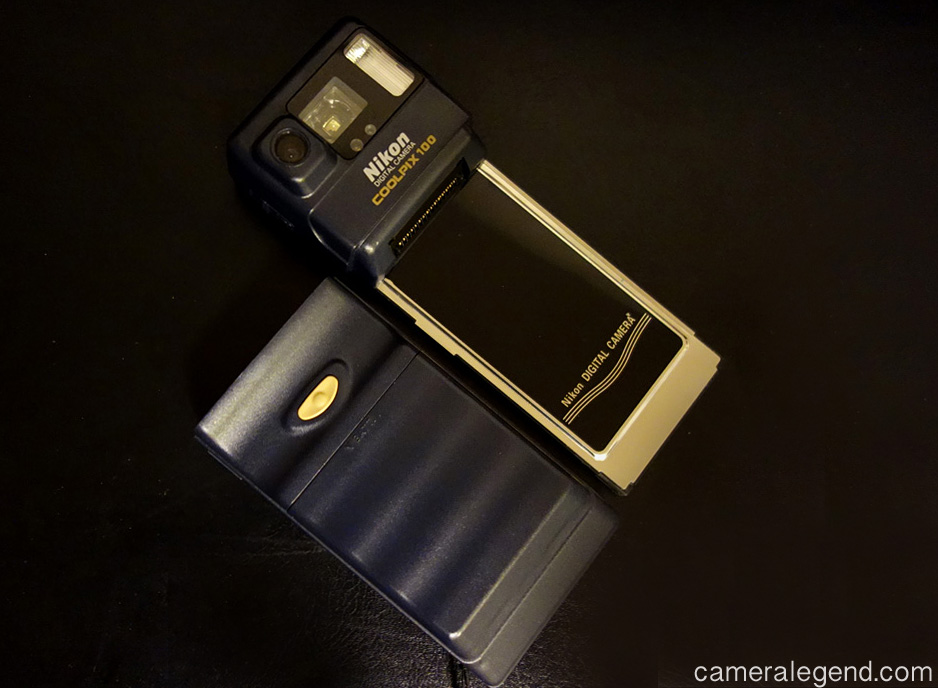
“Retro Thang.” The Nikon Coolpix 100, released in 1997, is Nikon’s first camera under the “Coolpix” banner.

The Nikon Coolpix 100 is a .03mp digital camera introduced by Nikon Corporation in 1997. It is the first Nikon Coolpix camera and the first Nikon digital aimed at the general public.

The Coolpix 100 featured 52mm f/4 fixed lens and a whopping .03mp resolution, proving a maximum of 512×480 in Fine mode on a 1/3″ sensor.

The camera takes no media card as it is built around an old school PCMCIA serial connection and has a built-in memory which holds a maximum of 19 images in Fine mode and 37 images in Normal mode.

DSC01103NikCPC

The Coolpix 100 is a long and funky camera. The camera is built around a PCMCIA device and takes no flash media. Instead it has built0in memory for very limited storage of images.

I found this camera for…59 cents!! The camera was in “As Is/Parts” condition. At first it didn’t seem to work, but after fiddling with the battery compartment, it came back to life.

However, I can’t show you any pictures from it because I have been unable to locate my oldest computer which might have a PCMCIA slot.

DSC01102NikCP2C

The Coolpix 100 with its “jeans” off revealing its PCMCIA computer connection.

Information is scarce on this camera. In fact, if you search “Nikon Coolpix 100” what comes up is a more recent “Coolpix P100” camera.

That said, this camera, as with many from the dawn of digital are not worth much if anything. It is only valuable to me as a collector, but financially it’s worth almost nothing.

Despite its low value and (now) low tech, the Nikon Coolpix 100 is indeed Nikon’s first ever consumer digicam under the “Coolpix” label and therefore has its place as a Camera Legend.


PhotoPlus Expo Show Report Part II: Canon, Nikon, Sony, Etc

The Leica SL (Typ 601) was the Big Daddy for me at this year’s PhotoPlus Expo, no doubt. I mean, after that, where do you go? 🙂

DSC01029CLeicaC

The Leica S and SL gallery of images.

Anyway, I know there’s a lot of other “fish in the ocean” so I’ll try to give you guys a rundown of other things I saw. This is Part II and my final show report for this year’s expo, but it is by no means a “complete” report of the show, it would take way too much time to do that and I’m sorry if I left out anything someone might have been interested in. I leave the complete reporting for sites like dpreview, etc, etc.

CANON

Canon had all their big guns out as well as their hot new lenses. Obviously, the cameras getting the most attention were the Canon 5DS and 5DS R, their 50 megapixel super DSLRs.

I tried the 5DSr and low and behold…it looks and feels like a 5D! I don’t know what else to tell ya! It feels good, it’s dependable, it’s a 5D series camera. Nothing super exciting, but you know it’s going to get the job done.

DSC01051SamCamC

Trying out the new Canon 5DS R, 50.6 megapixel champion with the 24-70mm f/2.8 II. Nice combo!

The Canon rep did ask, to my surprise, if I wanted to put a card in there and try it out. Of course, I didn’t have a card on me! All these years I’ve gotten used to the idea that manufacturers won’t let you put a card in their demo cameras so I didn’t bring one.

But I don’t regret it. What will I get? Some boring pics of the crowd at the expo? All the samples I need, I can find on the web anyway.

Canon did have some really nice large prints showcasing the capabilities of these cameras.

DSC01054Canon5DSRPic

Prints from the Canon 5DS and 5DS R. I walked right up to the print and saw hairs on the model’s nose. That’s resolution for you! 🙂

They looked gorgeous, superb, but not mind-blowing. I’m not taking anything away from these incredible 50mp cameras, but I didn’t think the prints were anything that you couldn’t do with today’s crop of 20+ megapixel cameras. It’s really a new day in photography when one has a hard time being impressed with 50mp prints!

I did ask the Canon representative if there was a 1DX replacement coming any time soon. The 1DX is nearly five years old now and seems due for an upgrade. The answer was that they do not know. Are you surprised? 🙂

Canon also had all their new lenses out, and I had a good time looking at them, although it’s not like I’m going to be getting any new lenses any time soon.

NIKON

Nikon had their usual DSLR lineup at the show. Of course, the D4s was there, the Df, and surprisingly the very old D3X was also on hand.

DSC01062NikonGenC

“I AM GENERATION IMAGE.” Nikon’s new cool slogan 🙂

All their big daddy lenses out for all to drool and fool around with. Nothing new as far as I can see.

Actually the coolest thing I saw at the Nikon booth was the retro looking black and silver J5 mirrorless camera 🙂

DSC01059NikonJ5C

Coolest Nikon at the show! The retro looking Nikon J5 mirrorless.

UPDATE 11/01/15: Just want to pass along some info for our Nikon fans out there that I have been informed of HUGE instant rebates going on for a limited time. You can check out all the Nikon deals HERE. From what I can see some of the instant savings are up to as high as $1100!! on certain Nikon camera/lens combos. If you’re looking to buy new Nikon stuff, this is the time to do it!

You may also find the Nikon deals HERE. While browsing/dreaming, I was amazed at the deals and wish I had the funds! For example, you can now get a new Nikon D7100 for close to the price of a USED D7000. This is a screamin’ deal for some of Nikon’s hottest cameras and lenses.

SONY

I had a good time checking out the new Sony A7RII and A7SII, I couldn’t get my hands on the RX1R II due to lack of time.

The new cameras felt great, but to tell you the truth, since getting my A7R last year I have very little interest in spending any more to ‘upgrade’ a camera that works well for my needs.

I’m finally at a point, thank God, where I really am not interested in the latest and greatest!

Note: Still editing pics, I have some from the Sony booth that I may post. Maybe, maybe not 🙂

FUJIFILM

Fuji had a hot booth showcasing their latest cameras and lenses. I was impressed with the prints from the X-T1. If my old X-Pro 1 had focused anywhere as good as the new Fujis, I would’ve never given up on the X system.

DSC01016FujiC

The ever popular Fujifilm spot.

Fuji also had a very cool “retro” area showcasing their popular line of Instax cameras. I give Fuji a lot of credit for being one of the very few manufacturers still dedicated to making instant cameras and instant film.

DSC01024FujiPrintsC

Fuji posted some wonderful pics, mostly from their X-T1 cameras.


ETC, ETC

Aside from the Leica SL (Typ 601), the only other camera I really wanted to see at the show as the fabled Ricoh/Pentax full-frame. Apparently, they had a near complete mock-up that was shown early on in the show, but it was no longer there when I went on Saturday.

My thoughts on this? Ricoh/Pentax…guys, enough of this hide and seek! If it’s that hard and if it’s going to take you that long to bring out a full-frame DSLR, don’t worry about it! It may be a showcase product, but it’s not like you’ll be selling a boatload of these vs Canon, Nikon, or Sony.

DSC01022RicohC

“Imagine. Change.” Ricoh/Pentax’s lineup. Always a very capable system and a great alternative to the Big Boys.

I’m a huge Ricoh/Pentax fan, but they’ve taken way too long with this thing. I’m all for “getting it right” and maybe that’s what they’re doing, but the longer they take, the more likely the tech inside the camera will be outdated.

They did have the awesome 645Z there and the images I’ve seen from this camera at its best eclipses almost anything else out there. At $6995, you can get this 51mp digital Medium Format camera for less than the new Leica SL! Wow!! 🙂

DSC01023PenPeepC

“You Know You Want It.” Ricoh/Pentax rep and customer debating on the hot Pentax 645Z camera system 🙂

Zeiss was on hand with all their HOT lenses! However, I don’t see myself being able to afford one of these any time soon 🙂

DSC01041CZeissC

Hot lenses!! Who doesn’t love Zeiss? I don’t even know one photographer who doesn’t 🙂

FINAL THOUGHTS ON THE EXPO

The PhotoPlus Expo is always a lot of fun, especially if you’ve never been there. But every year, the cameras and lenses have gotten better to the point where I feel it’s no longer all that exciting…for me, anyway.

I go there to check out the latest gear, yes, but I also go to hook up with good friends who I haven’t seen in a while. Sadly this year I wasn’t able to go on the day when the “Dream Team” was attending and they know who I’m talking about! Sorry about that, and hope to hook up in the near future 🙂

Let me say this; if you have a modern Canon, Nikon, Sony, Pentax, etc, you probably have a camera that’s “good enough” for your needs. We are very lucky to live in an age where cameras can do what they can do, I love it! That said, the better these cameras get, the more film I shoot 🙂

DSC01070SamLMendesC

“Film Buddies.” With my analog brother, Mr. Louis Mendes, NYC street photography icon. The Master Blaster has always been good to me and I consider him a friend and an inspiration.

I apologize to anyone who found this report lacking. I know there are a lot of Canon, Nikon, and Sony fans who probably wanted a little more.

I’m not a reporter. I’m a fan. I went to the show as a fan of these manufacturers and their products, and I am relaying what I saw, what I experienced.

Best,
Sam


It’s Fall Foliage Time!

It’s that time of the year again. Especially for those of us in the Northeastern part of the country, the autumn leaves are at or approaching their peak. In some parts, they may even be past their peak.

While I haven’t gotten my foliage pics yet this year, I hope to soon. Maybe this weekend or next.

Anyway, I thought this would be a good time to post some fall foliage from years past. Many with gear I no longer have, but how I miss them!

This is a great time to photograph and use some of those Camera Legends in your closet. Don’t miss it!

Update 10/17/15: I did get some shots today, but only have one to post so far. It is the top photo using the EOS-M I reviewed HERE.

IMG_0230AutumnEOSMCA copy

“AutM Leaves” 2015. Canon EOS-M, 22mm f/2 STM.

Autumn5DC

“Change” 2007. Canon EOS 5D, 70-200mm f/2.8L IS.

ZoeLeavesFA

“Fall Fashion” 2014. Nokia Lumia 1020.


AutumnD700NC

“Red, Green, and Gold” 2008. Nikon D700, Hasselblad 110mm f/2 Planar via adapter.

AutumnRollei

“Fall Back” 2007. Rolleiflex 2.8F, 80mm f/2.8 Planar, Kodak Portra 400 UC.

SONY DSC

“Crown Of Thorns” 2012. Sony NEX-C3, 25mm f/1.4 CCTV lens.

10685428_10204953304024692_577397599141384464_n

“It’s Raining Leaves” 2008. Contax 645, 80mm f/2.8 Planar, Kodak Portra 400 film.

Flashback Friday: The Nikon EM

DSC00987NikonEMC

“The Nikon EM” 2015. Nikon’s smallest, lightest, and cheapest 35mm SLR from 1979 seen here with the 50mm f/1.8 Series E lens, which is a great match for the camera.

The Nikon EM is a 35mm SLR introduced by Nikon Corporation in 1979. It was at the time, considered the smallest SLR Nikon had ever produced, and also the cheapest.

The camera was supposedly meant to be marketed to beginners and women in particular, but it wasn’t a hit for either targets. Apparently, many women avoided it with the belief that Nikon’s position of selling them an “easy to use” camera was sexist and insulted their intelligence. You got to remember, this was the late 70’s early 80’s! 🙂

In addition, it alienated some hard core Nikon users who felt the lower quality build of the EM was a sign of bad things to come, especially for a company known for their tough and heavy duty professional cameras.

The Nikon EM is basically an entry-level camera. It relies on two S76/A76 or one 1/3N battery. The camera features aperture priority only camera with no full manual mode. However, it does have something lacking on many Pro cameras and that is an emergency 1/90 mechanical shutter which can be called upon in case of battery failure.

With the EM, Nikon also introduced a set of lenses that matches the EM’s position for price and lowered quality. These lenses were called the “E Series” lenses. While lower priced than Nikon’s AI or AIS equivalent lenses, these E series lenses have developed  cult following for their price to performance ratio.

I have used the Series E 50mm f/1.8 and the 75-150mm f/3.5 zoom and they are both excellent lenses, optically anyway.

While there is nothing particularly special about the EM, I believe that time has helped the EM to achieve a “cute” status when people think of it. I mean, even for me, when I thought of what to profile tonight, the Nikon EM came to mind and I said…oh yeah, that cute little Nikon from the 80s 🙂

IN THE HAND

Despite the negatives, when you actually use the EM, it feels nice in the hand. Small, light yet adequately solid. This is a Nikon that you wouldn’t mind carrying around all day.

And while Aperture Priority may seem limiting, it is in fact the mode that seems to be preferred by most photographers. The fact that it has no manual override, well that I don’t like.

If the camera is too small for you, you can “bulk it up” by using the MD-14 motor drive which not only makes the camera grippier, but also has the added benefit of being about to do about 3.2 frames per second.

MY CONNECTION WITH THE EM

Cameras, like music, are objects that have the very good ability to bring you back to another time in your life.

I remember in 1981, as a kid, my Mom’s brother came from overseas with a couple of friends. They went downtown and came back with a camera, the Nikon EM. I believe it was one of my first encounters with a Nikon camera. My very first Nikon experience actually was being in Rockefeller Center in NYC and seeing this huge Nikon telephoto/telescope which was a 2000mm f/11 Cassegrain telescope. Same as the one being sold in this eBay auction.

http://www.ebay.com/itm/251761280659?_trksid=p2060353.m1438.l2648&ssPageName=STRK%3AMEBIDX%3AIT

BOTTOM LINE

The Nikon name evokes powerfully passionate emotions from photographers and even those who don’t know cameras, they know the Nikon name. It was, is, and probably will always be one of the greatest names in photography.

And while the Nikon EM is not the best representative of a classic manual Nikon SLR, it is a Nikon nonetheless, an interesting one, and perfectly usable in capable hands.

DSC00988NikonEMF4SC

“David & Goliath” 2015. The Nikon EM on the left shown for size with brute of the Nikon family, the F4s. Sorry for the poor quality photo. I didn’t feel like dragging out the studio lights tonight 🙂

Prices on the EM go anywhere from $10-40 and don’t pay any more than that.

The Nikon EM itself may never be a Camera Legend, but it is an interesting tidbit, and time capsule into Nikon’s direction going into the 1980’s.