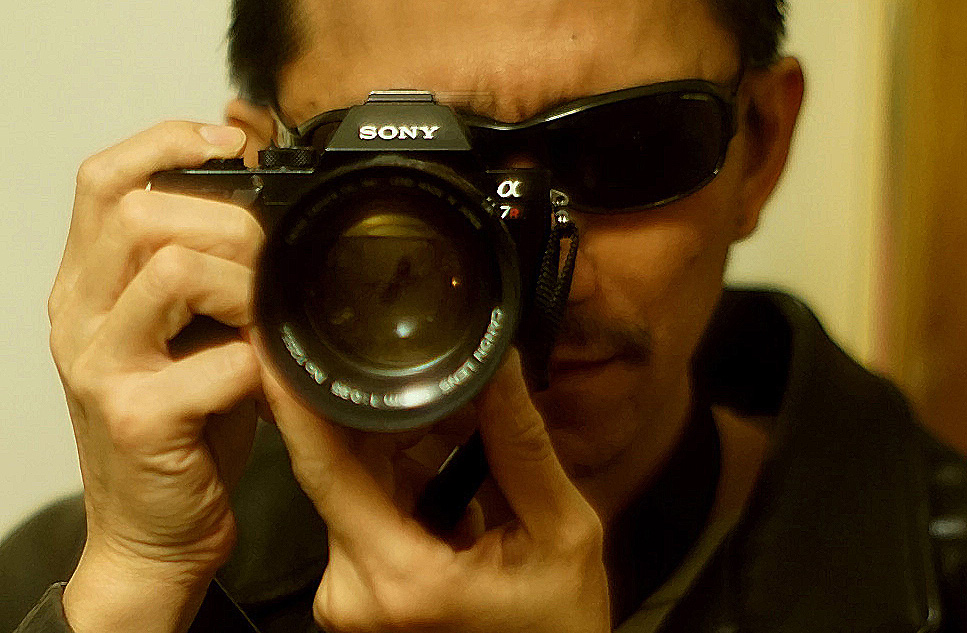
September Gear Lustin’ :-)

SamCam

Boy the time went by fast. I almost forgot that I’ve been on this project for over a year now. It’s been a lot of fun, even if it’s hasn’t been really easy to post stuff that I think would be worth your time.

I started this blog and the Instagram page to profile the cameras I have used in my thirty plus years of gear lusting and photography loving. I hope to be able to profile more interesting gear for you in the coming weeks and months. I thank you for taking the time to read and view this man’s OCD with cameras and lenses 🙂


My friends at Adorama reminded me of the great deals going on right now, with a lot of manufacturer rebates and instant savings, and I’m just passing this info along to you guys and girls. This is a good time to stock up on new camera bodies, lenses, and accessories and save a good deal of money in the process.

I really don’t have the funds right now or I would jump on these deals! Maybe some of you can take advantage of this. Here are some quick links.

Deals on camera bodies and lenses:

CANON Camera Bodies
CANON Lenses

NIKON Camera Bodies and Lens Deals
All NIKON Savings and Instant Rebates

And some amazing deals on the incredible new Zeiss Milvus lenses, which includes a new 50mm f/2, 85mm f/1.4, and 100mm f/2. These should all be incredible portrait lenses. Here’s the link to preorder these Zeiss lenses:

Zeiss Milvus Lenses

Plus lots of other great deals at their store. Happy shopping and enjoy!

Note: Sure this is a shameless plug for one of my favorite stores, but I have been buying from them for a long time and there are some great deals going on and I have to say they ship fast! And yes, if you buy through these links I might get a small commission which would buy me a cup of coffee and maybe help me keep blogging for you guys 🙂

Anyway, Adorama is great, especially for new items, and I would never steer you guys in the wrong direction. I buy from them myself and will continue to do so. If you can get some great gear and save some money at the same time, I figure it’s a win-win 🙂

Best,
Sam

The Original Fuji X100

DSCF2479SamC

“Underdog” 2015. Fujifilm was always an “underdog” in a world of giants like Canon, Nikon, and Sony. The original X100 of 2011 helped bring the film giant into the spotlight and into the hearts, minds, and wallets of photographers and camera lovers 🙂

The X100 is a 12.3 megapixel camera released in 2011 by Fujifilm Corporation.

The camera had an APS-C sized sensor and featured a 23mm f/2 Fujinon lens, which translated to the equivalent of a 35mm lens on a full frame camera.

The X100 was an instant hit when it came out, and continues to be a hot seller for Fuji with a couple of reiterations as the X100s and the current X100t. Let’s make it clear, for this review we are only talking about the original X100.

The original X100 does NOT have the much hyped Fuji “X-Trans” sensor, so X-Trans fans should remember this when considering the older X-100.

As with so many digital cameras today, the X100 has a wealth of features built in, many of which I’m not going to cover here, just to let you know right off the bat. You’re better off going to dpreview or the instruction manual if you need a breakdown of everything. I’m just giving you my experience with the camera and how I use it.

BUILD AND HANDLING

The X100 was an eye-catcher when it first came out. One of the reasons the X100 had such appeal was because of its retro looks.

137162322.Zas0cXSR.XiCadeZoe

“iRetro” 2011. Fuji X100 12.3mp. The Fuji X100 was an instant hit for Fujifilm, no doubt a lot of it had to do with the camera’s retro looks.

I did not set out to get an X100, but I happened to be in Washington Square Park in NYC in May of 2011 when I first saw the X100 in the flesh. It was hung around some guy’s neck. I’m a sucker for cameras as you might know, but I have a special soft spot for the “weird,” “strange” and “different.” Right away, I thought I had to have one! 🙂

Fuji clearly aimed to capture the hearts of classic camera lovers when they designed the X100! The camera does indeed look like an old rangefinder camera.

The camera feels good in the hand, albeit on the lightweight side, which is actually a good thing if you’re going to be carrying the camera all day. However, as a person who has used several film rangefinders over the years, I have to admit I was a little disappointed in the way the camera felt when I first got it; light and not as solid as the film rangefinders of yore. But that’s just a personal thing as the camera has proven quite durable in the four years I’ve had it.

The controls are well laid out, with the shutter speed and exposure compensation dials on the top right of the camera. The exposure compensation dial moves out of place too easily in my experience, so be mindful of this when you move it in and out of your camera bag.

Also on the top right of the camera is the “FN” or function button, which can be customized to do a variety of things. I personally use it as my ISO button, but I believe you can use it to quickly bring up the built-in ND filter (a cool feature!) or the film simulation settings.

Another nice touch is the “self-timer thingy” on the front of the camera which is not actually a self-timer, but a lever that will allow you to switch between the EVF and optical viewfinder. The dual EVF and optical viewfinder is another great feature that you don’t see very often.

On the back are buttons for playback, AE, AF, and view mode as well as AF lock, AE lock, drive, menu, white balance, and a nifty quick RAW button.

The more I write, the more I appreciate the thought Fuji designers put into this camera!


PERFORMANCE

The X100 is sort of a mixed bag when it comes to performance. Indeed, it’s this “imperfect” quality that gives me a love/hate relationship with this camera.

The autofocus is a tad on the slow side. And not just slow, but it often missed focus, sometimes on “easy” targets. In fact, this was one of the main issues reported by users when the X100 first came out.

137897502.j5SIhluz.DSCF0483M

“Dos Caras” 2011. The original Fuji X100 was plagued with focus issues early on. As can be seen in this image, it completely missed the mark on what I would call an “easy” target. Through a series of firmware updates, Fuji has remedied this problem, but have not completely eliminated it.

To their credit, through a series of firmware updates, Fuji has addressed this and now the camera, at least mine is somewhat better in the AF department and more pleasant to use. A little faster, but no speed demon. Certainly more accurate, but still misses the shot and sometimes “easy” shots.

You can manually focus the lens, but it’s too slow a process for me to bother with.

For me, the best way to achieve accurate focus with the X100 is to use the central spot for AF and to focus the camera using the EVF. I find I get a much better hit rate of sharp shots versus just using the back LCD.

IMAGE QUALITY

One thing I can’t deny is that the X100 is capable of superlative images. At its best, it is superb, but it does not always come easy. A lot of it, again, has to do with the slow and sometimes inconsistent autofocus.

DSCF2229OldWomanC

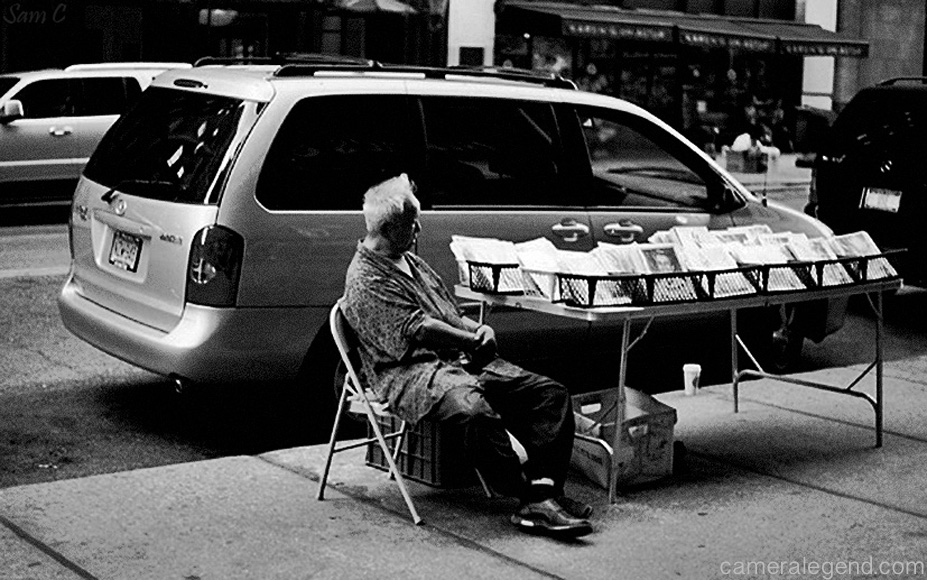
“Camera Art” 2013. Fuji X100 12.3mp. I shot this “from the hip” as I walked by this lady on Khaosan Road in Bangkok, Thailand. I held my breath because of the X100’s quirky AF, but the camera nailed the shot.

The 23mm f/2 (35mm equivalent) Fujinon lens is somewhat soft wide open, at least on my camera, but makes for good portraits at that aperture. The lens has minimal distortion and is very sharp from about f/4 and up.

DSCF0545BugC

“Bugster” 2011. Fuji X100 12.3mp @ f/5.6, an example of the crispness possible with the X100.

The bokeh is good, not outstanding, but neutral to my eyes. The lens gives a very nice flare that I like when pointed close to a light source, i.e., the Sun.

VioletC

“Sprout” 2011. Fuji X100 12.3mp. An example of the flare and better bokeh possible with the X100.

140738504.uhRq05Dh.DSCF1641JuJuZoe1

“New Year’s Day” 2012. Fuji X100 12.3mp @ f/2. An example of the neutral quality of the Fujinon’s bokeh. And in Washington D.C., nothing changes on New Year’s Day! 🙂

You can count on great images from ISO 100-3200, even 6400 and 12800 will do pretty well when you need it.

137916975.rr7AiVam.DSCF0415PlayHere copy

“A Dollar & A Dream” 2011. Fuji X100 12.3mp. An example of a (for me) very usable ISO 12800.

The Fuji X100 is also capable of delivering bold and rich colors and tones, something Fuji has always been known for. I have not played around much with the film simulations, although I do like the Velvia and Provia presets. However, for the most part, I’m pretty much a straight shooter and I will do some post processing work afterwards in Photoshop if need be.

DSCF10051C

“Fuji Colors” 2011. Fuji X100 12.3mp. The X100 delivers rich colors and tones, something Fuji cameras have been renowned for.

On the basis of image quality alone I can’t fault the camera. Some people claim the original X100 has a certain “magic” to the images not seen in the X100s and X100t. I have not used either of those cameras so I cannot compare them. I will say at its best, I can see the “magic” but it takes the right photo op and circumstances. In other words, the X100 is also capable of very ordinary looking images, a lot of which I can blame myself for 🙂

The camera takes wonderful HD videos too, although as I’ve mentioned before I’m not a video guy so don’t take my word for it 🙂

One thing I will say about the video function is that there is no dedicated “video” button. You have to push the “wheel” near “DRIVE” up twice. Easy enough, but in the beginning I often pushed it by accident, got into video mode at the wrong time and couldn’t figure out how to get out of it fast enough. Just an FYI because this always happened to me at the wrong time!

MY LOVE/HATE RELATIONSHIP WITH THE X100

As mentioned before, I love this thing, but at times I hate it.

On one hand it looks so lovely, but when I pick it up, I feel like I’m holding a glorified digital point and shoot camera. On the other hand, it’s so well designed I appreciate the thought they put into designing it.

On one hand, it has given me some very nice images, some of which I really love. On the other hand, it has given me many lousy images due to mis-focusing and slow operation. Sometimes I hold my breath when I take a shot because I’m not sure I got the shot.

DSCF1373NakedCowboyC

“Nekkid Buck” 2011. Fuji X100 12.3mp. I took this shot of the “Naked Cowboy” as we walked passed each other in the crowd. To be honest with you, I’m surprised the X100 nailed this shot!

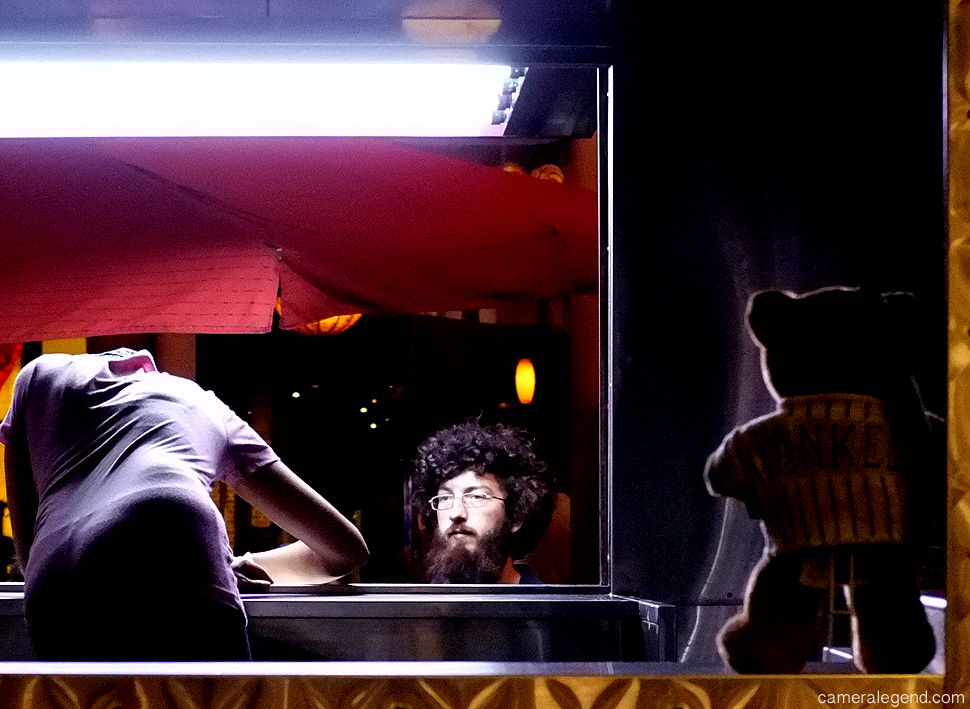
DSCF0393YankeeC

“Night Stalker” 2011. Fuji X100 12.3mp. I couldn’t get over the man’s intense stare at the vendor 🙂

One thing for sure, this camera has got character! And I don’t mean just the lens, I mean the camera itself feels like a spouse that you love one day, hate the other, but somehow the good outweighs the bad and you decide to stick with them 🙂

DSCF0308ZoePba

“Zig Zag Zoe” 2011. Fuji X100 12.3mp. The X100 has given me many images, such as this one, which I cherish. While a lot of it has to do with the camera’s abilities, a lot of it also has to do with the subject at hand 🙂

BOTTOM LINE

The X100, despite its quirks and maybe because of its quirks, is a standout among digital cameras.

It was an instant hit and brought Fujifilm out of the abyss and into a new era of popularity that it had never seen before. Fuji was always a cult favorite, but the X100 and its siblings helped the company grow into a major player in the digital camera field. It seems Fuji did everything right, in stark contrast to the once almighty Kodak, another film giant, which seemed to have done everything wrong in the digital arena.

DSCF0213WTC

“Out Of The Abyss” 2011. Fuji X100 12.3mp. Hard to believe that only four years ago, the Freedom Tower in NYC was still half done! Just like the Tower, the X100 took Fujifilm out of the abyss and into superstardom in the world of modern digital cameras.

If seeking an original Fuji X100, prices are trending at $350-500 depending on condition, accessories, etc.

The X100 is an enigma that is capable of superb images, yet at the same time can frustrate you with quirky operation. But the camera is unique, it has character, and I have no doubt it is a Camera Legend.

MilSamC

“X Champ” 2012. The Fuji X100 12.3mp is the original “champion” of the Fuji X clan 🙂

The Minox DCC 5.1

The Minox DCC 5.1mp digital camera from Minox. Let’s make no mistake about it, this is a toy camera and I only got one for my collection as it is cute as a button 🙂

The Minox DCC 5.1 is a 5.1 megapixel camera introduced in 2010 by the famous miniature camera maker Minox.

While it obviously mimics the looks of the legendary Leica M3, an M3 it is not. This is pretty much a toy camera, pure and simple.

The camera is clunky to use and the image quality is quite bad. You can forget about shooting it at night or in low light unless you have the accessory flash. Over the years, I have been known to take cameras to their low light limits, and if the camera is half way decent, I can get something usable out of it. But this one, for low light shots, I said “Fuggedaboutit” 🙂

Sure, you might if you are so inclined, get some cool effects with it, but it’s a novelty, not an everyday camera.

There will be no “official” reviews on this one. In fact, everything you need to know about it, I just wrote it in the sentences above.

I got it for under $50 and it’s purely for my collection as a camera buff. One thing I will say is that, just like the model holding the camera, it is cute as a button…which is why I got it 🙂

As bad as these cameras are as a “camera” they still have their appeal as collectibles and in that respect, I wouldn’t be surprised to see these “Leica” Minoxes end up as an interesting footnote in the Camera Legend of Minox.

Although the Minoxx DCC 5.1 is an older model, there are a couple of other similar cameras Minox put out, including the last 14mp model. Although I still think they are very much toy cameras, if you’re interested you may be able to get one at a good deal on here for Minox cameras.


The Rolleiflex Black Baby 4×4 Camera

SamRolleiFACBKPS

“Black & Quack” 2015. With the “Black Baby” Rolleiflex 🙂

The Rolleiflex “Baby” models are twin lens reflex cameras made by Rollei. This particular model is the post war “Black Baby” and was made in 1963. The Rolleiflex “Baby” lineage goes all the way back to 1931 and ended around 1968.

The camera takes 127 film or otherwise known as 4×4 (cm) which is considered an obsolete or “dead” format because 127 film is no longer made, at least not in bulk or by major manufacturers.

You can find 127 film quite easily on eBay, but most of these are outdated and overpriced, and usually sold by Eastern European sellers. However, hang around and I’ll tell you where you can buy some fresh 127 film.

I have not used this camera extensively so this is by no means an official “review.” I initially got this as a collector’s piece knowing that I would not be doing much shooting with it.

THE CAMERA

The camera as is stated is pretty much a “baby” Rolleiflex TLR. You focus through the waist level finder using the knob on the left hand side and wind the film with the right hand knob. It’s basically a miniature Rolleiflex TLR.

DSC00614RolleiPSC

“Size Matters” 2015. The Black Baby Rolleiflex on the left, and the Rolleiflex 2.8C Xenotar for size comparison.

The shooting lens is a 60mm f/3.5 Schneider Kreuznach Xenar which is basically a Tessar type lens that should be quite sharp and contrasty.

In my experience, you can’t go wrong with either Zeiss or Schneider lenses and on these Rollei cameras, they are top notch.

The camera feels well built, but may be a little awkward to hold and use especially if you are used to “normal” sized TLR’s.

BOTTOM LINE

The Rollei “Baby” models are quite popular with collectors, with the “Baby Grey” being the most popular and abundant. These can go anywhere from $50 to $250 if priced fairly.

The Black Baby goes for a bit more. I personally find this one to be the most desirable model because it is the one that looks closest to a modern Rollei TLR.

I got mine for a little over $300, but I’ve seen sellers asking over $1000 for them. However, those over $1000 usually do not sell. Why? Because people aren’t stupid! They know that 127 film is virtually gone and you can get a 6×6 Rollei for that price. A fair price I would say would be from $300-450 for this particular model.

Even though 127 film is basically obsolete, you can now get 127 film, fresh, from…B&H! Yes, that’s right, good old B&H. The film is only available in ISO 100 speed and is called “Rerapan 100” and it is a little pricey at $11.99 for each roll. If you go in there, tell ’em Sam sent you 🙂

Although I would greatly prefer the added versatility of ISO 400 film and a lower price, I’m happy to have at least one source of fresh 127 film.

Some folks have taken the widely available 120 medium format film, cut it down and re-spooled it into 127 film. I have not had the time, the skills, nor the inclination to do that however, not that it seems that hard.

Needless to say, at $11.99 a roll, this camera will not be a daily shooter for me. As I said in the beginning, I basically bought it for my collection, and to be able to actually shoot it is an added pleasure.

I still have my first roll of 127 film in this camera. When I get the results, and if they’re good enough, I will update you on another posting.

While most of these “Baby” Rollei cameras are sought for collections, they are also great shooters, and they are an interesting part of the Camera Legend that is Rollei.

The Best Camera I Never Knew Part I: The Rollei Rolleimatic

SamRolleiFACBK

We can’t always have winners…

In the first post of this series, I take a look at cameras that I have come across, which may or may not be Camera Legends, but somehow they didn’t work out for me.

I’m sure there are cameras that many of you have used, that you heard a lot (or a little) about, you wanted them, and eventually got them, but for some reason or another they didn’t live up to your expectations.

First up is…

THE ROLLEI ROLLEIMATIC

The Rolleimatic is a uniquely designed camera introduced by Rollei around 1980, I believe. It was designed by the famous camera designer Heinz Waaske.

The camera features a 38mm f/2.8 Tessar type lens lens and relies on scale focusing.

The camera’s claim to fame is a rather odd design where the “flap” that covers the lens also doubles as a film advance mechanism.

The camera looked very cool to me, certainly stands out among point and shoot cameras of its era. I love anything retro, so at under a hundred bucks, I had to give it a try. With the legendary Rollei name, you would think this would be an instant winner. However, for me, it wasn’t.

WHY IT DIDN’T JIVE WITH ME

Information on the Rolleimatic is scarce on the web. One great review I read was from a cool guy named Mike Elek, also a classic camera aficionado, and he stated that the camera is a little fidgety to load film.

Well, he was right and then some! I couldn’t get one roll of film to load in this camera! 🙂

Ok, so I thought…maybe there’s something I’m doing wrong. So I found the online manual, I tried and retried, and retried…couldn’t get a damn roll to stick in this camera.

Sometimes, I would get close and it would latch on for like two winds, then the film came loose and I’d have to start over again.

The problem is there is no “slit” in the film take-up like other cameras. Instead there is a “film like thingy” in there that you’re supposed to hook the film up to. I should’ve taken a picture of it, but the best way I could describe it is that the part looks like a piece of 35mm film, but stronger, and is removable. It has “teeth” that is wrapped around the film advance roller and you’re supposed to get your film under the “teeth.” Well, that I did, but it still didn’t work!

Being that he was the only person who seemed to know anything about this camera, I emailed Mike and he was kind enough to write me back. He even made a YouTube video to show how to load the film, what a good guy!

Anyway, despite all his help, I couldn’t do it. Maybe something was wrong with my particular camera.

The camera looked awesome cool, but all it gave me was a headache 🙂

BOTTOM LINE

The camera was sent back for a refund. I’ve been using film for more than thirty years, this was the first camera that I couldn’t load. I’m convinced that it was the ‘funkiness’ of the design 🙂

Mr. Waaske, God Rest His Soul, was a brilliant and creative camera designer. A Legend. I have nothing, but respect for his creations. However, sometimes being too creative might not be such a good thing.

If hunting for one of these, and I’m not sure that’s a good idea, prices are trending at $50-160. So they are not expensive, but they do seem scarce.

The Rolleimatic is one of the Best Cameras I Never Knew. But it is not alone. There will be more to come 🙂

The Ricoh GR1 Film Camera

The Ricoh GR1 Film Camera Review

UPDATE 9/3/2018: As a companion to this 2015 review, I am adding a new video on the GR1 for those folks who enjoy watching videos more than reading, and yes, even though reading is better for your brain, I do understand the need for videos 🙂

If you’re on YouTube, I would love to hear from you! Please don’t forget to LIKE, COMMENT, SUBSCRIBE for new videos and updates. Thanks for your support!

The Ricoh GR1 is a 35mm point and shoot camera introduced by Ricoh in 1996. It was considered a high end or “luxury” point and shoot camera.

The GR1 came from a unique era in the mid to late nineties when manufacturers such as Leica, Nikon, Konica, and Contax put out several point and shoot cameras with high specifications, forever changing the way the lowly point and shoot camera was perceived. Ricoh’s first entry into this market was the GR1, and while the luxury point and shoot cameras from all the manufacturers have their own cult following, the GR series might be right there at the top, or second only to the Contax T series in terms of following and reverence.

BUILD AND HANDLING

Among the GR1’s many useful qualities, the best may be its size. It is small, light, thin, and truly pocketable which is one of the reasons why it was and is considered a great street camera.

DSCF0640RGR1FA

“Black Or Silver” 2015. Take your choice of black or silver for the GR1. Either way, you have a very capable, non-flashy point and shoot that’s perfect for street work.

As you know, the best camera is the one you have with you, and with the GR1, there’s no excuse not to have it with you at all times.

This was especially relevant in the 90’s, but maybe not so much today with the advent of high quality phone cameras now on the market. In fact, the phone cameras have largely replaced even digital point and shoots, let alone film versions. However, for the classical street photographer, film remains THE medium of choice.

The GR1’s body feels lightweight with a mix of plastic, metal, and a magnesium alloy chassis.

While the camera is really a point and shoot, with programmed AE and aperture priority only, one of the things that made the GR1 stand out from your standard point and shoot cameras was the ability to control some aspects of the shot. For example, on the top right dial, you have “P” for programmed AE, and then your aperture selection, i.e., f/2.8, 3.5, 5.6, etc, etc.

On your top left, you have an exposure compensation dial that gives you plus or minus two stops.


The original GR1 and GR1s have no manual ISO selection. The GR1s added supposedly better coatings, a backlit lcd, and the ability to use filters, but is pretty much the same camera. The GR1V has it all, plus manual ISO selection, in addition to a few other features like a more flexible SNAP mode. Of course, you also have the GR21 with its super wide 21mm f/3.5 lens, but that’s another animal altogether.

On the GR1, I will just use the exposure compensation dial should I need to make adjustments and it usually works fine for my purposes.

THE LENS

The GR1 is equipped with a super sharp 28mm f/2.8 GR lens. As a guy who lives at 50mm, I initially thought as many people do, that 28mm might be too wide for me. But I have been able to do portraits with it, and it’s perfect for street work.

129739276.Y6Sl2aBn.GR1LitP

“A Portrait Of Dad” 2006. Ricoh GR1, Kodak Gold 400. An example of using the GR1’s 28mm wide angle for portraits. Dad relaxing with a smoke while sitting on a bench in Riverside Park, NYC. After his passing in 2011, I found it hard to look at this shot, knowing that a lifetime of smoking cigarettes killed him. However, with the passing of time, I’ve come to accept that cigarettes were a huge part of his personality and they gave him immense pleasure and relaxation, despite the final outcome. RIP my Papa, I’ll always cherish our moments.

The lens is very good at f/2.8, but is extremely sharp from around f/5.6 and up. For a wide angle, the lens has very little distortion. Maybe some slight barrel, but not significant enough to worry about, especially for street work.

PERFORMANCE

Among the GR1’s great qualities are its fast and accurate AF, and a SNAP mode where the camera will set focus for 2 meters or 6.5 ft to infinity, which cuts down shutter lag allowing for quicker shots. This was a very popular feature with street photographers, and Ricoh has kept this unique feature on every GR camera ever since, including the latest GR 16mp camera.

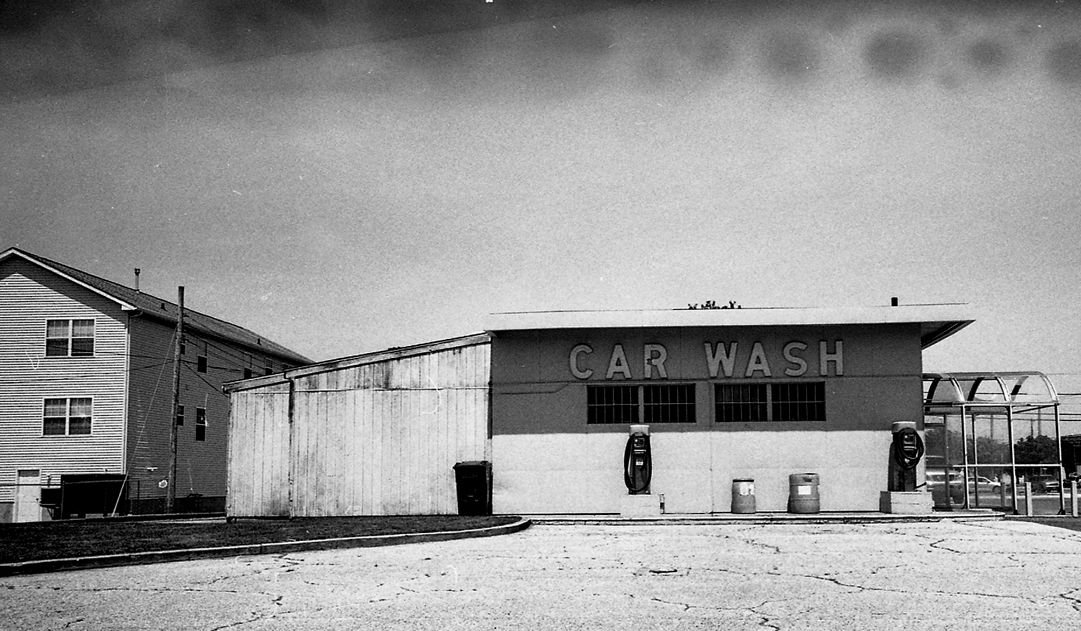
CarWash074FAC

“Car Wash” 2015. Ricoh GR1, Ilford FP4 Plus 125 in D76 developer. Wildwoods, NJ. Note the flaws in the sky, a result of my imperfect developing.

The camera, while stealthy in its look and size, is certainly not quiet. In a silent room, you will hear the motor advance. However, on the streets, this is generally not a problem.

GR1FP4125HouseWW072

“Tribute NYPD Officers” 2015. Ricoh GR1, Ilford FP4 plus 125. It was good to see the unity that people in Wildwoods, NJ, feel about the recently fallen NYC officers.

ISSUES

The GR1, while certainly a classic, is not without its “issues.” Main problem I have seen on these cameras is the fact that the top lcd goes bad. It’s more common to find GR1’s with bad lcd’s than it is to find one with no lcd issues. Sometimes you will get a partially functioning lcd with missing segments. For example, you press MODE and you will get the “mountains” or infinity symbol, but press again and you’re missing the SNAP symbol. Or you will get a partial frame counter or none at all.

This seems to be a problem on all GR1’s, including the GR1s and the GR1v so inspect carefully before you buy.

This will indeed be a problem for many folks. It is too bad that Ricoh used some very poor lcd’s much like the Contax cameras of that era. All lcd’s can go bad over time, I understand that, but I definitely see this more with Ricoh and Contax. Surprisingly, the Canon EOS line had some of the most trouble free lcd’s of cameras of two decades ago or more.

imgGR1Queens054FA

“Backwards Time Traveler” 2015. Ricoh GR1, Ilford Delta 400.

Another issue is the viewfinder indicators such as the framelines, and focus confirmation goes dim and in some cameras, are barely discernible.

The last and probably most troubling issue would be if the shutter or motor are dying. If this is the case, you can forget about it because Ricoh does not service these cameras any longer. You can usually tell these problems by a shutter that won’t open or close, and a motor that gets progressively noisier.

All that said, the LCD issue which is the most common, is not really a make or break for me. As long as I can set the aperture, I’m good. I do not usually use SNAP mode anyway, and if in doubt, I’ll leave it on “P” mode and pray 🙂

I try to remember that this IS a point and shoot, and if you use it that way, you will generally not be disappointed. At 28mm, you can usually get a sharp shot if you focus on anything five feet away or more. I only worry if I’m trying close portraits.

BOTTOM LINE

The Ricoh GR line is most certainly iconic. No doubt helped by the works of legendary Japanese street photographer Daido Moriyama who helped make using a point and shoot in the streets “hip.”

1441351_10204549930660610_784127188593436077_n

“The Golden Man” 2006. Ricoh GR1, Kodak Gold 400. I loved the light shining down on that afternoon in Riverside Park, NYC. I originally titled this “The Man With The Golden Ear” and Dad was truly a man who would listen to all my issues and offer great advice. He was there to accompany me to an interview. I got the job. He was really a man with the golden touch 🙂

If looking for one of these, prices are trending at $250-350 for the original GR1, $350 and up for the GR1s, and $450-650 for a GR1v, depending on condition.


The Ricoh GR1 is a Camera Legend, and a legend of the streets. It is THE superstar point and shoot camera of street photography. If you can find a rare flawlessly working one, or can live with its known “issues” you will have a very special camera that will reward you with the ability to take fantastic shots in a small and truly pocketable form.

imgGR1ZoeZayFA

“Softees” 2015. Ricoh GR1, Ilford Delta 400. Probably a slow shutter speed and some movement resulted in a soft image. Almost didn’t put it in the review, but I love the faces 🙂

***DEAL ALERT***

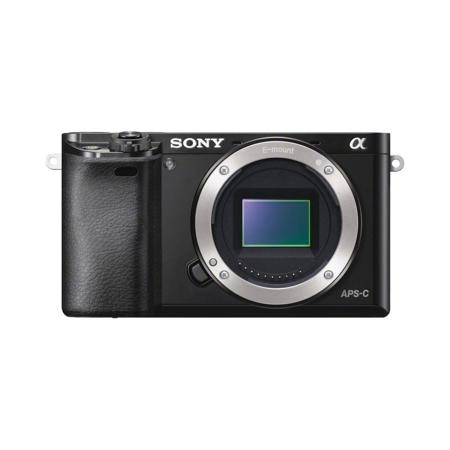
Save $100 on the HOT Sony A6000! Use the link to buy from our safe and trusted affiliates. You will pay nothing extra and support Camera Legend at the same time to help us fund more reviews and articles on the cameras and lenses you want to see. The gear other sites neglect are the ones we want to write about for you! Thanks for your support.
Alpha A6000 Mirrorless Camera Body, BlackAlpha A6000 Mirrorless Camera Body, Black$448BUY NOWAdorama

The Incredible New Fuji X-H1

Canon T90: “The Tank”

SCFA

“The Tank” 2013. My war-torn Canon T90 and 55mm f/1.2 Aspherical. They may be in “ugly” condition, but damn I love this combo!

The Canon T90 is a 35mm SLR introduced by Canon in 1986. It was their most advanced model in the classic Canon FD mount.

One look at the T90 and you can see that it was THE bridge camera to the Canon EOS line of cameras, which was introduced only a year later in 1987 with the Canon 650.

DSCF0648CanonT90MKIIC

“All In The Family.” The Canon T90 from 1986, side by side with the EOS-1D Mark II digital from 2004. Note the family resemblances, despite the incompatible lens mounts.

THE FD MOUNT OUTRAGE

Although Canon introduced a Cosina made T60 model in 1990, the FD line was effectively over with the introduction of the EOS mount in 1987.

At the time, there was a bit of outrage from loyal Canon FD owners who now had their lenses rendered useless on the new incompatible EOS mount. They felt betrayed, and many even switched to “the enemy” Nikon, pledging they’d never use Canon gear again. Even today, I still hear of people who never forgave Canon for abandoning the FD line. Talk about crazy passionate! 🙂

Anyway, as great as the FD mount was, I believe that time has proven Canon right in their decision to change to the all electric EOS mount. With this mount came super-fast and near silent “Ultrasonic” motor autofocus lenses, super telephoto lenses, and some very unique “L” lenses such as the 85mm f/1.2L, the 135mm f/2L, and the 200mm f/1.8L, which are among some of the finest lenses ever made by anyone.

The larger EOS lens mount also made it possible to mount “alternative” lenses such as Olympus OM, Nikkors, Leica R, and Contax/Yashica mount lenses to name a few, which was not possible with the FD mount.

BUILD AND HANDLING

If you ever used an EOS camera, and most of you probably have, then you’d be pleasantly surprised to see and feel how much the T90 handles like an EOS camera with its buttons and front right hand dial.

The camera is built well, although it feels a little plasticky with its polycarbonate body. It is however solid and rather heavy, especially with the required four AA batteries and a lens attached.

The body is molded as if there was an accessory battery grip built on to the camera, so if you’re one who likes those bulky add on grips, you’ve got one built-in with the T90. It’s a beast! They didn’t call it “The Tank” for nothing 🙂

PERFORMANCE

I’ve used a couple of these cameras over the years and they have always provided near perfect exposure in aperture priority or program modes.

a0033_33babyjpfa1

“Village Of Love” 2013. Canon T90, 55mm f/1.2 Aspherical on expired Kodak Ektar 100. A little bit of love going on in NYC’s Greenwich Village! This image I think has a bit of that 80s look to it. My method of creating “vintage” modern photos is to use “old” equipment vs apps or filters.

The T90 has a brilliant metering system, which included center-weighted, average, partial, and spot metering, highlighted by its famous “multi-spot” metering which will allow you to spot meter several readings in a scene and have the camera average them out for an accurate reading. You also have TTL flash with compatible Canon flashes.

There are only a handful of film cameras with multi-spot capabilities, the other two that I can think of offhand would be the Olympus OM-4/4Ti and Canon’s own EOS-3.

This is also useful if you’re one of those Ansel Adams acolytes who embrace the Zone system.

IAsleepBWPba

“I, Asleep” 2003. Canon T90, 50mm f/1.4 FD lens, film unrecorded. NYC is known for being a dynamic city, but with a gig this boring…hey! 🙂

I think the reason multi-spot is less of a selling feature these days is simply because with digital, you can just retake the photo if it didn’t come out the way you wanted. Progress has made life for us photo bugs easier, if not necessarily better photographers, technically anyway.

imgT9055Shaft'047Cam

“The Mac Is Back” 2013. Canon T90, 55mm f/1.2 Aspherical on expired Kodak Ektar 100. Legendary NYC photographer Louis Mendes. Lou is a well known figure on the streets of New York. Even if you don’t know him, you probably have seen him if you walk around the streets of Manhattan enough. With his throwback “Shaft” look and his iconic Speed Graphic, Lou takes one of a kind instant portraits and has made a living and a legend out of it. When I saw Lou again about a year later, he actually remembered that I shot him with a T90. Sharp man!

BOTTOM LINE

The Canon T90 and the vast line of FD and older breech mount lenses are among the best value in film photography today.

If you’re a student, new to film, or an old pro looking to rekindle your photographic passion, and you love electronic cameras, the T90 and a couple of lenses would be a good place to start.

ZJT90Cam

“That Aha Moment” 2013. Canon T90, 55mm f/1.2 Aspherical on expired Kodak Ektar 100. Colors fading and shifting…a “natural” Instagram! 🙂

If shopping for a T90, prices are dirt cheap these days and trending at $20 to $100 depending on condition. Anything more is a ripoff, unless a really good lens is included.

One problem well known with the T90 is the famous “EEE” error message which usually indicates a sticking shutter. Be forewarned that many T90’s develop this problem as they age. How do you get around this if your T90 develops this problem? Well, first I’d try putting in a fresh batch of batteries. If that does not work, the best solution is to pick up another one, preferably cheap. You’d probably pay more trying to repair it, and that is if anyone would even be able to repair the T90 these days. As I said, just pick up another one 🙂

You should also fire the shutter from time to time if the camera is not in use for long periods, as with all film cameras. This can, but is not guaranteed to help avoid the EEE error.

Despite this one potentially serious flaw, there can be no denying one thing that is true…

The Canon T90 is a Camera Legend and considered by many to be the best camera Canon ever made. At the prices they’re going for today, you could have one of the greatest, most technically advanced film cameras in your hands for the price of dinner. Not a bad deal in my book!

CANON T90

PROS: Well built and sturdy; Takes cheap and awesome FD glass; Excellent metering; Multi-spot metering capabilities; Plentiful on the used market; dirt cheap 🙂

CONS: Prone to the infamous EEE error, mostly due to a sticking shutter problem; Electronics that do not age well; A bit confusing to use without user’s manual; Bulky and heavy with lens attached and batteries installed.

The Sony A7R: Is It The Ultimate?

DSC00513SamCamI

“The Dream” 2015. The Sony A7R, when introduced in 2013, represented the pinnacle in digital camera technology. Seen here with the Canon 50mm f/0.95, it is a “Dream” combo for me. I played around with some “Pop Art” type settings for this shot 🙂

The Sony A7R is a 36.4 megapixel mirrorless digital camera introduced (along with the 24mp A7) by Sony in 2013.

Now think about it…a mirrorless camera with a whopping 36.4 megapixels on a full-frame sensor. You might call the A7R an instant Camera Legend!

Note: With the exception of the first two photos, I have included some larger than usual photos especially for this camera. You may have to double click on the photos to see them at their intended sizes.

FIRST IMPRESSIONS

While the camera looks like a miniature DSLR, it is indeed NOT a single lens reflex. Instead, it is a mirrorless camera that does not rely on a reflex mirror as in traditional SLR cameras.

You have the option of using the back LCD, as in all digital cameras, or the built-in electronic viewfinder (EVF). The EVF has a resolution of 2.4 megapixels and is one of the best I’ve ever seen.

The camera is small, but feels good in the hand. Solid, light but with a nice heft to it. The right hand grip feels comfy and secure to me, but might not for someone with larger hands.

When I first handled the camera at the PhotoPlus show in NYC in 2013, my impression was that the camera looked and felt a lot like my Olympus OM-D EM-5, only stronger and not as light as the OM-D. I would say it is like the EM-5 ‘grown up’ 🙂

ZLipsC

“Pucker Up” 2014. Sony A7R, Voightlander 35mm f/1.2 Nokton Aspherical, first version. Lipstick, ear-rings, kids jewelry…growing up way too fast! 🙂

It is not the prettiest camera in the world, but not the ugliest either. It feels like a ‘machine’ or a computer with a camera that Sony put together, in essence that’s what it is, but I kinda like that. And this machine is made for image making. It is not here to win any beauty contests, it is here to work. And it is an excellent worker.

CONTROLS AND FEATURES

The controls are well laid out with the mode dial, on/off dial, and exposure compensation wheel at the top. The inclusion of the “Fn” or function button on the back makes it easier to access key features such as ISO, drive mode, flash, focus, etc, etc. This is certainly a lot better than some of the lower end NEX cameras I have used where you have to use the scrolling virtual menu to access these features.

The menus are typical Sony and any NEX user will be familiar with most of it. You can customize this camera to do a lot of things, but I suggest you read the manual to have it do what you want.

As mentioned earlier, the EVF is wonderful, amazing really. I was always an old-school optical viewfinder guy, but the EVF on the A7R has won me over. Combined with the focus peaking, I have been able to get sharp shots in situations where it would almost be impossible. It’s that good.

There’s a lot more features to this camera than I care to write about. All I can say is that you can do almost anything you want with it 🙂

AUTOFOCUS

I can’t say much about the AF because I have mainly used manual legacy glass, i.e., Leica M, Olympus OM, Nikkors, etc, with this camera.

I did use a kit lens from the cheap Sony A3000 on the A7R and it focused fast and sure. Note that if using AF lenses from the APS-C NEX series, the A7R automatically switches to its 1.5x crop mode at a still respectable 15.4 megapixel resolution.

The two AF primes most users rave about when using the A7R/A7 series are the Sony made Zeiss 35mm f/2.8 FE and the Zeiss 55mm f/1.8 FE Sonnar lenses. I have yet to really desire these, due to the lack of funds, and my simply having no problems getting sharp shots with my legacy glass. One day I hope to get around to one of these fine AF Zeiss lenses, and the 55mm f/1.8 is the one I’d get first.

MANUAL FOCUS

As mentioned, I have been using the A7R almost exclusively with legacy glass. This is the best camera I have used for this purpose.

I set the focus peaking to red, mid level, and just focus away. Focus peaking allows for the camera to highlight (in red, yellow, or white) the edges of your subject when the camera determines that you’re in the focus zone. Sometimes, you may have situations where you can’t really get a good ‘peaking’ but the EVF is clear enough where I can make the focus most of the time.

DSC00383RPC

“Twilight” 2014. Sony A7R, Canon 50mm f/0.95 “Dream Lens” at wide open, ISO 800. Please click on the photo for a much larger and better view.

Focus peaking is easy to use and a very effective tool for using manual focus lenses on your camera. As mentioned earlier, the implementation on the A7R is one of the best I have used. It makes you wonder how we took all those nice photos on film SLR’s all those years without it 🙂

Don’t get me wrong. You’d probably still get a better hit rate with the autofocus 55mm f/1.5 FE, for example, but I’ll be darned if don’t tell you how pleasantly surprised I was to see how well I could focus my old lenses.

DO I NEED 36 MEGAPIXELS?

This is probably one of the main questions people have when deciding whether or not to buy the A7R. For some, it is the reason to stay away. For others, it’s reason enough to sway them to give in to their G.A.S. “Gear Acquisition Syndrome” 🙂

I’ve been using this camera for almost a year, got it last May, 2014. Here’s my take on this…

Probably 99% of the time, 99% of us won’t need 36 megapixels. We get the A7R because we WANT it. There I said it 🙂

Back in 2004 and 2005, when we had 5 megapixel and 8 megapixel cameras ruling the digital camera world, I obsessively printed up 13×19 and 20×30 prints from cameras like the Nikon D1X and Canon EOS 20D and the results looked great. Even a 13×19 from a 4mp D2H looked pretty awesome.

It may seem silly now, but you have to remember in 2004 and 2005, this digital stuff was still a relatively new game. With each increase in megapixels, we were ‘oohing’ and ‘ahhing’ and going bonkers with the latest and greatest. Today, 20+ megapixels don’t even make eyes blink anymore. Maybe some realized that after 10 megapixels, it was “good enough.”

So since printing billboards with an A7R is no problem, anything printed smaller will be a piece of cake for this camera.

Initially I did not intend to get the A7R, partially due to its price and partially because I didn’t need 36 megapixels for what I do. I do mostly street and portraits. I’ve done weddings and had a few shots published in a magazine, but professional photography is not my thing. Like many of you, photography is my passion and I prefer to keep it that way.

Anyway, I ended up with the A7R about half a year into its introduction because I was able to get one brand new through a friend for $500 less than the store prices. I can’t resist a bargain, so the savings were enough to push me over. Of course, I had to get rid of some cherished items to come up with the cash 🙂

Besides saving $500, I thought the A7R would be the ultimate solution for my legacy lenses. And indeed, the A7R has really turned out to be that camera.

Here’s the best excuse you need for wanting those 36.4 megapixels: If you come across that once in a lifetime shot, and assuming you actually get the shot, you will have the peace of mind in knowing you took it with your best camera. Simple as that. If in that dream world, MOMA wanted an exhibition print of your shot, they can have it with the A7R, again assuming you got the shot. Worst case (and more likely for me) scenario, you have some beautiful large prints in your home 🙂

DSC00266A7RTrees1C

“Quadpods” 2014. Sony A7R, Canon FD 55mm f/1.2 Aspherical, ISO 100. Check the image below for a 100% crop of this image.

DSC00266A7RTrees2

A 100% crop of the image above. The A7R provided excellent resolution with the classic Canon FD 55mm f/1.2 Aspherical lens, but also reveals some chromatic aberration from this classic aspherical lens as well. You’d probably never spot it on prints up to 13×19 and even if you did, would it be a problem? 🙂

PERFORMANCE

The A7R has really impressed me with its results. When the Nikon D800/D800E came out in 2012, I read so many things about how 36 megapixels would require “super” photo techniques, tripods, the best lenses or otherwise you’d end up with blurry useless shots. Ten years ago, they said the same thing about ten megapixels so I took that with a grain of salt.

While it is true that if you used those “super” photo techniques, you could get the best out of the A7R, it is NOT necessary to get consistent sharp results out of the A7R. They may not always be “tack” sharp, but unless you’re shooting landscape exhibits or advertising campaigns, it should be sharp enough.

I do a lot of night and low light shots. I’ve always kept the camera in Auto ISO and it’s one of the few cameras that really does the job at this setting. I only adjust manual ISO if I specifically want ISO 100-400 or anything above ISO 800. With fast lenses and in low light, the A7R tended to choose the lowest ISO values it could get away with, thus providing better quality images with these lenses.

DSC00502StompC

“STOMP” 2015. Sony A7R, Voigtlander 35mm f/1.2 Nokton Aspherical, first version at ISO 320. I actually shot this out of a moving car, pre-focused and a little off on the focus plus car movement, but I still like it. Driving by shooting can yield interesting results, but I do not endorse it 🙂

I generally turn off the noise reduction on my cameras, but with the A7R I keep the noise reduction at its “Normal” default and it does a nice job with ISO’s as high as 6400 providing a good balance between detail and noise. I only use RAW on this camera if there is difficult lighting or if I have the camera on a tripod. Otherwise, the “Fine” or “Extra Fine” jpegs are good enough for me.

DSC00479CILobsterBoxC

“Lobster Box” 2015. Sony A7R, Canon 50mm f/0.95, ISO 100. As mentioned in the article, the Sony A7R in Auto ISO mode chooses the lowest ISO values possible with fast lenses in low light to provide better image quality.

DSC00490ZoeC

“Flying High” 2015. Sony A7R, Voigtlander 35mm f/1.2 Nokton Aspherical, first version at ISO 100. First day out in the park and swinging higher than I’d ever seen 🙂

Many of my legacy lenses cannot out resolve the A7R sensor. Even many modern lenses cannot out resolve the 36mp sensor. However, don’t let that dissuade you. Even my vintage Canon “Dream Lens” 50mm f/0.95, a lens known for its soft ‘dreamy’ quality wide open, is surprisingly nearly as sharp as a modern 50mm when stopped down to f/5.6 or so.

DSC00380ZoeDreamLensC

“Bundle Up” 2014. Sony A7R, Canon 50mm f/0.95 “Dream Lens” at ISO 1000. Shot at around f/1.4 and processed to minimize the well known aberrations that have endeared this lens to its owners. Please click on the photo for a much larger and better view.

DSC00354A7RZoe1ZC

“Autumn Leaves” 2014. Sony A7R, Canon 50mm f/0.95. Please click on the photo to see the details of the 100% crop inset. The crop is from the zipper of the jacket on Baby Z’s left side. At first it might seem ‘standard’ fare for a 50mm lens until you realize this is the Canon “Dream Lens” often thought of as soft. As you can see, it kept up amazing well with the A7R’s 36.4 megapixel sensor, better than I thought!

Just because you’re not using all those 36.4 megapixels doesn’t mean its wasted. You still get the benefit of being able to crop small sections of the files and still get usable pictures. And of course, you can print larger.

Wide lenses, such as my Voigtlander 15mm f/4.5 Heliar, do not work well on the A7R resulting in vignetting and color cast around the edges and blotchy spots. You could probably use correction software to fix these issues, although I haven’t tried.

The A7R sensor (same Sony sensor as in the Nikon D800/D800e) is also well known for its superb dynamic range. I can pull out great shadow detail in underexposed images and rarely ever get blown highlights with this camera.

DSC00107BabyJP1C

“Lifehouse” 2014. Sony A7R, Voigtlander 15mm f/4.5 Heliar M mount, ISO 100. Note the vignetting and color cast around the edges. Please click on the photo for a much larger and better view. Not pretty (except the couple, of course!), but it can be corrected to some degree with software. Or you can be happy and look at those issues as a “Natural Instagram” 🙂

BJPC

“Baby Beach” 2014. Sony A7R, Canon 50mm f/0.95 at wide open, ISO 100.

For the A7R, I generally stay in the 28mm range for wide angle where it works just fine.

The camera also does 1080P Full HD video though as mentioned in other articles, I’m not a video guy. My home videos from the A7R look nice though 🙂

BOTTOM LINE

I love this camera! It’s as simple as that. It has become my go to camera if I think I’m going to be shooting something worthwhile. It’s fantastic at low ISO’s and excellent at high ISO settings.

If I were doing it all over again today, for the same money, I’d probably get the A7II with its 5 axis stabilizer, but I haven’t really needed image stabilization because I equalize the A7R’s lack of IS by using fast lenses.

If shopping for the A7R, the price for new as of today (B&H) is $1898, and I’ve seen them sell used for as low as $1200 which is a screamin’ deal.

The A7R is a wonderful and very versatile camera, capable of opening up a whole new world of photographic fun and exploration for you. As mentioned earlier, the Sony A7R became an instant Camera Legend the moment it was introduced.

DSC00478ZayC

“A New Zay” 2015. Sony A7R, Canon 50mm f/0.95 “Dream Lens.” It is indeed a new day with Baby Zay and the Sony A7R in the house! 🙂

Is it the “Ultimate?” Well, let’s say it didn’t stop me from wanting other cameras. It did however fill me with the thought that I didn’t need other cameras, I just want them because I love cameras! Anyway, this is not a camera I would use for events where fast AF and rapid fire is needed. It is kind of overkill for street work, which is what I love. However, at its best you can’t deny the image quality of the Sony A7R. It is among the best, and it is a Camera Legend standing high above its mirrorless peers.

Sony A7R

PROS: 36.4 Megapixels (you want it!); Possible Medium Format look in 35mm digital package; Superb EVF; Superb dynamic range; Excellent focus peaking for manual lenses; No AA filter for potentially sharper images; Lightweight, but sturdy; Great colors; Usable high ISO performance; Makes fantastic large prints

CONS: 36.4 Megapixels (you don’t really need it); The need for bigger memory cards, more processing power from your computer; Color cast and other issues with wide angle manual focus lenses; No AA filter, potential moire; Limited AF lens lineup; Battery life; Feels like it might be a bit fragile for long term durability, only time will tell I guess.

My first choice if buying an A7R today would be to check the competitive prices at Amazon through their affiliates. You can find some very competitive prices from the link below. I’d also recommend Adorama and B&H, never had a problem with either of these camera super stores. Buying from these dealers through these links helps to support this blog and helps me add to its content. It will cost you nothing and you’d be buying from the very best dealers. Thanks for your time reading this article and thanks for your support.

Amazon’s list of competitive stores selling the Sony A7R.


The Nikon V1

The V1 is a 10.1mp mirrorless camera introduced by Nikon Corporation in 2011 as part of their new mirrorless “CX” format.

DSC_0258V1SamCam

Nikon V1 with the 18.5mm f/1.8 ‘normal’ lens.

No doubt this was an attempt by Nikon to give their loyal customers a mirrorless system to answer the challenges of the rising popularity of mirrorless cameras, fueled primarily by Olympus, Panasonic, and Sony.

The V1, J1, and subsequent models while initially “trashed” by critics for having a sensor even smaller than micro 4/3’s, have now achieved a cult-like following from those who have used the cameras.

The cameras and lenses have been praised for their “film-like” color and rendering, as well as very fast AF, which was not a hallmark of mirrorless systems until the past couple of years.

DSC_0152Pumpkins

A straight out of camera shot from the V1 and 18.5mm f/1.8 Nikkor showing rich colors and details.

I enjoy using the V1 as a quick go-to camera that I can rely upon. It will not replace the image quality of a full-frame DSLR, but it does have a certain ‘look’ that I like.

It does have a kind of “film-like” look to the images that a lot of people say, which I think comes from the ‘grain’ or ‘noise’ like a 35mm scan, and the camera produces very nice colors. Sometimes, especially in indoor or low light shots, the camera will produce an almost cartoonish look, almost like using a high pass filter in Photoshop. This doesn’t happen all the time, so don’t worry about it. Just an observation.

DSC_0256ZZPicI

“Z Sisters” 2015. Nikon V1, 18.5mm f/1.8, ISO 3200. Out of camera JPEG showing a slight “cartoony” look. Or perhaps it is the subjects 🙂

The build feels good in the hands, apparently the camera has some magnesium alloy parts to give it strength while keeping the weight down.

The camera can slip out of hand very easily and I would recommend the accessory grip, either from Nikon or one of the third party manufacturers.

The controls are well laid out and the menu will be familiar to Nikon digital users. One ‘flaw’ I see is that the mode dial/wheel moves out of place easily. It could move from camera mode to video mode just from taking it out of your camera bag, as has happened to me, so you want to keep an eye on that.

I have used three native lenses with the V1. The 10-30mm f/3.5-5.6 VR, the 10mm f/2.8 Pancake, and the 18.5mm f/1.8 ‘normal’ lens. These lenses translate to around 27-81mm for the zoom, 27mm for the pancake, and 50mm for the 18.5mm lens. There is an awesome 32mm f/1.2 that is equivalent to an 86mm short telephoto. This lens I have not tried, but the photos that I have seen look awesome. Unfortunately, it’s a pricey lens (almost $900) and that’s more than I’d want to spend for this system.

All the three lenses I have used are excellent performers. However, if you are a bokeh fan, short of that $900 32mm f/1.2, the well priced 18.5mm f/1.8 (At or below $200 USD) is the only one capable of giving you decent bokeh on your 1 System camera.

I have also used “alternative” lenses on it such as the 42mm f/1.2 Olympus Pen lens, and CCTV lenses and have had mixed results. Critical focus is a little harder with these lenses due to the V1’s 2.7x crop factor and the lack of focus peaking. The camera does offer image magnification though that is limited in its usefulness for me. Nikon does offer their own adapter called the FT-1 for using Nikkor lenses while maintaining AF. Though curious, I have not gotten one simply because most of my Nikkors are manual focus, and my AF Nikkors will simply become telephotos on the V1’s small sensor.

DSC_0095ZoeCL

“Lost In Leaves” 2012. Nikon V1 with the Olympus Pen 42mm f/1.2 legacy lens. As mentioned in the article, manual focus is not exactly easy or fun with the V1, but it can be done.

The V1 can also do Full HD 1080p video. My home videos look good, but honestly I have not played with the video that much. I’m not really a video guy, though I was really into video about 10 years ago. I was also into laserdiscs, minidiscs, Mini DV, etc…ten years too early before the really good stuff came out! 🙂

But back to the V1, I would recommend this camera as a good family camera or second or third camera. It also makes a very nice street camera as there is ample depth of field from the small sensor so most of your images in daylight should be sharp. Because of the 2.7x crop factor, a lot of nature/animal photographers have taken to it as well. This is a pretty versatile and underestimated system.

Though it won’t replace the image quality from a full-frame sensor, there are many things you can do with the 1 System cameras. Family snaps, street, vacation camera, nature/telephoto work all can be handled well. And their small sizes will ensure that you’d more likely bring the camera along as opposed to your 35mm full-frame system.

The V1 was introduced with the J1, which is virtually the same camera without the EVF, but has the one advantage of having a built-in flash. I have not even touched upon the latest generation, which I think is up to the V3 now.

dsc_0155vzoefa

My favorite aspect of the Nikon V1 is the ability to produce really rich, ‘delcious’ colors straight out of camera. While it might be a bit saturated as opposed to real life, I like the look.

DSC_0109ZoeMom

“V1 Love” 2015. Nikon V1, 18.5mm f/1.8 lens. Excellent sharpness and details out of this combo. The V1 is small, affordable, and capable. What’s not to love? 🙂

DSC_0190ZaydaC

“Baby Fresh” 2015. Nikon V1, 10-30mm f/3.5-5.6 VR. ISO 3200 I believe. Out of camera jpeg. Note excellent sharpness, but plenty of color noise. The price you pay for a small camera with a small sensor. I don’t mind it, especially for family snaps, but some might find it objectionable.

Whether the V1 will remain a viable part of the Nikon system or a technical ‘blip’ in ten years remains to be seen. However for the cult of Nikon 1 users, all these cameras, and the V1 being the first flagship of the system is destined to become a Camera Legend.

Right now the best selection V1 cameras can be found on AMAZON. They’ve also got good deals on the 18.5mm Nikkor right now. Everyone and their mothers buy from Amazon and you can never go wrong with them. Even when I’m not buying cameras from them, I end up buying adapters and SD cards at great prices. Even if you’re not buying cameras, lenses, or cards, if you buy anything from Amazon and click on the link above it will help me continue building the contents of this site for you. Many thanks.

Nikon V1

PROS: Good to excellent image quality; Small, light, easy to carry around; good EVF; Fast AF; Rich colors

CONS: Limited lens selection; 2.7x crop factor turns most manual lenses into telephotos; image noise at high ISOs; mode dial moves out of place easily; not easy to create bokeh with small sensor

The Canon 5D Mark II: A Retrospective

IMG_4774SamC

“The Mad Duck” 2015. Canon EOS 5D Mark II, 40mm f/2.8 STM.

With Canon recently announcing its latest 50.6 megapixel 5DS and 5DSR, I thought this would be a good time to look back on the 5D Mark II. Already the most versatile bargain in the digital camera world, the arrival of Canon’s newest is bound to drive prices down, making the 5DII an even more attractive offering in the used camera market.

The Canon EOS 5D Mark II is a 21.1 megapixel full-frame camera introduced by Canon in 2008. It was the follow-up to the ground breaking 12.8mp 5D of 2005.

The 5D Mark II was a significant upgrade. In addition to the new 21.1 megapixel CMOS sensor, the Mark II offered a high resolution 3 inch LCD, built in sensor dust reduction system, live view and 1080P video, and a native ISO range from 100-6400 (you can also get ISO 50, 12800, and 25600, but the latter two are very noisy). It retains the original 5D’s 9 point AF system, but offers micro adjustment for up to 20 lenses.

BUILD QUALITY

The 5D Mark II looks like the original 5D, but feels very slightly better to my hands. It’s still the same lightweight, magnesium alloy bodied camera you have grown to love in the 5D Classic.

ZCam

“Z Cam” 2011. The 5D Mark II remains, as was the 5D Classic, a lightweight, but durable camera. Canon 5D Mark II, EF 50mm f/1.8, ISO 4000.

AUTOFOCUS

Although it shares the same 9 point AF system of the original 5D, the Mark II felt very slightly faster or at least more ‘sure’ to me.

I have read a lot of complaints about the 5D/5DII’s AF system over the years on various photo forums, especially in AI Servo mode. However, I cannot comment on that as I’ve almost always used the camera with the center point only, recomposing as needed, and have always found it fast and effective, even in tough lighting conditions.

MSCam

“The Blues Man” 2011. British Blues guitarist Matt Schofield, shot for Premier Guitar Magazine. Canon EOS 5D Mark II, EF 85mm f/1.2L, ISO 3200.

The one time I recall using it in AI Servo mode was at a wedding shoot and it was fine for a moderately paced bride and groom. I never needed to use the micro adjustment feature, but it’s good to know it’s there.

5DIIMuleGuy

“The Mule Guy” 2011. It seems the “Mule Guy” has been photobombed! 🙂 Canon EOS 5D Mark II, EF 85mm f/1.2L, ISO 100. Batangas, Philippines.

LIVE VIEW AND 1080P HD VIDEO

These are the features that made the 5D Mark II a Camera Legend. The live view, which was a relatively new feature for cameras in 2008 and thought of as ‘gimmicky’ by some detractors, has been incredibly helpful when using the camera with manual focus lenses. The ability to magnify the live view image helps a lot when using my manual focus Nikkors, Olympus OM, Contax, or Leica R lenses.

IMG_2897ZoeI

“The Artist” 2011. Canon EOS 5D Mark II, Contax 50mm f/1.4 Planar MM lens.

The Mark II did not have the cool focus peaking feature we have all come to know and love (or loathe) on the cameras of today. However, I believe there was a firmware hack from Magic Lantern that could do this. In fact, I think I installed it once, but it messed up my camera in other functions so I returned the camera to its original state. Many others have installed the Magic Lantern hack with no issues, so your milage may vary. Install with caution.

Although not the first DSLR to offer HD video (the Nikon D90 has that distinction, but offered only 720P video), the 5D Mark II was the first DSLR to offer 1080P Full HD video and this is what the Mark II will always be remembered for! The 5D Mark II offered video makers a budget solution for filming broadcast quality video with the ability to use a wide variety of lenses.

Especially popular was its ability to use fast lenses to create that highly desirable (but maybe overused) shallow depth of field look in video. One early complaint was that the 5DII could only do video at 30 frames-per-second, however Canon later updated the firmware to offer the much requested 24 fps for that “cinematic” look.

I’m not really a video guy so I can’t say much other than the home videos I took with the 5DII looked great to me.

The 5D Mark II was a very influential camera in terms of DSLR video and has been used to film television shows including a much publicized episode of Fox’s “House” in 2010, the new Hawaii 5-0 series, and a host of other professional productions. Hey, if it’s good enough for them, it’s good enough for you and I 🙂

IMAGE QUALITY

The 5D Mark II is capable of superb quality images. When I first got the camera in 2010, I was a little disappointed. As I told a friend, the first test images I took indoors looked like a 10mp file, but upsized.

But knowing that a true assessment cannot be done with one week of shooting, I had faith that the Mark II’s true strengths would shine through and it did, and continues to do so after five years of ownership.

The thing is, you will get the best out of the 5D Mark II if you use your best glass in their sweet spot. Also, while the camera does offer very good quality up to ISO 3200 or even ISO 5000, you will see the 21.1mp difference at low ISO settings, which is probably true of most cameras.

IMG_2243ZoeCLe

“Hide & Seek” 2011. Canon EOS 5D Mark II, EF 135mm f/2L, ISO 200. For a larger and better view, please click on the photo.

I found the colors from the 5D Mark II files at factory settings neutral and pleasing, not overly contrasty as in my Nikons from that era or even my 5D classic, which had a contrasty look to the files that I actually liked. Anyway, all this can be tweaked to your liking either in-camera or in post-processing.

The 5D Mark II was released in 2008 and thus might be considered “old” in the digital camera world, but the camera and its performance remains a beauty!

MamaQFa

“Old Beauty” 2011. I met this charming lady in Batangas, Philippines. Just like her, the 5D Mark II from 2008 is an “old beauty” in the digital camera world. Canon 5D Mark II, EF 85mm f/1.2L, ISO 100.

THE BOTTOM LINE

The 5D Mark II is the ultimate “jack of all trades” camera, but everything it does, it does very well.

This camera has been the “bread and butter” camera for thousands of photographers since it came into market in late 2008 and despite the introduction of the 5D Mark III and 6D in 2012, the 5D Mark II remains a viable lower cost alternative that still delivers competitive stills and video. It is incredibly popular with professional portrait and wedding photographers.

IMG_1010BabyJPBWCLPic

“The Kiss” 2011. Canon 5D Mark II, EF 85mm f/1.2L, ISO 500. Manila, Philippines.

If shopping for a 5D Mark II, prices are trending at $1000 to $1759 (refurbished from Canon). Sometimes, you may find them for under $1000.

The 21.1mp full-frame sensor, the live view and broadcast quality HD video, the ability to use some very fine and unique “L” lenses…what’s not to love? 🙂

Z3Pic

“Z3” 2011. Trying high-key lighting, although I much prefer natural light. Canon EOS 5D Mark II, EF 50mm f/1.8

While the 5D Mark III may offer better AF, dynamic range, etc, the 5D Mark II can probably do all you need at a much lower price.

The 5D Mark II is the camera that took the legend of the 5D series to the next level, and a very high level at that. And at current used prices, it is a sure-fire bet, a proven, time-tested workhorse for a pro quality DSLR that still delivers state of the art stills and videos. The 5D Mark II can just about do it all, and that makes it a Camera Legend.

CANON EOS 5D Mark II

PROS: Superb image quality possible; resolution; good high ISO performance; dust reduction system built-in; sRAW modes; live view; 1080P Full HD Video that’s good enough for Hollywood!

CONS: Same AF system as 2005 5D Classic (not necessarily a bad thing); AI Servo not up to 1D standards; jpegs a bit soft; WB a little off in certain lighting; ISO 6400 and up not great

FINAL WORD: A superb camera for stills and a pioneering camera that changed video for DSLRs.

Amazon has a good selection of the 5D Mark II cameras for sale. Prices can change at any time so be on the lookout for price drops!